Qualcomm Technologies, Inc. and BMW Group today announced a major agreement for compute silicon for the automaker’s next-generation digital cockpit and ADAS/AD (advanced driver assistance system/ automated driving) systems through the next decade. The agreement reflects years of technical collaboration and spans Qualcomm Technologies’ Snapdragon Digital Chassis solutions, including its most powerful SoCs (system-on-chips), Snapdragon Elite automotive platform, and dedicated AI accelerators. The agreement establishes the hardware for BMW Group to deliver the next generation AI-powered experiences.
“Being selected as their lead compute silicon provider for the digital cockpit and automated driving reflects the trust BMW Group has placed in our technology and roadmap,” said Nakul Duggal, EVP and Group GM, Automotive, Industrial and Embedded IoT and Robotics, Qualcomm Technologies, Inc.
The companies’ collaboration was most recently demonstrated with the November 2025 launch of Snapdragon Ride Pilot in the BMW iX3, the first vehicle in BMW Group’s Neue Klasse program. Co-developed by both companies, Snapdragon Ride Pilot powers BMW’s Symbiotic Drive experience, integrating the driver into the automated driving system in a way that is uniquely BMW.
“Together with Qualcomm Technologies, we’ve created a groundbreaking system, which is a significant contribution to the big technological leap we take with our Neue Klasse,” said Mihiar Ayoubi, Senior Vice President of Development, Driving Experience, at BMW Group.
Resulting from a three-year collaborative effort, the Snapdragon Ride Pilot system was revealed in conjunction with IAA Mobility 2025 in Munich. The system had initially been validated for use in more than 60 countries, with expected expansion to over 100 countries in 2026. Significantly, it is available to all global automakers and Tier 1 suppliers through Qualcomm Technologies.
Qualcomm powers major BMW superbrains
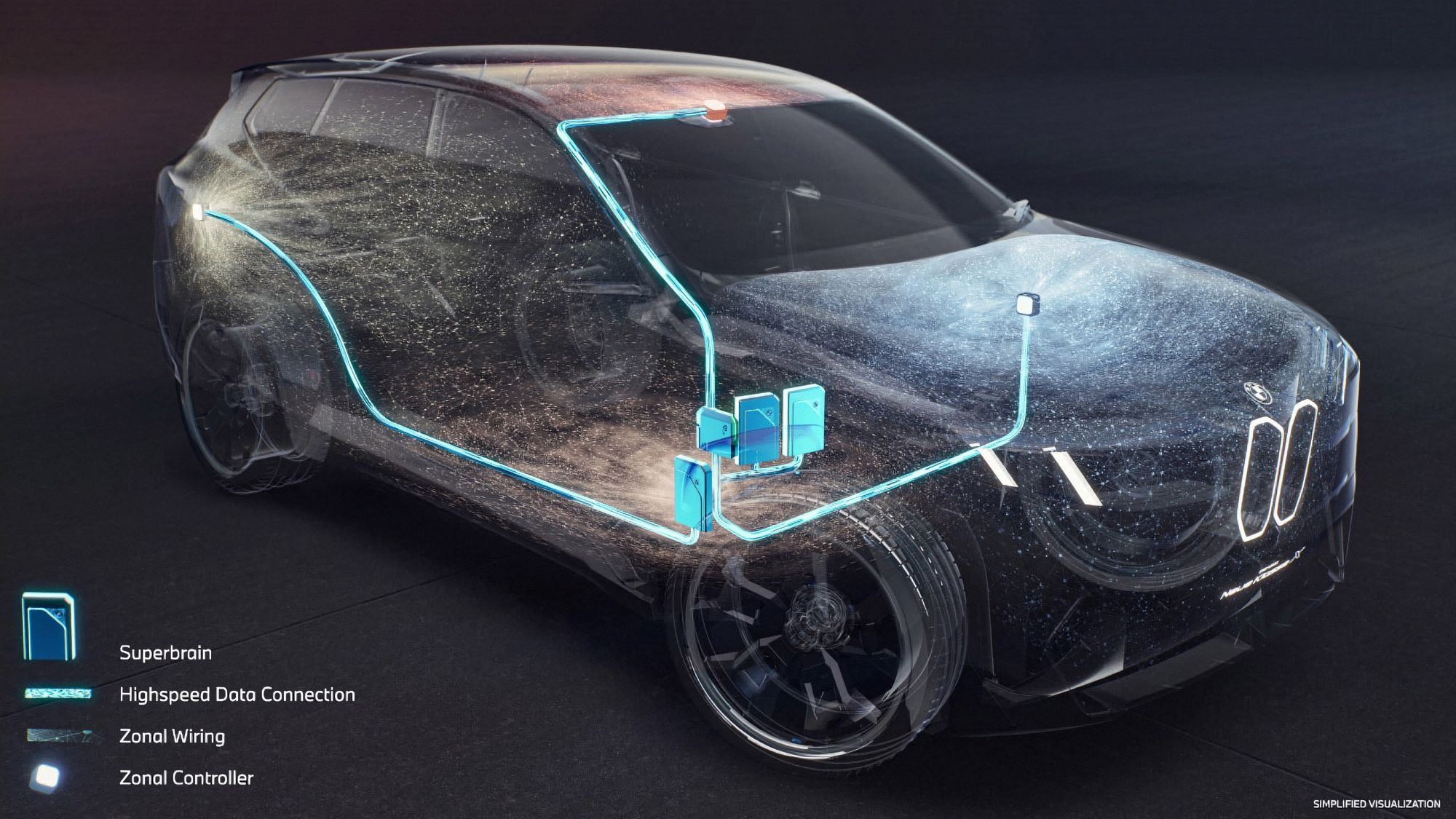
The iX3’s new E/E (electrical/electronic) architecture has four high-performance “superbrains” that pool their processing power for not only automated driving but also driving dynamics, infotainment, and basic and comfort functions. They also provide the basis for a new software architecture that can be upgraded to incorporate function updates, including for AI-enabled features.
The new digital nervous system consists of a wiring harness divided into four zones. This reduces weight by 30% compared to the technology used previously and allows for around 600 m (1970 ft) less wiring. Digital smart e-fuses replace traditional safety fuses. They enable intelligent power modes for different vehicle states that help to improve the car’s overall efficiency.
The iX3 Snapdragon Ride-based ADAS system integrates high-performance SoCs for centralized sensor data processing, advanced computer vision modules for perception, and the Snapdragon Ride AD (Automated Driving) software stack co-developed with BMW that includes drive policy and safety guardrails. The system enables advanced capabilities, including contextual lane change and overtaking, initiating maneuvers based on subtle driver cues such as mirror glances or steering nudges; active lane change and highway assistant for hands-free driving on approved road networks; and an ecosystem provided by AI-powered slot detection parking assistance and camera-based in-cabin monitoring.
The hardware underpinning the system is controlled by BMW’s superbrain of automated driving, a central intelligent computer powered by Snapdragon Ride SoCs that offers 20 times higher computing power than the previous ADAS generation. The system uses a unified architecture that includes an array of high-definition 8- and 3-MP cameras and radar sensors, enabling 360-degree coverage along with high-definition mapping and precise GNSS localization.
The iX3 is also equipped with Qualcomm Technologies’ V2X 200 chipset to support vehicle-to-everything (V2X) communications to allow it to “see” and “hear” beyond line-of-sight ADAS sensors, helping reduce collisions through direct communication between the vehicle and infrastructure, pedestrians, and other road users.
The system uses a camera-based vision stack for object detection, surround view, lane recognition, traffic sign interpretation, parking assistance, driver monitoring, and mapping. Perception performance is enhanced through low-level perception using a “bird-eye-view” architecture and new methods for information extraction from fisheye cameras.
The low-level perception between camera and radar is designed to reduce tracking latency, optimize system performance in active safety scenarios, and detect complex urban intersections. To improve computational efficiency, hardware and software co-design, along with network architecture search, are applied to manage compute resources and memory bandwidth. The system’s advanced context-aware driving uses a balance of rule-based and AI-based models for behavior prediction and behavior planning to help enable safe handling of complex driving scenarios.
The AD software stack features a perception stack developed by Qualcomm Technologies and a drive policy engine co-developed with BMW. The stack is engineered to enable automakers and Tier 1 suppliers to build scalable solutions with flexibility, cost savings, and fast time-to-market, with their own drive policy or a turnkey platform.
Stack development and testing are supported by the data and simulation factory, a key component of Snapdragon Ride, for fast development of automated driving software capable of addressing complex real-world scenarios. This toolchain integrates real-world data with synthetic data generation and AI-based simulations to create a robust and diverse set of driving scenarios, enhancing the training and testing of automotive models.
Snapdragon Ride Pilot supports over-the-air updates and is fully customizable via the Snapdragon Ride SDK, giving automakers the flexibility to tailor solutions across vehicle segments. The software stack leverages fleet data to evolve and enable enhanced safety and comfort over the life of the vehicle.
Helping achieve five-star Euro NCAP
Earlier this month, BMW announced that the iX3 was awarded the highest rating of five stars in the latest safety test conducted by independent assessment organization Euro NCAP, being one of the first vehicles to be assessed according to the thoroughly revised test protocols introduced in 2026. The new testing procedure has a greater focus on real-world scenarios on the road and imposes significantly greater requirements for vehicle safety.
The iX3’s safety system is engineered to meet the highest safety standards and supports AD levels ranging from entry-level NCAP (New Car Assessment Program) to Level 2+ highway and urban NOA (navigation on autopilot) capabilities.
BMW says the first Neue Klasse model impressed in each of the four new crash safety stages—Safe Driving, Crash Avoidance, Crash Protection, and Post Crash Safety—exceeding the scores required for a five-star rating by a significant margin. The automaker says the performance is rooted in the brand’s all-encompassing approach to safety; the concept of the iX3 takes into account the protection of those on board in a collision as well as crash avoidance systems and functions that help to extricate occupants after a crash.
This fits in with the new and more stringent Euro NCAP assessment system. Previously, ratings were given for protection of vehicle occupants and vulnerable road users and for the vehicle’s safety assistance systems. The new procedure now covers the entire sequence of events and places a clear emphasis on everyday road scenarios.
BMW says that the standard driver assistance systems in the iX3 played a key role in this strong performance. It posted a score of 73% for Safe Driving, which is 13 percentage points higher than required for a five-star rating in this category.
In the Safe Driving category, Euro NCAP gave the BMW a positive rating in recognition of its ability to help drivers stay alert to the traffic around them. The Speed Limit Info display showed the correct speed on 97% of a cross-border test route covering around 2000 km (1243 mi) through Italy, France, Germany, and Austria.
Contributing to the positive assessment was the combination of physical controls for essential driving functions, the central display for adjusting infotainment and comfort-enhancing functions, and the Intelligent Personal Assistant for voice control.
For Crash Avoidance, the iX3 scored 83%, impressing with an extensive array of active safety systems, including front collision warning with brake intervention. Also earning praise was the exit warning function, which reminds occupants getting out of the car to be aware of cyclists approaching from the rear, preventing injuries caused by opening the vehicle’s doors at the wrong time.
-

- BMW Group Neue Klasse superbrains zonal visualization.
-

- BMW iX3 50 xDrive with M Performance Parts.
-

- BMW iX3 50 hands-free automated driving with the Motorway Assistant.
-

- BMW iX3 automated driving with the Motorway Assistant.
-

- BMW Group Neue Klasse superbrains hardware and software foundation.
-

- Snapdragon Ride Pilot was jointly developed by Qualcomm and BMW.