Last week, Brunswick, Germany-based urban mobility startup Novus GmbH announced it had closed a funding round in the double-digit millions of dollars, led by the Berlin- and San Francisco-based venture capital firm 468 Capital and its leaders Ludwig Ensthaler and Emanuel Pallua. The company, already in series production with the Novus One “Lightbike” two-wheeler in customers’ hands in several European countries, says this round is where it scales into a second, higher volume model and into the U.S. market.
Novus is focused on building an urban mobility platform far beyond the two-wheeler niche for the over 400 million car drivers across Europe and North America. In the U.S. and Europe, a car license is all it takes to ride the entry-level Novus One configuration.
It pitches its electric two-wheeler—with no clutch or gears—as easier to ride than a bicycle and easier to drive than a car, with most first-time users mastering it in three minutes, even with no two-wheeler experience. The Lightbike is said to open a new vehicle category, bringing together the intuitiveness of an e-bike, the lightness of a scooter, and the power of a motorbike.
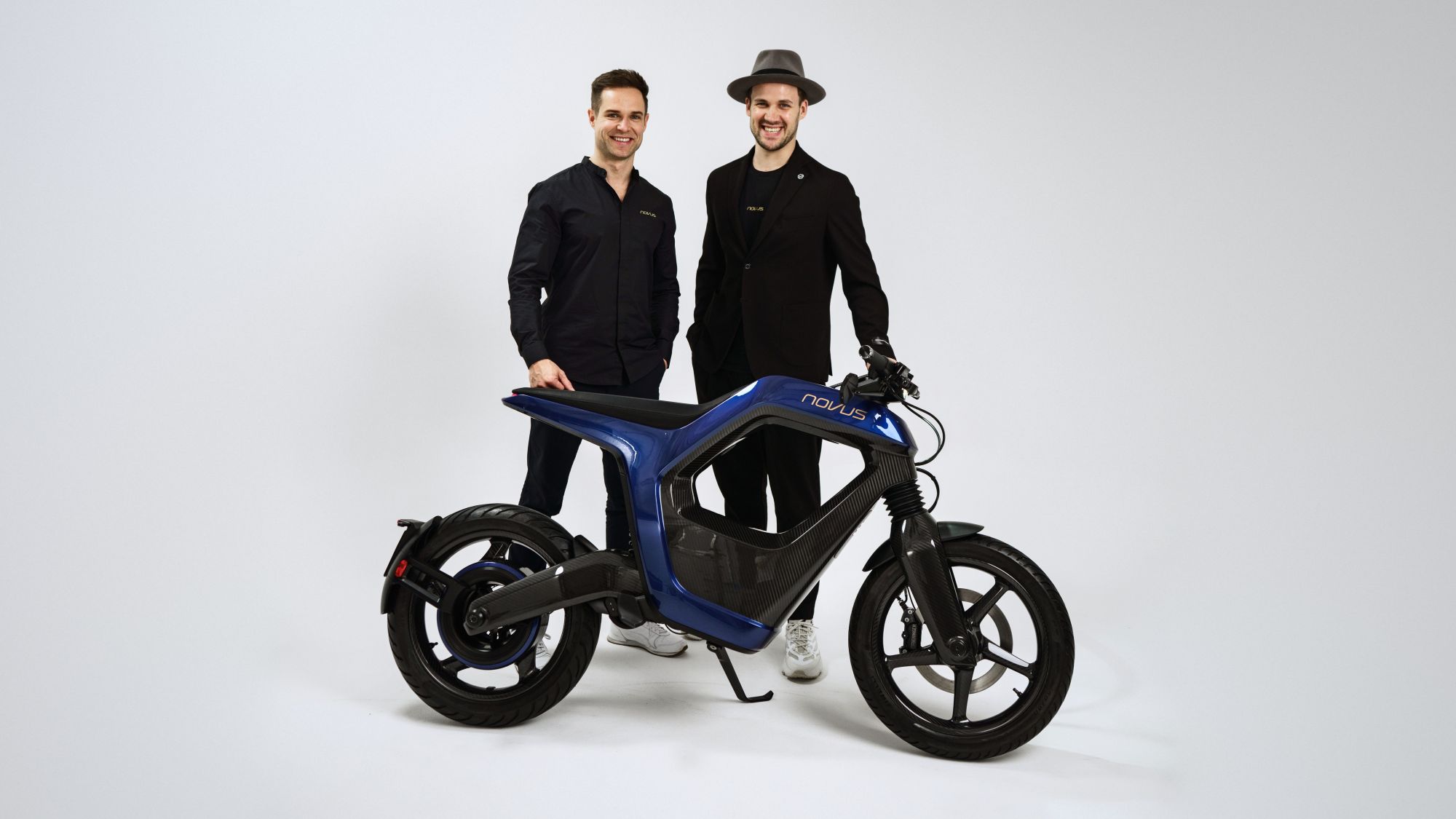
“I was drawn to motorcycles from early on, but I could not find a city vehicle I actually wanted,” said René Renger, Founder and CEO of Novus GmbH. “So, I designed something inspiring, sustainable, and quiet, and founded Novus to build the most desirable urban vehicle. Our goal is not to electrify the motorcycle market or to build just another two-wheeler. Our goal is to redistribute urban mobility. Seeing investors of this caliber join us tells me the market sees it too.”
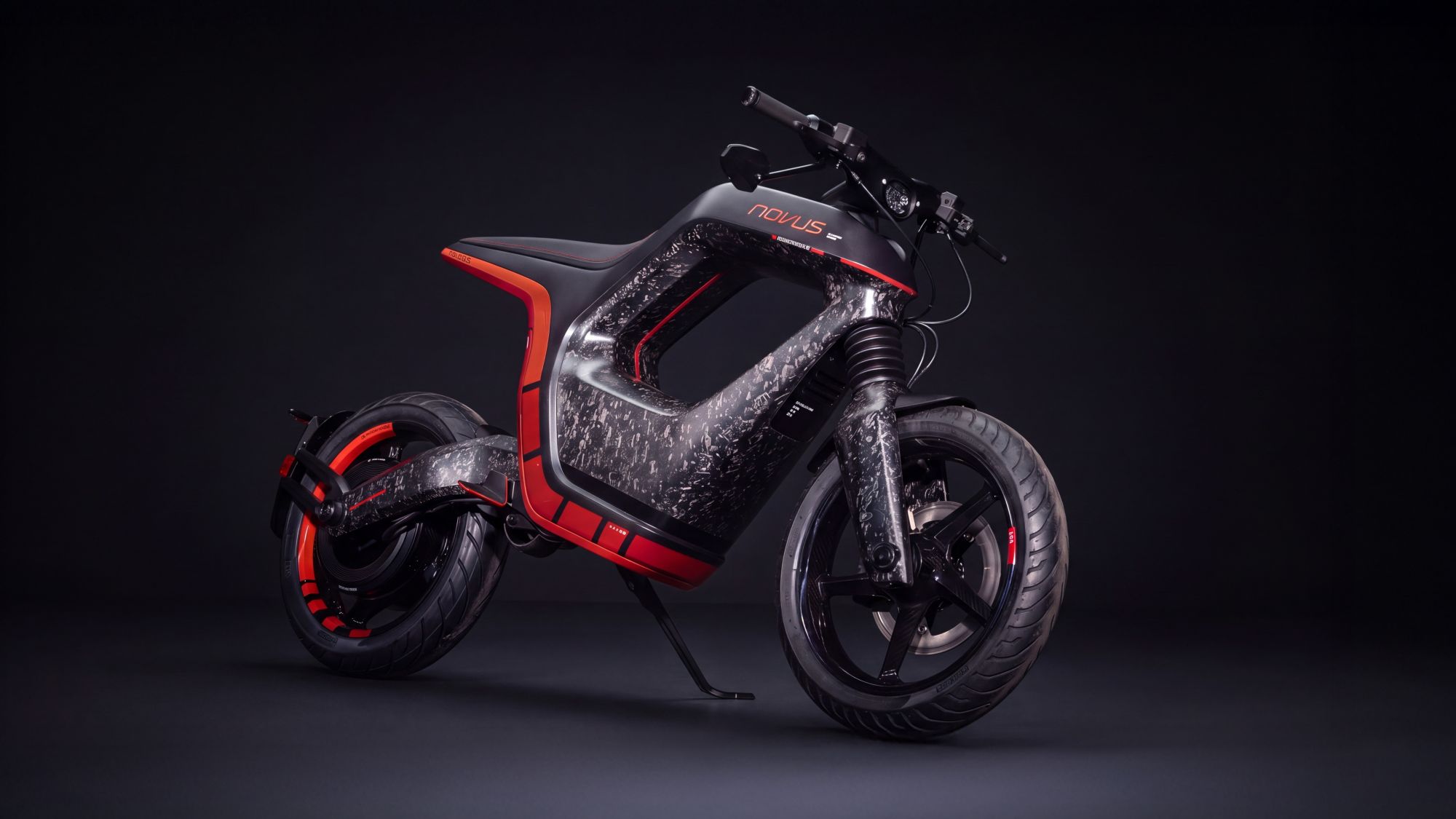
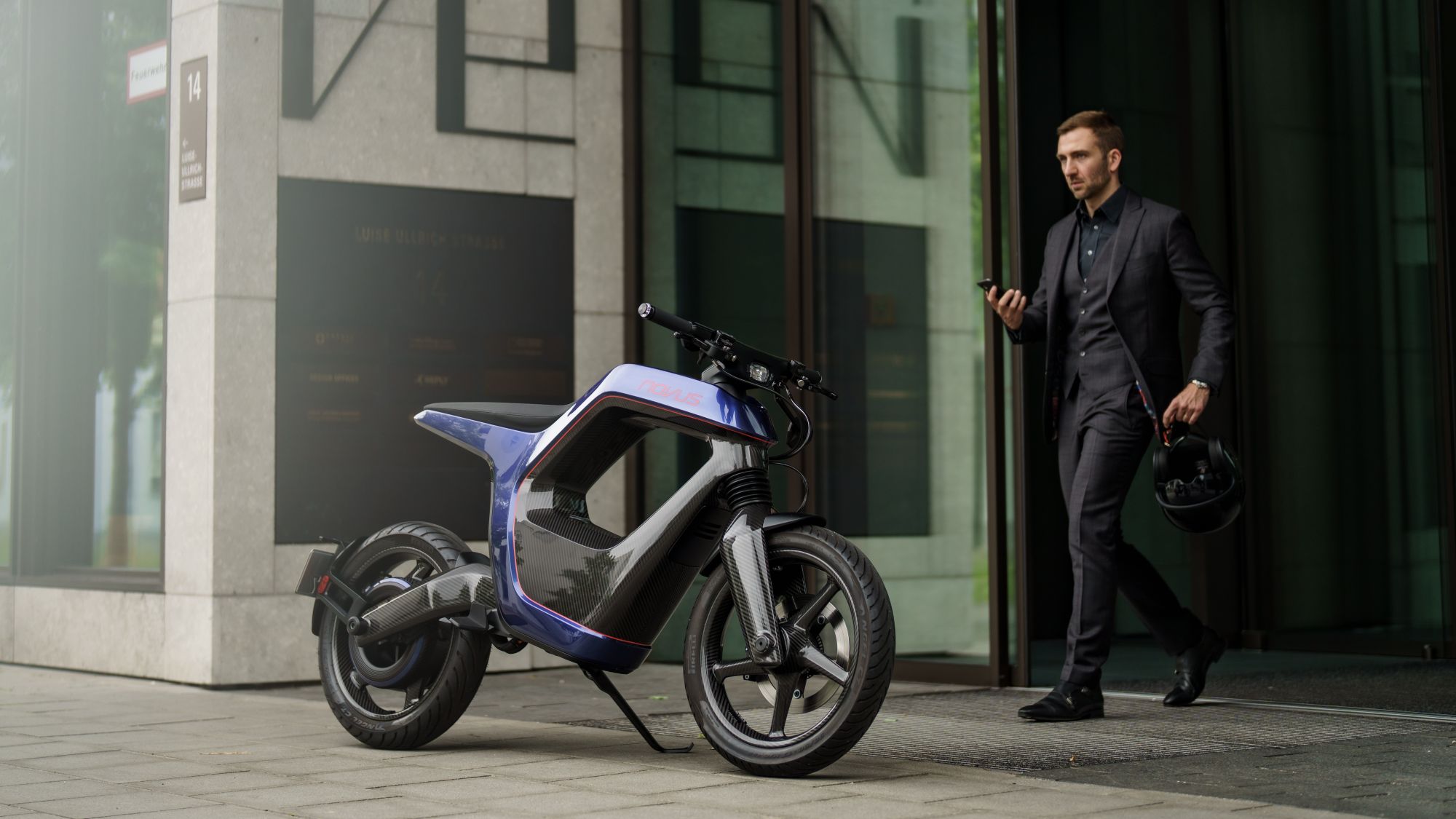
The design philosophy is “maximum integration and a radical reduction to the essential,” with technical elements integrated into the carbon structure. The result is a design that deliberately demonstrates how urban mobility no longer requires a conventional engine, no chain, no gears, and no body panels.
The target audience is people who have not yet found the right vehicle for the city, for whom a car is too large, a motorcycle too heavy, or an e-bike not enough.
“Novus stands for urban ease and high performance in a single vehicle, addressing a market between the iconic design and lifestyle of a vintage Vespa and the riding pleasure of a Ducati,” Renger explained.
Consumer and tech shareholder ecosystem
The story of the Novus One began in 2010 with a sketch by Renger. The first prototype took shape in his apartment, converted into a workshop, together with his fellow design student Marcus Weidig, who is currently Co-Inventor & Lead Developer at Novus GmbH.
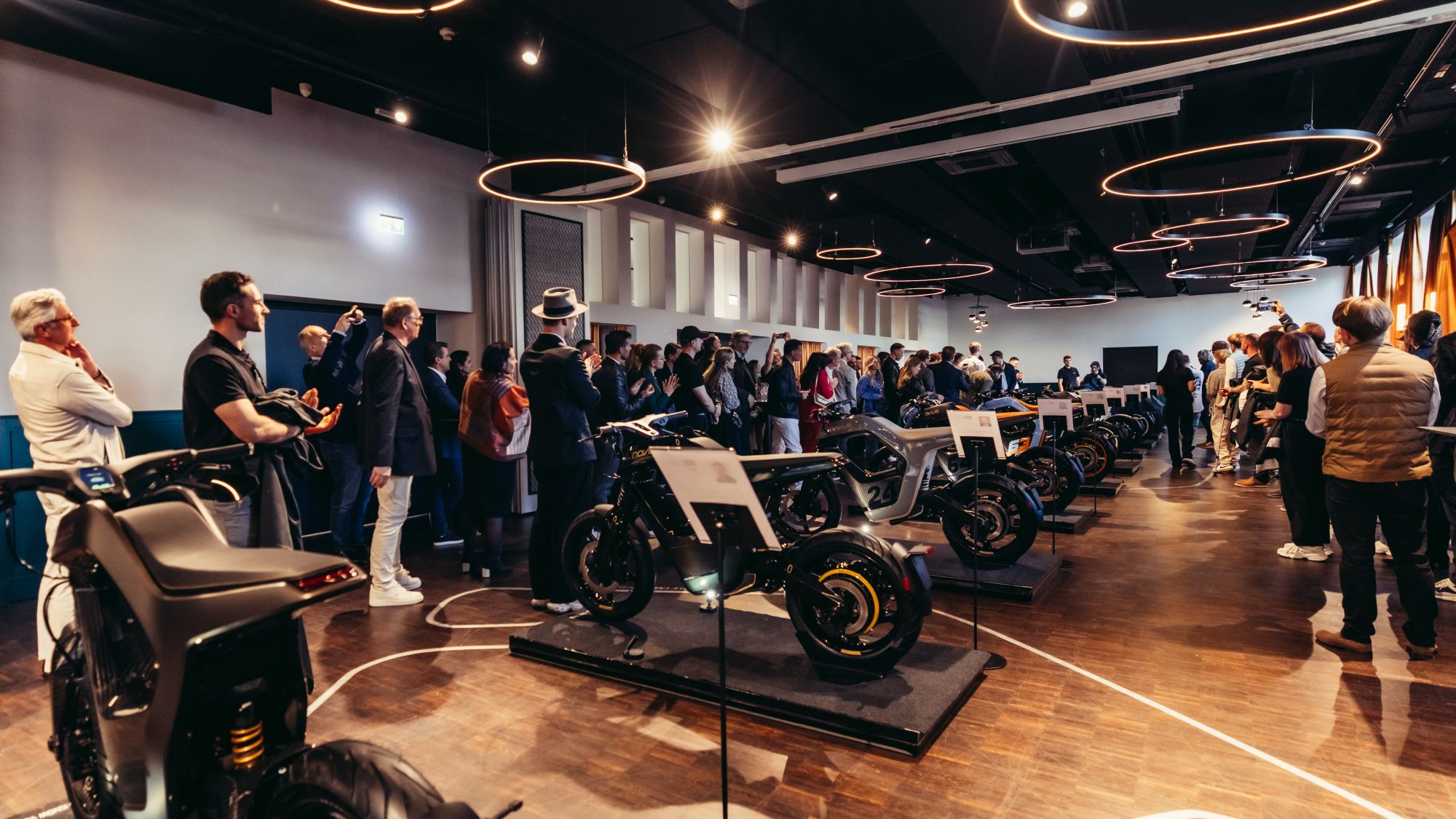
In 2019, Renger left his role as Lead Interior Designer at Volkswagen, where he worked on Golf 8 and ID. Buzz, and founded Novus. In May, Novus shipped its first series vehicles of its limited-to-100 Founders Edition Novus One by spending only a fraction of the capital vehicle manufacturers typically require.
“Sixteen years ago, we started in my living room with a design,” said Renger, in May. “Today, our vehicles are riding through Munich and on Mallorca, each one built individually for its owner in our manufacture. This is the beginning of a brand that intends to redefine urban mobility.”
Among the first investors was Philipp Schiemer, former CEO of Mercedes-AMG.
“What Novus has built is rare in its uncompromising execution,” he said. “This is a new vehicle category, fully thought through. That conviction is what we need, because in the Western world, independent new vehicle manufacturers in electric mobility can be counted on one hand. And the last market entry of a German premium brand lies decades in the past. Right now, Germany, as an industrial location, needs companies like this.”
Novus develops, designs, and assembles in Braunschweig, with components sourced predominantly from Europe: carbon from Austria, motors from Switzerland, suspensions from Belgium and Italy, and batteries from Czechia.
The Novus shareholder ecosystem primarily comes from consumer and tech. Its 30+ investors include founders and executives from Kembara VC, Adidas, Audi, BMW, Chrono24, Finn, Grover, Mercedes-AMG, New Balance, Vay, and Xiaomi; venture investors from Silicon Valley and Europe; and even Formula E driver Sophia Flörsch.
“We did not go looking for traditional mobility investors,” said Hannes A. H. Krieger, Chief Operating Officer & Founding Member of Novus GmbH. “We built something closer to our own Y Combinator: a network of leaders who have scaled and disrupted markets in tech, automotive, and consumer. Our shareholder ecosystem, one of the strongest in European early-stage ventures, is what sets us apart.”
Key backers include Eric Bach, former Senior Vice President of Product and Chief Engineer at Lucid Motors, and former Director of Engineering at Tesla. He now contributes as an investor and board advisor for Novus vehicle development.
“The Novus One is the most consequent vehicle concept I have seen in years,” said Bach. “This is urban mobility without compromise and outside the old categories.”
Another investor is Martin Hoffmann, who scaled On from a Swiss startup into a global premium performance running and clothing brand and took it public as its CFO and co-CEO.
“The best consumer brands win on desire, not on specifications, and that desire is rooted in innovation that disrupts an industry,” said Hoffmann. “The Novus One is the first urban vehicle I have seen create that pull. It is the vehicle everyone will want for moving through the city. That is why I invested.”
Novus One
The company began Novus One customer deliveries in May. The full-carbon Founders Edition is built with “manufacture-grade craftsmanship” European components in Germany.
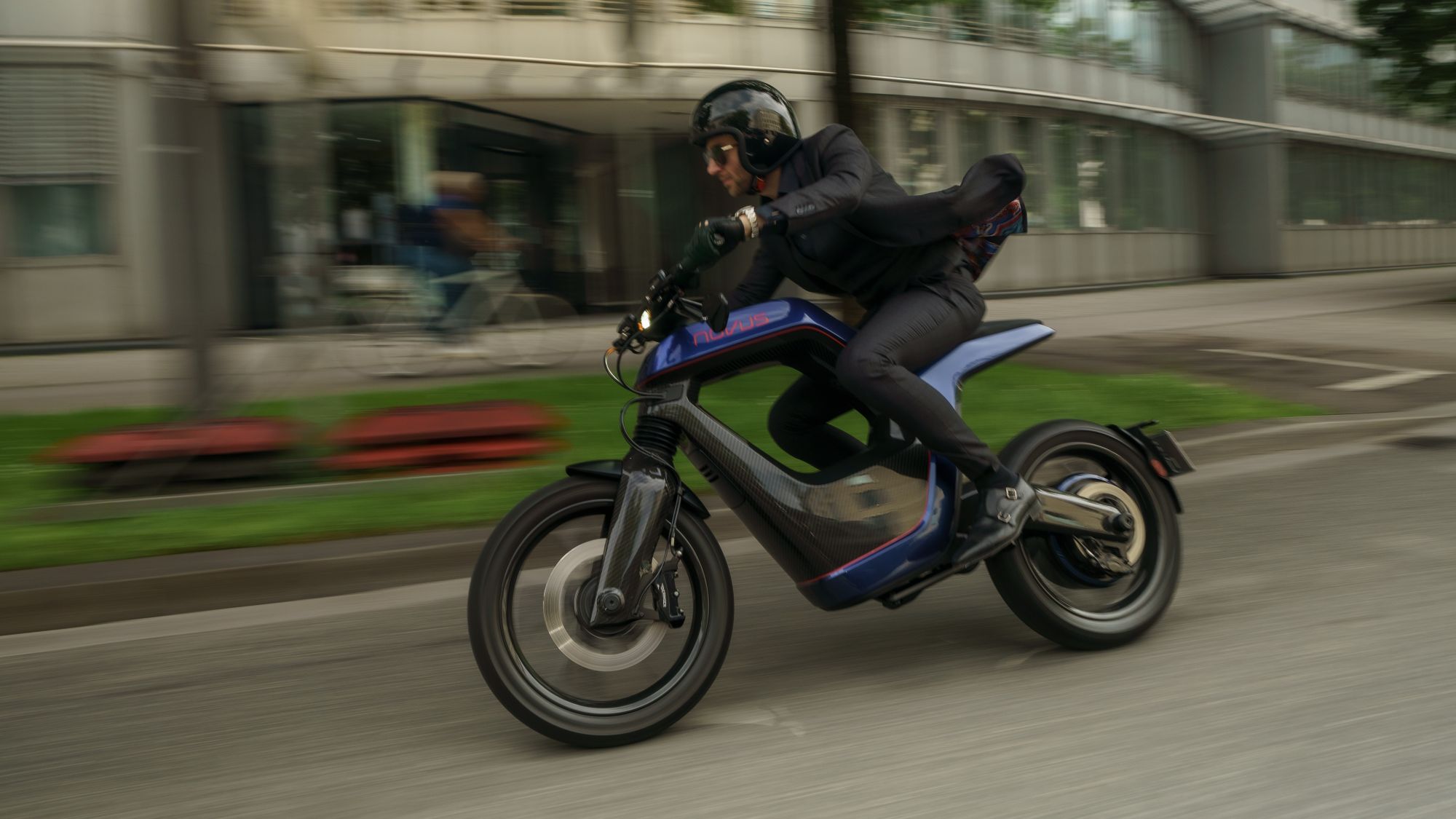
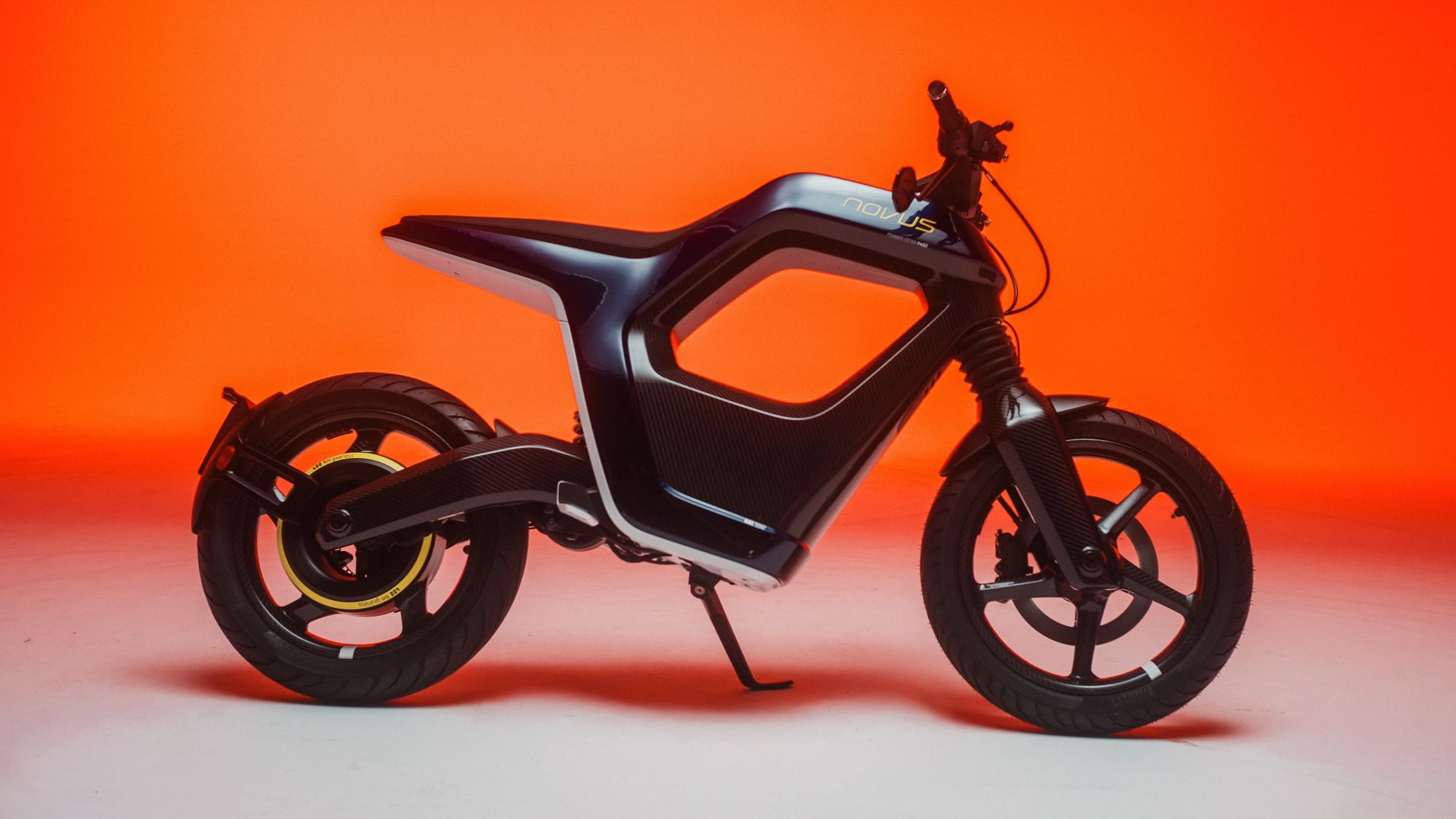
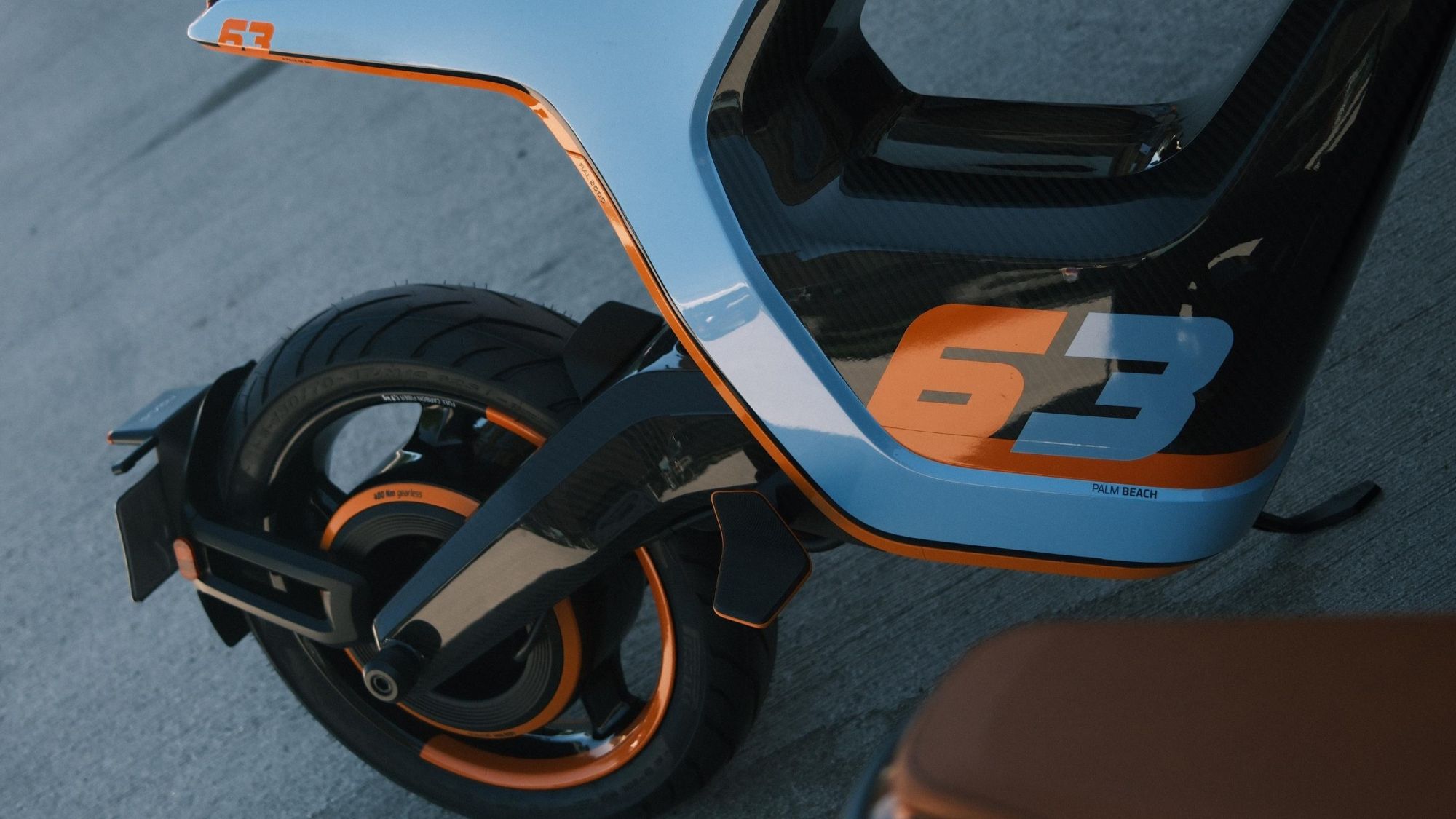
The Lightbike architecture features a self-bearing carbon frame (in addition to a swingarm, fork, and rims in carbon) and a hub-mounted drivetrain that results in a vehicle that weighs just 121 kg (267 lb) instead of the over 200 kg (441 lb) of comparable motorcycles.
The single-seater is 1939 mm (76.3 in) long, 753 mm (29.6 in) wide, and 1063 mm (41.9 in) tall. The design-defining single-piece frame is also the load-bearing structure. The hollow frame weighs just 5.2 kg (11.5 lb) and houses all the electronics safely inside.
The company says that the lightweight construction is unique in the industry, and it enables a vehicle that can be configured in software as a Class L1e (50 cm³ equivalent) scooter, for speeds up to 45 km/h (28 mph), or a Class L3e (125 cm³ equivalent) motorcycle, for up to 130 km/h (81 mph). The higher tier is upgradable after purchase.
In Germany, the lower tier is rideable with a standard car license (Class B). In Italy, Spain, Portugal, and several other European countries, the standard car license covers the full performance tier.
Novus One features three performance-controlling riding modes. With a maximum of 430 N·m (317 lb·ft) from the transverse-flux wheel-hub motor specially developed with GKN in performance mode, it can accelerate from 0 to 50 km/h (0-31 mph) in under 2 s. Peak power is 25 kW (33 hp), with nominal power of 11 kW (15 hp). Its 6.2-kW·h battery, operating at a 104-V nominal system voltage, gives 150 km (93 mi) of range and charges from 0 to 80% in 90 min.
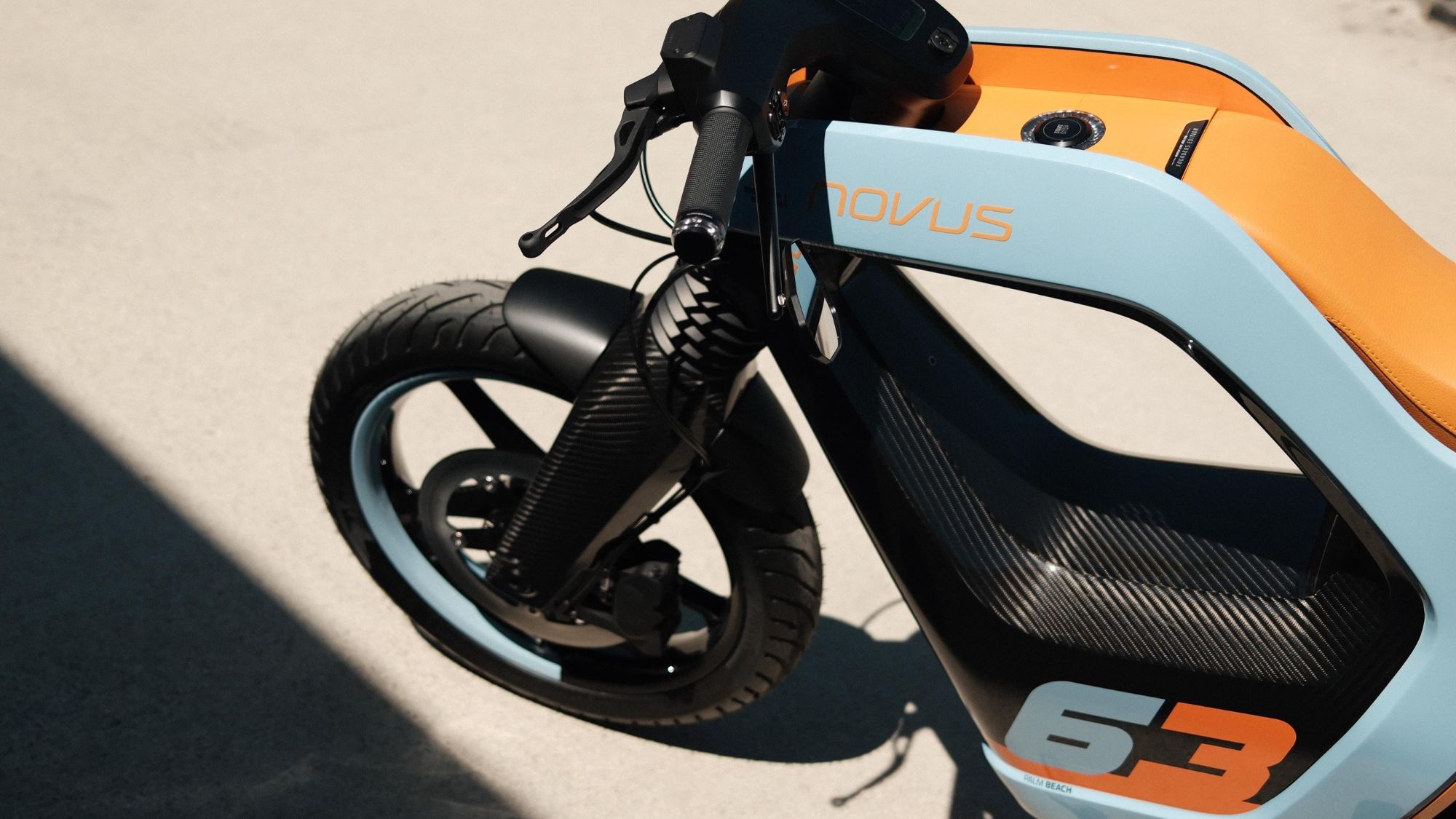
The front wheel is suspended by a mono fork with 100 mm (3.9 in) travel. The CNC-machined unit is adjustable in compression and rebound and fully integrated into the steering tube. This approach, which is unusual for a motorbike, is inspired by the world of bicycles and can only be implemented because of the consistent focus on lightweight construction.
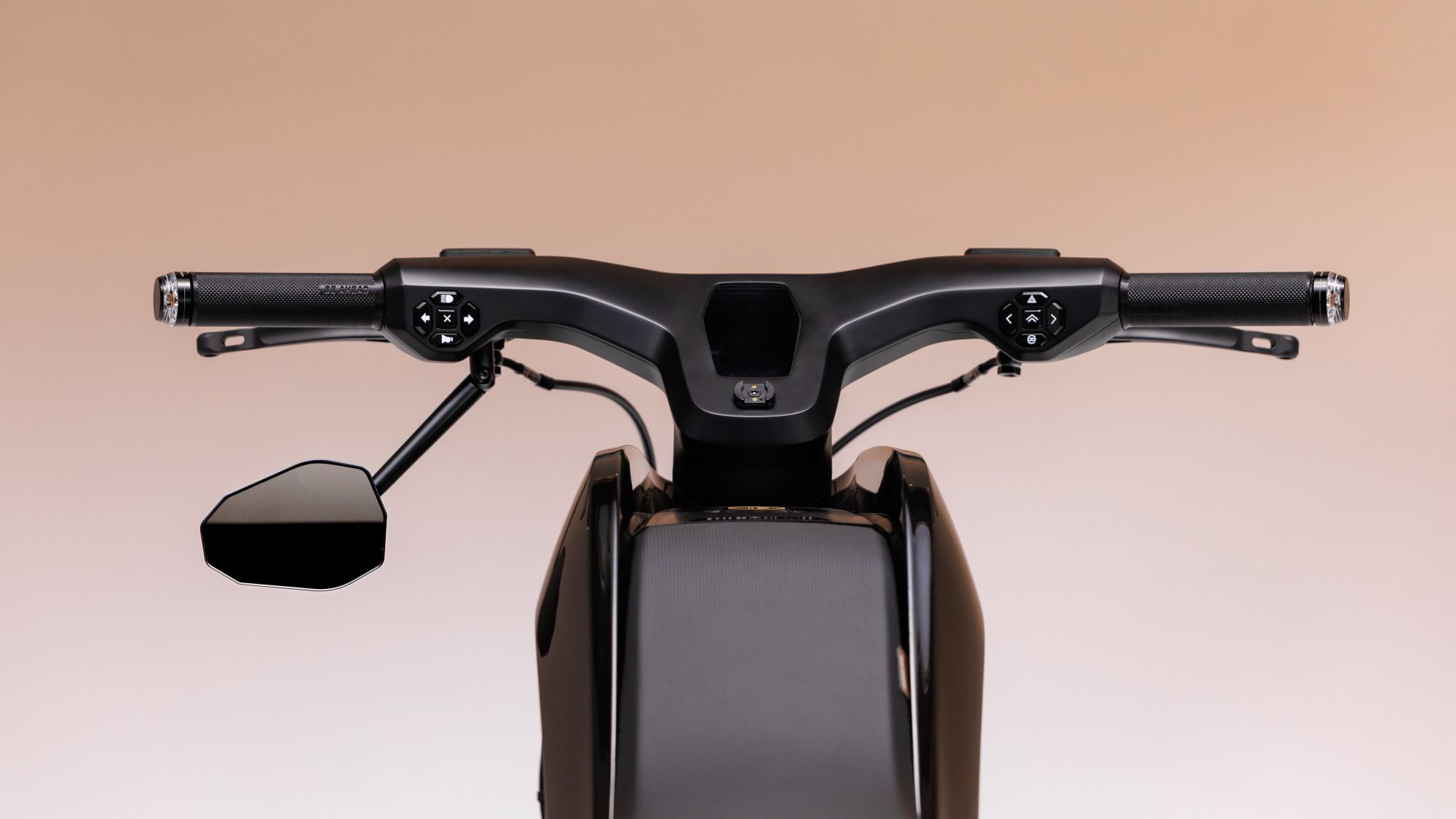
All controls are reduced to the essentials and integrated into the handlebar unit. A rider’s smartphone can be mounted centrally on the handlebars with the SP-Connect system. The My Novus app serves as a digital interface to the vehicle. It acts as a digital key, enables navigation, and provides access to various vehicle settings.
The Novus Omni System coordinates and controls the interconnected control systems. Integrated Wi-Fi and over-the-air updates make it possible to keep the vehicle up to date, unlock performance variants, and offer software-as-a-service.
“Hardware is where the next wave of AI lands: robotics moving out of the lab and into daily life,” said Renger. “Vehicles that learn how you ride, that assist before you ask. We are building the urban mobility platform for the AI generation.”
The Founders Edition lists from €21,300 (net).
Second product in development
The Founders Edition will be followed by the broader market launch of the Novus One with the Doerr Group in Germany and additional partners in Spain and other European lifestyle metropolises. The Lightbike is the first of a platform of two- and four-wheel vehicles for the city, built on the same lightweight architecture and the same principle of ease-of-use.
The new capital funds the 2027 market launch in the U.S., broad expansion across European lifestyle metropolises, and development of the Novus Two, a volume model that brings the Lightbike category to a wider market. The new model will carry the Lightbike category into volume, the company promising an accessible entry-level model at a significantly lower entry price of €14,500 or $14,500, but with the same design DNA, new materials, and built around a more automated production process.
Key features are fast charging of 30 min to 80%, and up to 400 N·m (295 lb·ft) of torque. The two-seater will be adjustable among three positions, from comfort to sporty, with storage options providing up to 45 L (1.6 ft³) of additional space.
Production is scheduled to start in late 2027, with availability from Q4 2027. Customers can get more info and reserve it at https://novusbike.com/novus-2.
Market entries in the U.S. and the United Arab Emirates are planned for next year. The U.S. market launch begins in California, starting in Los Angeles and San Francisco, with local points of contact intended to support handover, maintenance coordination, and service access.
Longer term, Novus says it will serve a broad spectrum of urban non-car mobility, with its growing product portfolio aimed at five-digit annual volumes.
-

- Novus One riding in Munich.
-

- Novus CEO Renger and COO Krieger.
-

- Novus One Founders Edition launch in May.
-

- Novus One is carbon-intensive.
-

- Novus One side view.
-

- Novus One rider leaves office.
-

- Novus One Palm Beach 63 closeup.
-

- Novus One Palm Beach 63 closeup.
-

- Novus One display and controls.
-

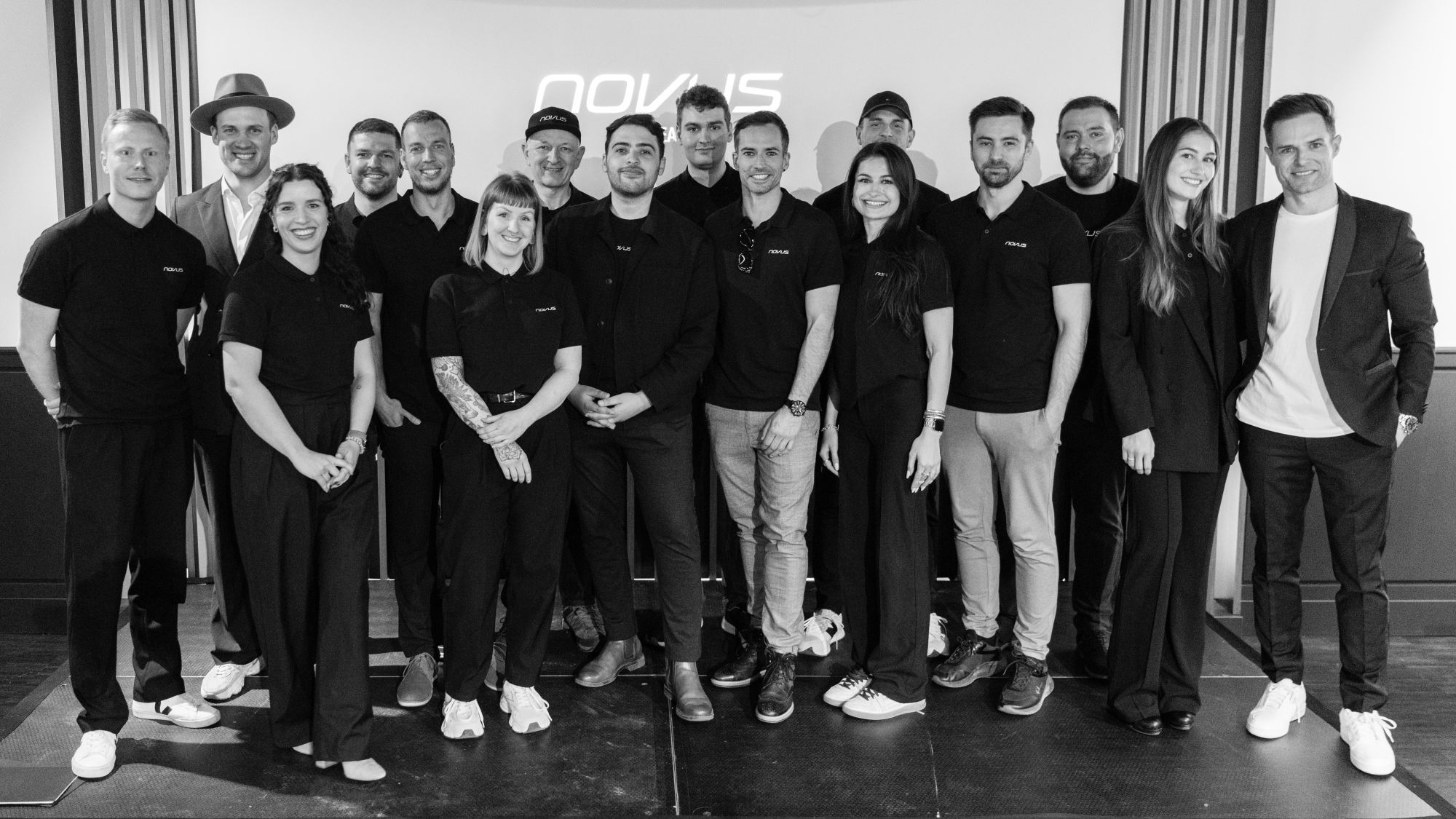
- The Novus team earlier this year.