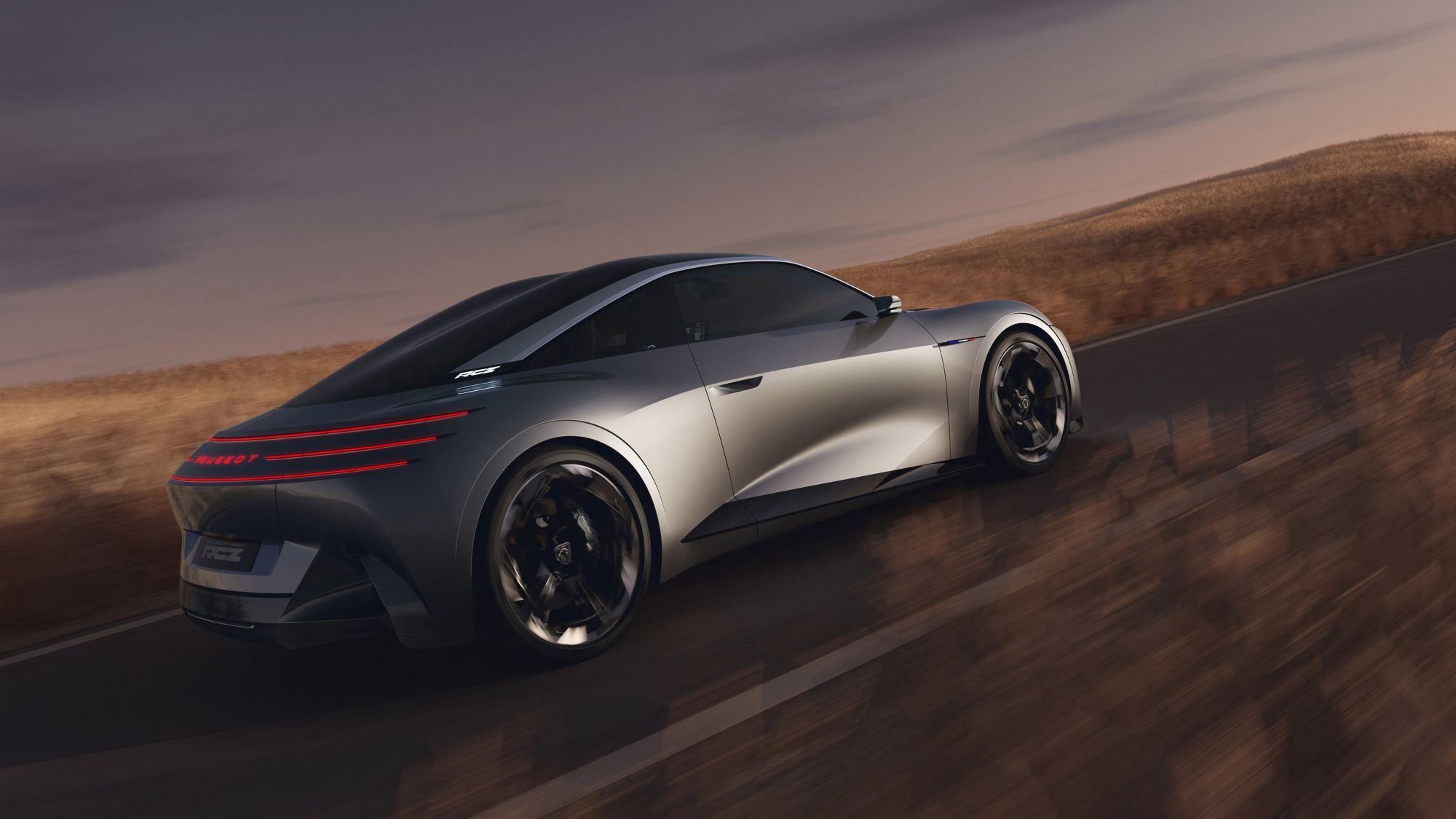
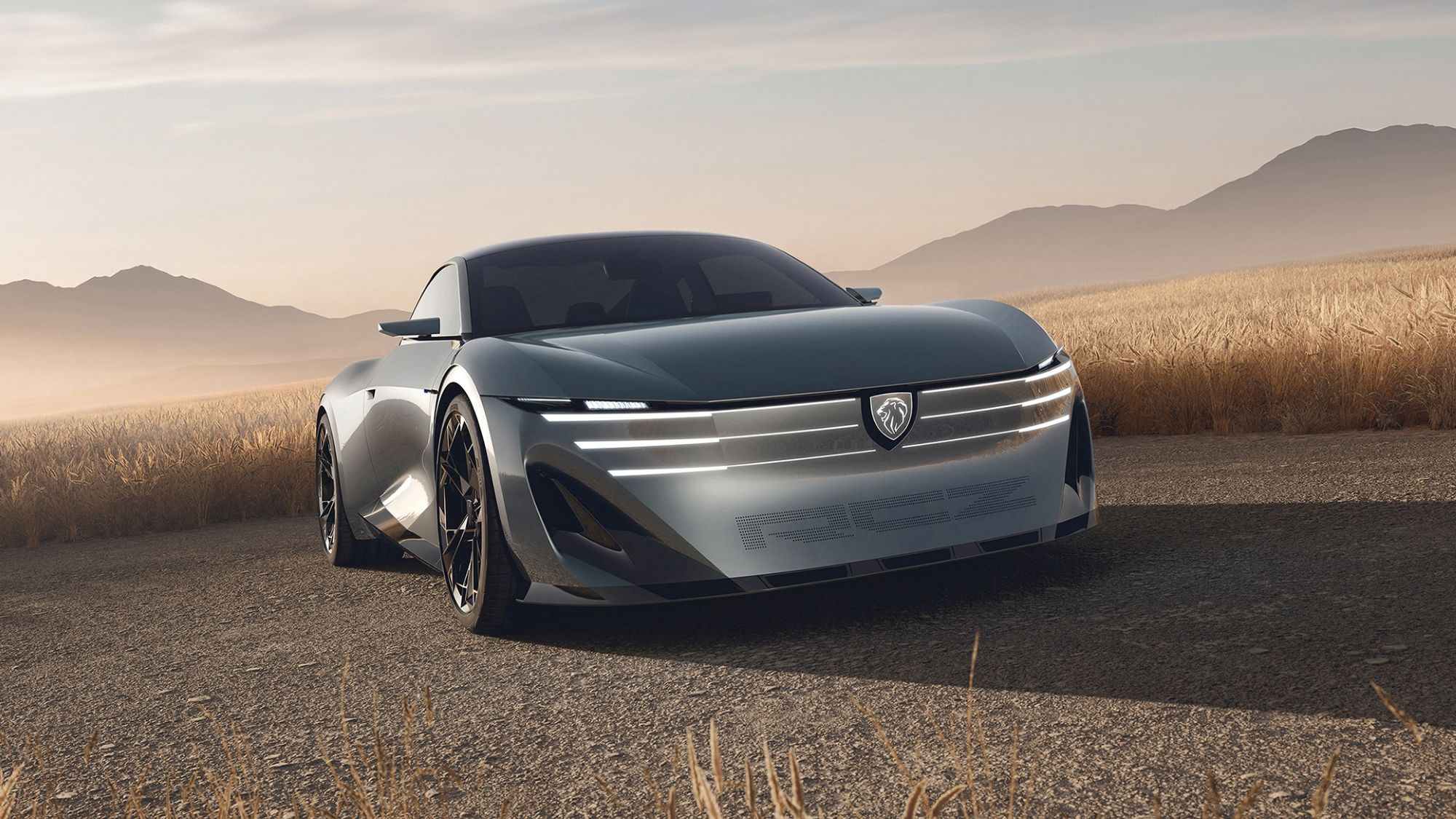
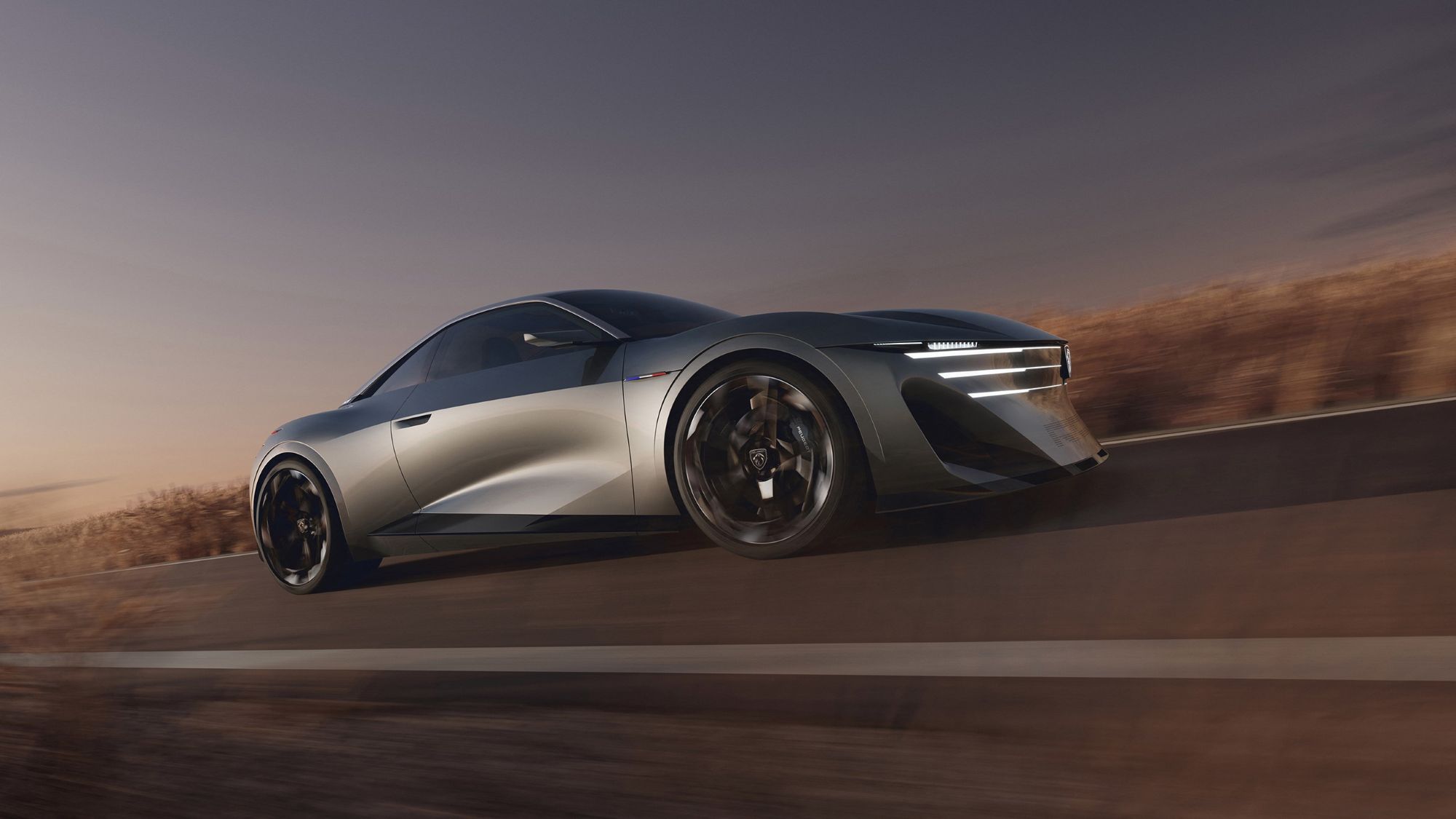
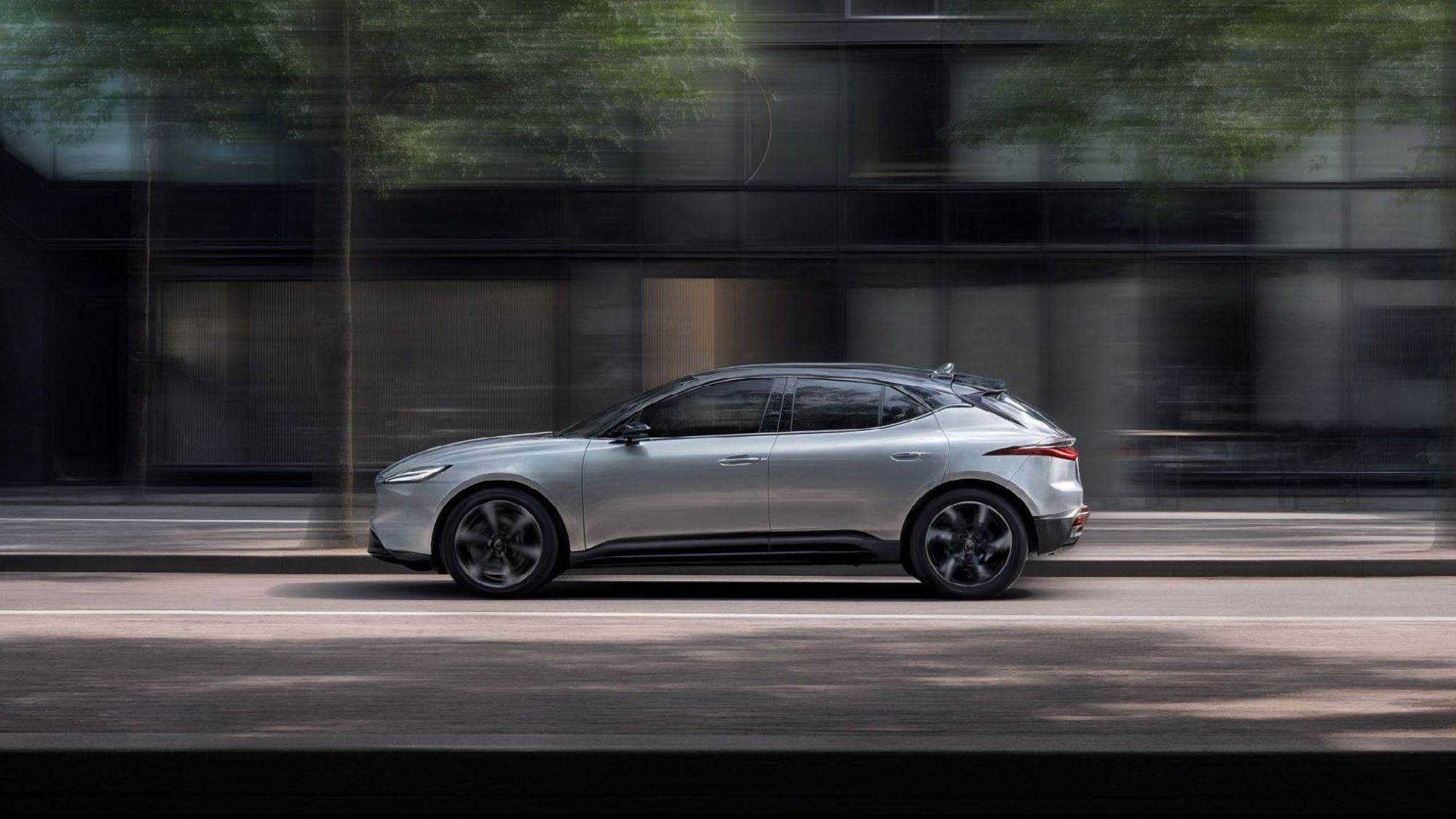
Peugeot says its RCZ Vision concept car is a brand manifesto for its future but draws inspiration from its history, being the successor to the production RCZ coupé available from 2009 to 2015. The concept vehicle shown at the 2026 Paris Motor Show wraps Peugeot’s new “Feline Future” design language over technological innovations designed for the brand’s models of tomorrow.
“With Peugeot RCZ Vision, we are setting out our vision with a car firmly focused on the future, dedicated to delivering the ultimate driving pleasure,” said Alain Favey, Peugeot’s CEO. “With emotion at its heart, this manifesto embodies the boldness of Peugeot and shows that design and technology can work together seamlessly to create an experience that is instinctive, refined, and intensely desirable.”
The pursuit of lightness and efficiency through design extends throughout the vehicle. Aerodynamics, weight optimization, and an electric architecture all contribute to the target of achieving an estimated energy consumption of 11.5 kW·h/100 km on the WLTP combined cycle.
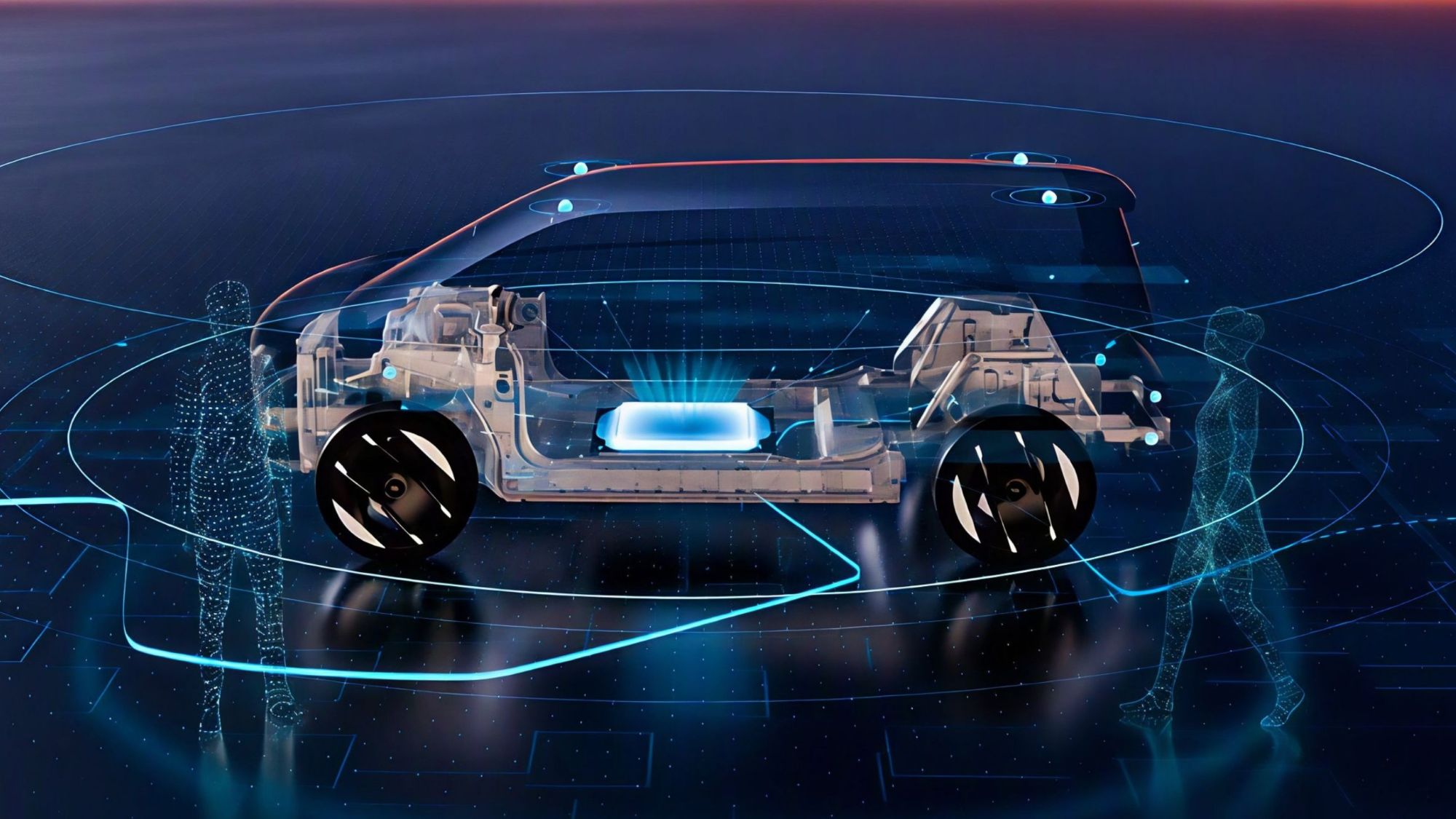
Based on the STLA One platform from parent company Stellantis, the concept combines dual-motor, all-wheel drive and a solid-state battery designed with Factorial Energy on a 1000-V electrical architecture to deliver 373 kW and up to 600 km (373 mi) of range. Factorial describes the collaboration as the latest step in its work with Stellantis, which also includes a Dodge Charger Daytona development vehicle currently being road tested.
The solid-state battery’s technology enables more energy to be stored in a smaller volume, benefiting both driving range and battery size. The vehicle’s low-profile silhouette is partially enabled by an ultra-thin battery pack measuring just 110 mm (4.3 in) thick.
The Factorial cells were tailored to the concept’s performance goals of delivering higher energy density with outstanding charging and power capabilities. The high-voltage technology is designed to accelerate charging, with a 10% to 80% boost in just 10 min.
More broadly, the next-generation STLA One platform is designed to support the brand’s future technologies, particularly x-by-wire systems. The scalable architecture aims to reduce complexity, accelerate development cycles, and improve profitability through engineered-in modularity and readiness to accommodate new battery options. It also facilitates the reuse and recycling of components at the end of their service life.
Feline Future
Peugeot says the RCZ Vision is the first expression of the Feline Future design philosophy that will shape its future models.
“With RCZ Vision, we are giving our design language, Feline Future, a new expression,” said Matthias Hossann, Peugeot’s Design Director. “Born from the tension between feline strength and the precision of materials, this instinctive and sensual design harnesses technology to enhance emotion and driving pleasure.”
Feline Future is defined by five principles: Freedom (inspires designers to move beyond convention); Courage (drives bold and uncompromising choices); Elegance (comes through simplicity and precision); Inner Force (is expressed through the car’s powerful yet composed presence); and Instinct (creates an immediate, sensory connection between the car, driver, and road).
The concept’s “feline stance” is meant to convey inner force and visible power without aggression. Its front and rear shoulders are strongly defined, and its flanks are deeply sculpted, while its forms remain soft and rounded.
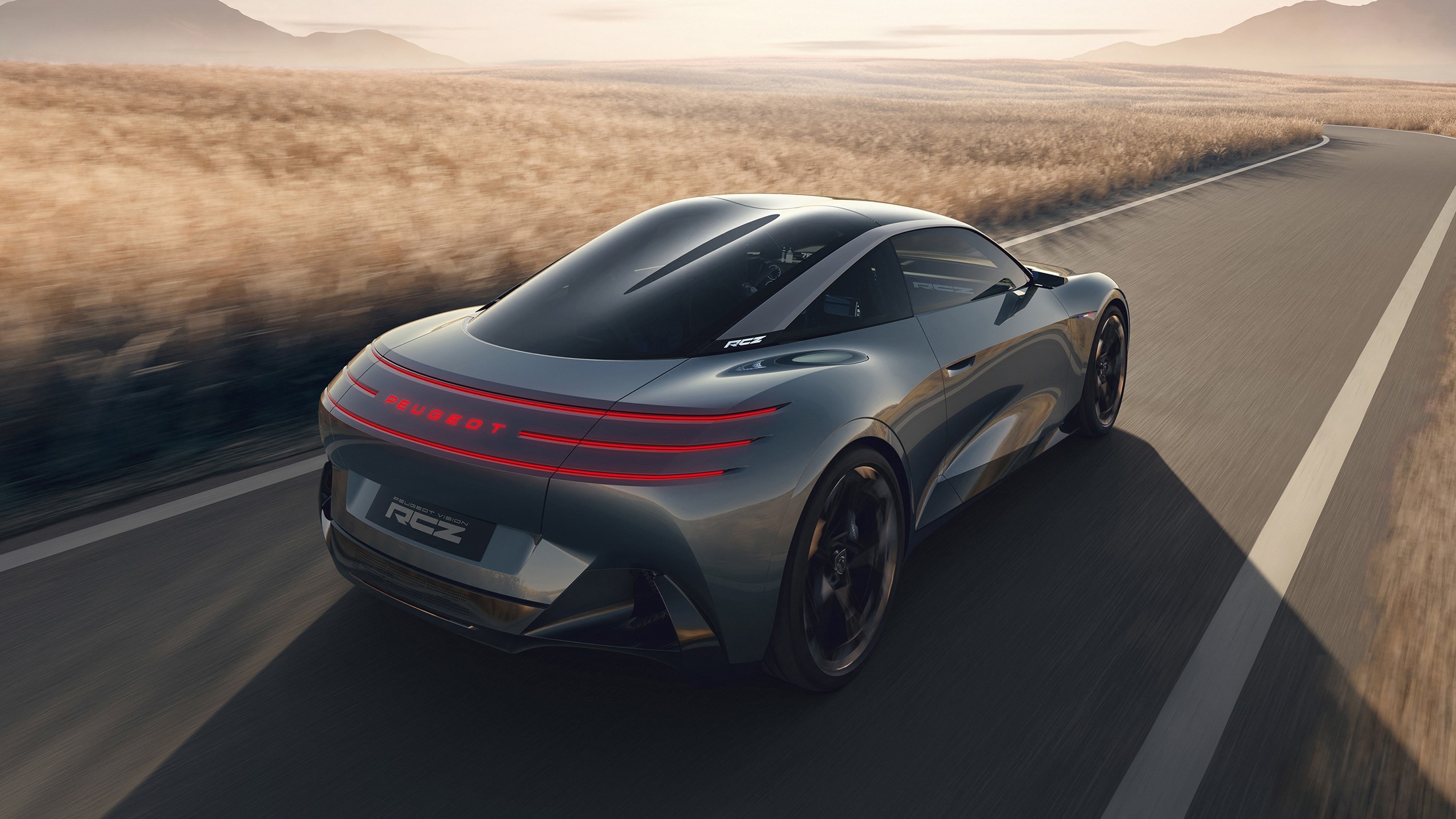
A new horizontally arranged light signature is meant to reinvent the “iconic three claws that swipe.”
In front, the three horizontal light claws are topped by ultra-compact thin-lens LED headlamps to form a “Lion’s gaze.” Other front design highlights are an illuminated emblem, a micro-perforated RCZ graphic across the bumper, and air intakes with grilles made up of micro-sculpted RCZ motifs.
At the rear, the three horizontal claws incorporate all the lighting functions. An active spoiler—like that of the original RCZ—deploys only while driving to optimize aerodynamics.
The “double-bubble roof” and cockpit arches pay tribute to the original RCZ. On the concept, the glass-bubble concept is taken further, extending from the hood to the vehicle’s rear. The double-bubble profile is accentuated to optimize rear-seat space. The arches are reinterpreted in a modern way, being slimmer and seemingly floating to bring “visual lightness” to the design.
The 21-in front and 22-in rear lightweight forged-aluminum wheels feature a radiating-spoke design, a longstanding Peugeot signature, refined to minimize material usage. The small triangular details around the rim are a nod to those found on the first-generation RCZ wheels.
Bright and welcoming cocoon
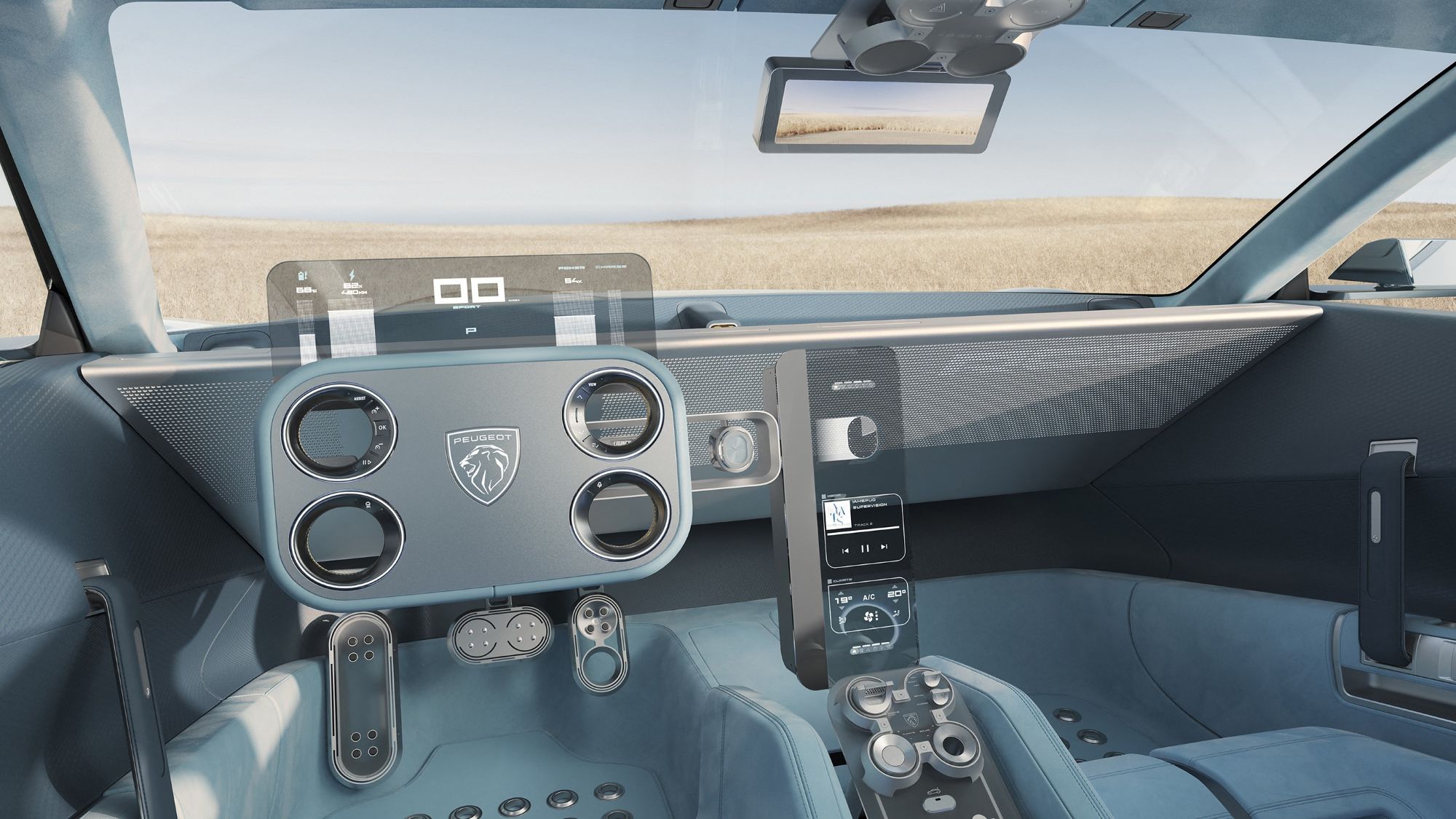
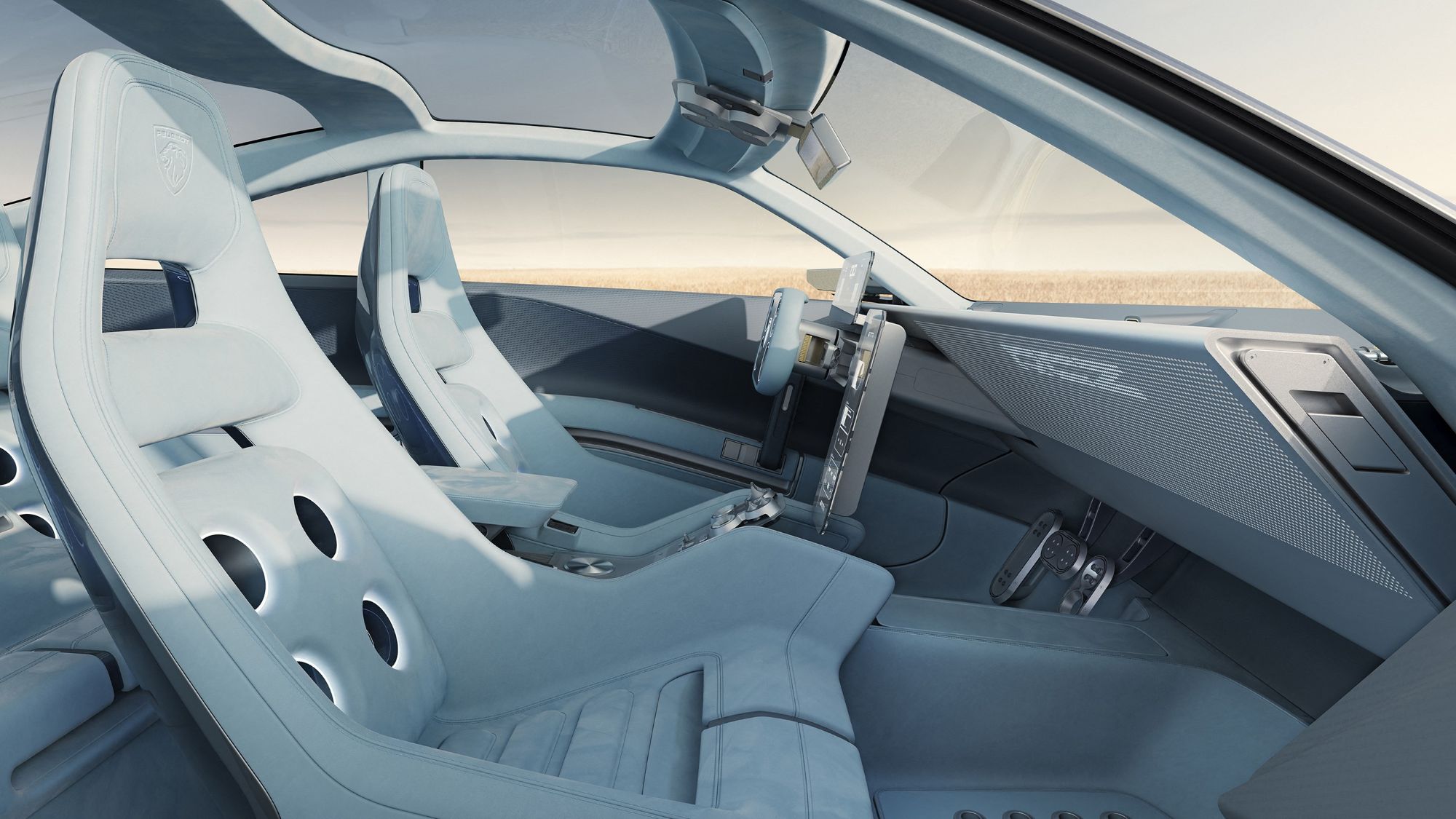
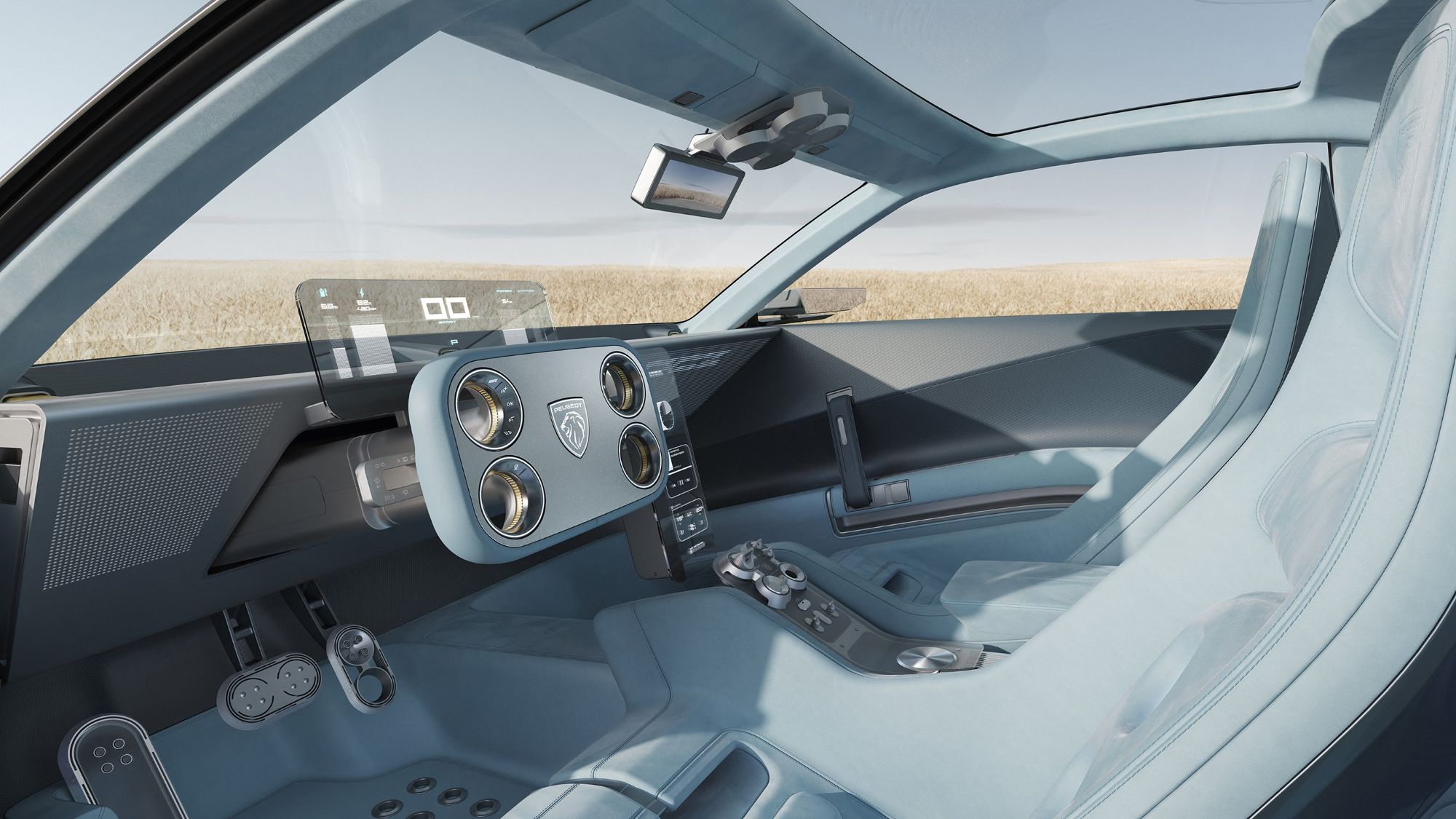
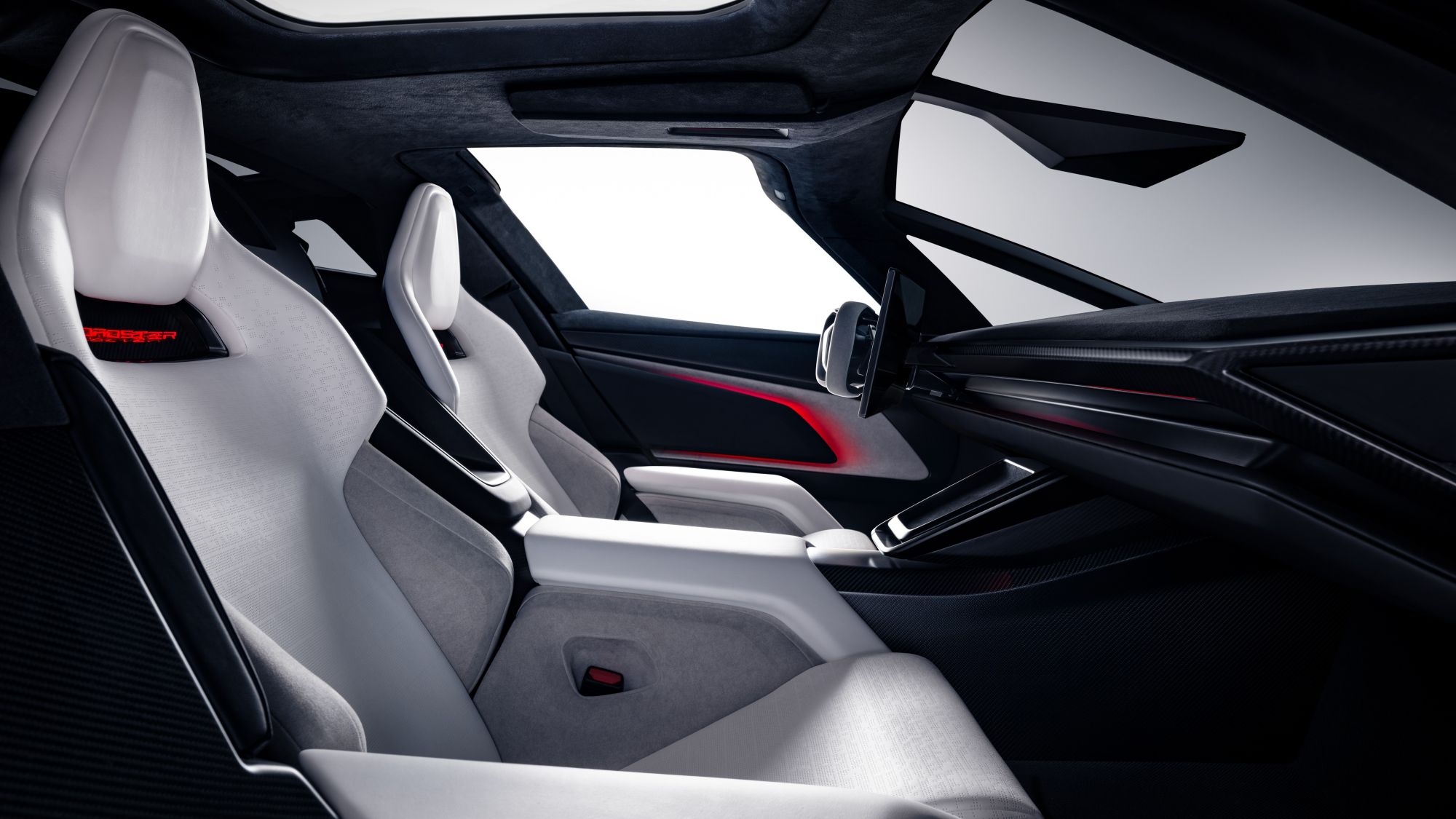
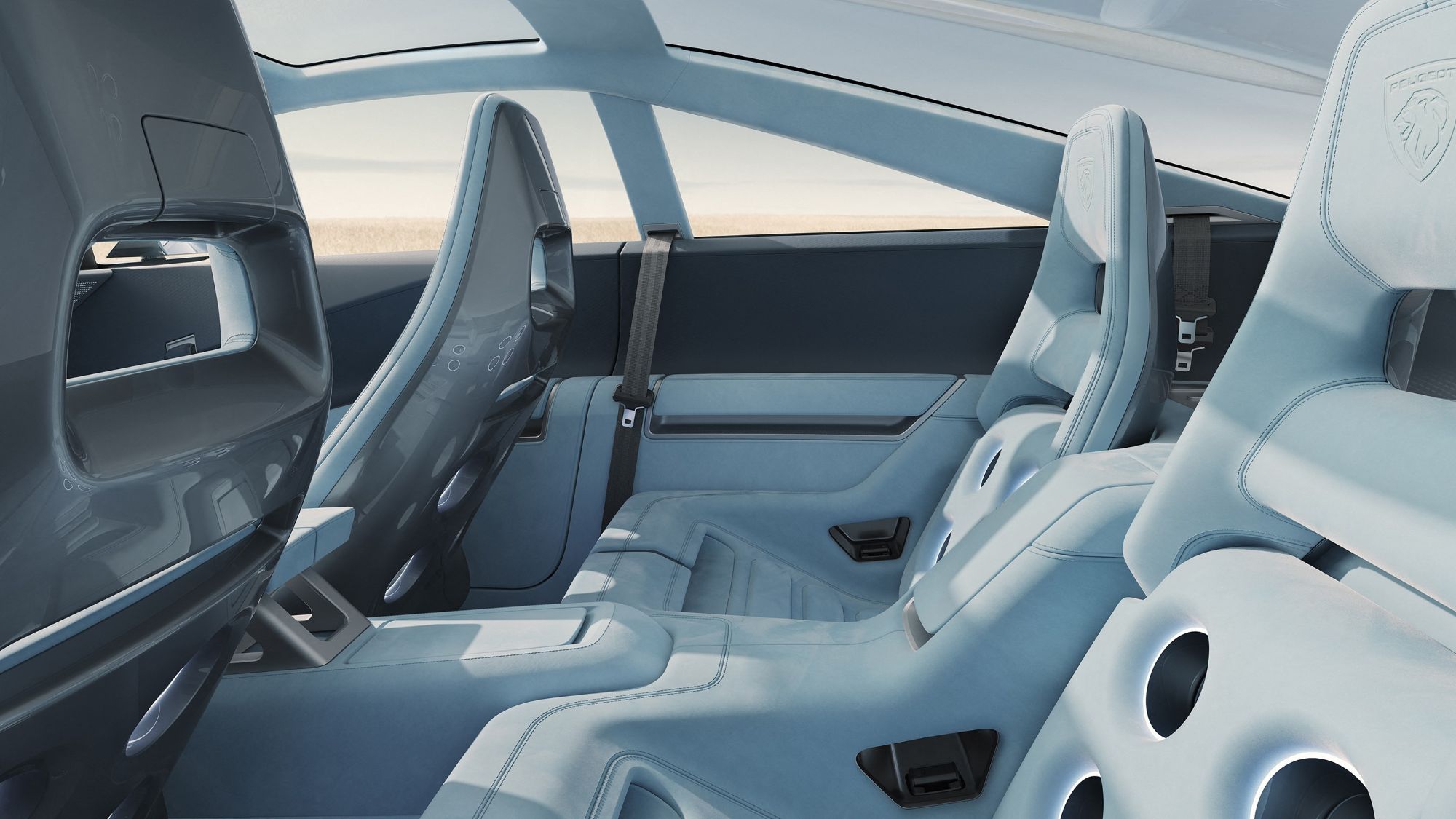
Designed as “a bright and welcoming cocoon,” the cabin features discretely integrated technology to preserve a friendly, calming atmosphere focused on occupant well-being. It is trimmed with Alcantara, recycled leather in a light-blue color scheme to enhance the feeling of openness, and machined-aluminum components.
The dashboard is sculpted closely around its technical components, minimizing its volume to optimize interior space. The approach is taken to the extreme with mobile air vents that can “disappear” into the dashboard when not in use. The “floating” center console brings together several physical controls—for driving modes, climate control, etc.—machined from aluminum and arranged on a frosted-glass surface.
The four-seat GT cabin is designed for easy access to the rear. The seats’ asymmetrical architecture is intended to optimize lateral support. The seats feature open sections to reduce weight without compromising passenger comfort. The rear seatbacks can be folded down to increase luggage space.
The seats are upholstered in Pelinova leather made from recycled offcuts—untanned animal leather that would otherwise typically go unused. The new material offers the qualities of leather, including its scent and feel, with a reduced environmental impact.
Updated i-Cockpit
The i-Cockpit, which has been a key Peugeot interior element for 15 years, gets an update for the RCZ Vision. With “better, over more” screens, the reinvented Peugeot onboard experience is intended to make technology more intuitive, ergonomic, and immersive, notably through the Hypersquare steering wheel and an updated UI (user interface) featuring transparent micro-LED displays.
Positioned just above Hypersquare, one of the transparent micro-LED displays presents driver information in a less-intrusive way but with “an unprecedented level” of personalization, with drivers able to configure the flow of information according to their needs. The second “floating” central micro-LED display, which is vertically oriented and slightly angled toward the driver for optimal ergonomics, provides access to infotainment and navigation systems.
Thanks to its transparent structure, the central display can be switched off completely, virtually disappearing from view, freeing the dashboard of unnecessary visuals and creating a cleaner aesthetic. This can reduce visual distractions, but the driver can still get essential information on the screen above Hypersquare.
The concept vehicle is equipped with the same production version of Hypersquare that will feature in the new Peugeot E-208 production car. Its unique ergonomics allow the driver to focus on driving, with main functions accessed by fingertips within four rings.
An interesting interior detail is the dashboard clock designed by French watchmaker Serica that blends into the central display support. The Serica Ref. 1174 Parade watch integrated into the i-Cockpit features a Glacier Blue dial to match the interior color.
Once in place, the watch’s design is echoed on the screen with a graphic digital interpretation, and only the front of the watch case remains visible. It is said to be easily removable to serve its purpose on an owner’s wrist.
X-by-wire
The concept showcases Peugeot x-by-wire technologies that replace mechanical and hydraulic systems with electric connection and actuation.
Hypersquare, combined with steer-by-wire, delivers a reinvented driving experience said to be more instinctive and precise. Beyond power assistance, the system innovates by adapting the steering ratio according to vehicle speed.
At low speeds, Hypersquare and steer-by-wire make maneuvering easier by not requiring multiple turns of the steering wheel. Maximum rotation is slightly less than one full turn, compared with the more conventional three turns. At higher speeds, the steering ratio is reduced to ensure optimal smoothness and composure.
The technology also filters out unwanted vibrations caused by road-surface imperfections to deliver better driving comfort in all conditions.
The RCZ Vision is the first Peugeot to feature brake-by-wire technology, providing more precise modulation and regenerative integration for greater efficiency.
The concept also features Level 2++ automated driving, with hands-free control in the city and on the highway.
-

- Peugeot RCZ Vision side.
-

- Peugeot RCZ Vision front.
-

- Peugeot RCZ Vision rear side.
-

- Peugeot RCZ Vision rear side.
-

- Peugeot RCZ Vision interior driver’s side.
-

- Peugeot RCZ Vision interior passenger’s side.
-

- Peugeot RCZ Vision interior driver’s view.
-

- Peugeot RCZ Vision interior rear.