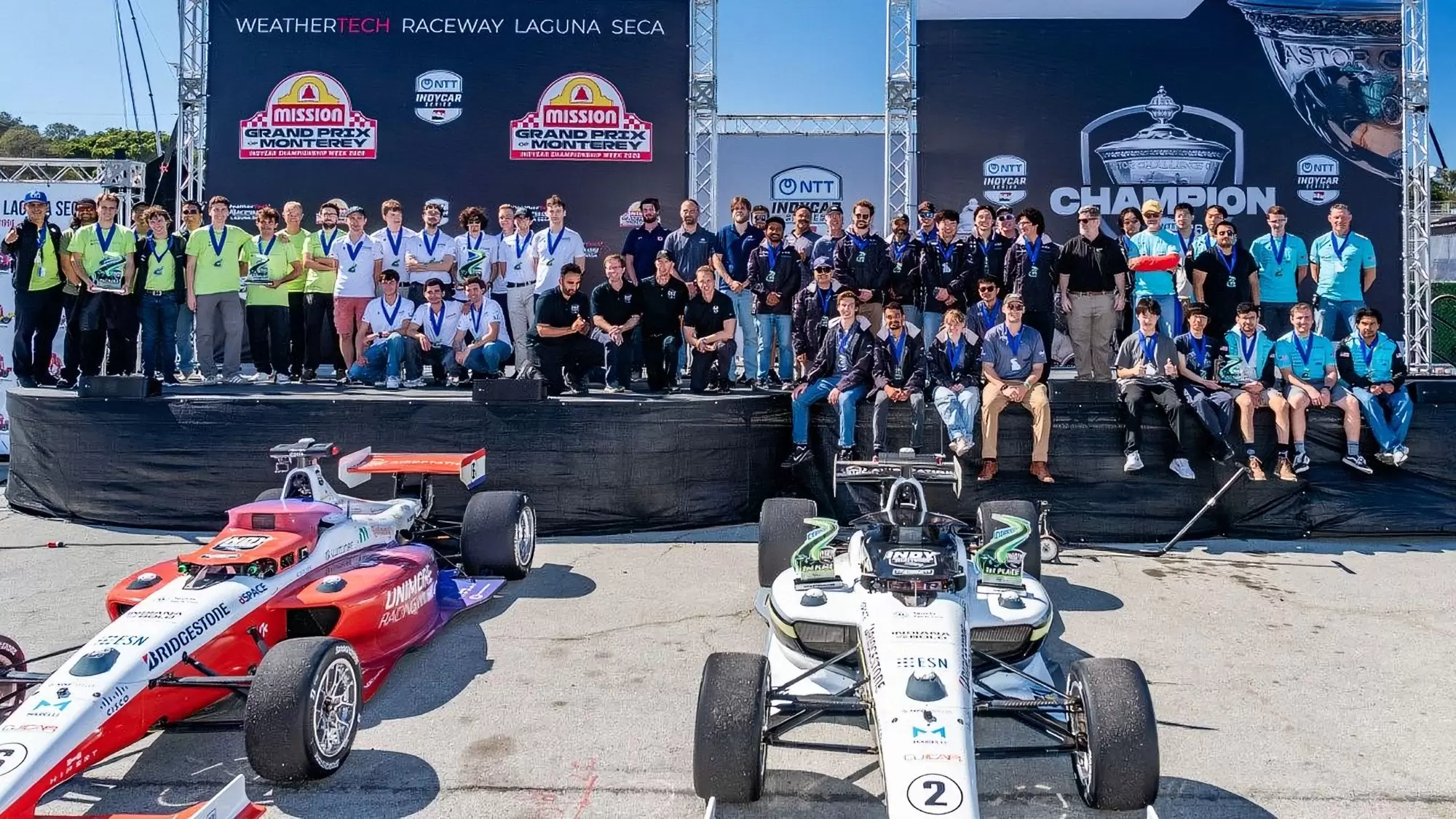
The Indy Autonomous Challenge (IAC) again kicked off the NTT IndyCar Series’ Grand Prix of Monterey Weekend with an autonomous race held on the famed WeatherTech Raceway Laguna Seca on September 3rd. Following its debut in 2025 at the venue, the IAC returned with autonomous racecars competing head-to-head on one of the world’s most technically demanding road courses.
For the race event, eight university teams from North America, Europe, and Asia competed, with their AI driver software piloting IAC’s AV-24 autonomous racecars:
- AI Racing Tech team from UC Berkeley, University of Hawai’i, UC San Diego, and Carnegie Mellon University;
- Autonomous Tiger Racing from Auburn University;
- Caltech Racer from California Institute of Technology;
- IU Luddy from Indiana University;
- KAIST (Korea Advanced Institute of Science and Technology);
- PoliMOVE Autonomous Racing Team from Politecnico di Milano, Tecnologico de Monterrey in cooperation with Michigan State University, and Lawrence Technological University;
- Purdue AI Racing from Purdue University;
- Unimore Racing from University of Modena and Reggio Emilia.
Unimore Racing won the competition. The team’s software-driven autonomous single-seater clinched the victory in a dramatic head-to-head passing competition, in the final matchup defeating Purdue AI Racing after successfully completing three overtakes through the Corkscrew section of the track. PoliMOVE Autonomous Racing Team secured a third-place finish.
“Last year, our university teams made history by proving that autonomous racecars could master WeatherTech Raceway Laguna Seca, one of the world’s most technical circuits,” said Paul Mitchell, CEO of the Indy Autonomous Challenge and its parent company, Aidoptation BV. “This year, we are raising the bar by bringing our passing competition to a road course for the first time. Our teams’ AI drivers must understand, anticipate, and interact with another vehicle while operating at the limits of performance. More than a race, this competition is a proving ground for our ultimate goal of safe high-speed autonomous driving.”
One of the main competition changes this year was that the IAC with partner DSPACE introduced a new virtual qualification process for the autonomous racing student competition. This is the first time that participating teams had been required to qualify for an autonomous race within a virtual testing environment before being allowed to compete on a physical track, according to DSPACE.
Teams validated vehicle behavior, race strategy, and overtaking performance in a realistic digital twin of Laguna Seca raceway using a DSPACE SIL (software-in-the-loop) tool chain consisting of the VEOS platform for simulation of software models, ECU networks, and communication data; ASM dynamic physical models representing vehicles, traffic, and environments (like traffic dynamics and off-road behavior); and AURELION 3D visualization and ray-tracing software used for realistic sensor simulations.
The virtual qualification was especially challenging because Laguna Seca raceway is known for its significant elevation changes, blind crests, and technically demanding corners. These characteristics present unique challenges in terms of autonomous vehicle control, path planning, and decision-making.
In the SIL simulator, teams encountered many situations similar to those during the real event. Basic qualification scenarios included the safe navigation of the complete race circuit, recognition and correct response to race flags, returning to the pit lane when instructed, handling telemetry interruptions and communication loss, and maintaining safe vehicle behavior under all conditions. In addition, teams were required to demonstrate advanced autonomous racing capabilities such as multicar racing scenarios, interactions between competing vehicles, autonomous overtaking maneuvers, attacker-versus-defender race situations, and safe decision-making in dynamic traffic situations.
To qualify for the event, teams had to successfully complete extensive testing and demonstrate reliable vehicle behavior in all required scenarios. During the qualification process, more than 500 autonomous overtaking maneuvers were executed and validated, helping teams demonstrate safe interaction and decision-making in competitive multivehicle scenarios. After completing virtual qualification, all participating teams qualified for the Laguna Seca race event that took place on September 3rd.
“This is the first time the Indy Autonomous Challenge has brought its established competition ruleset for overtaking maneuvers to Laguna Seca, a circuit known for its significant elevation changes and challenging vehicle dynamics,” said Janam Sanghavi, Director of Vehicle Engineering at the Indy Autonomous Challenge. “The DSPACE simulator enables teams to safely and effectively stress-test their multicar path planning and decision-making systems before operating in this highly challenging environment.”
The introduction of virtual qualification is said to mark another step toward making autonomous racing safer, more scalable, and more accessible by shifting critical validation activities from the racetrack into simulation.
“Our simulation environment enables teams to validate race behavior, vehicle interactions, and overtaking strategies before taking to the track,” said Robin Heveling, Project Lead for the IAC simulation solution from DSPACE. “Bringing critical testing into the virtual domain allows teams to work faster, reduce risk, and make more effective use of limited track time.”
The IAC has held six passing competitions since 2022, all on oval tracks, including the historic Las Vegas Motor Speedway, Texas Motor Speedway, and Indianapolis Motor Speedway. The passing competition format requires two autonomous racecars to alternate between attacking and defending roles across progressively more demanding performance rounds, culminating in high-speed overtaking maneuvers that can push the racecars to their limits.
“Bringing IAC’s passing competition to a road course significantly raises the technical challenge,” said Sanghavi. “At Laguna Seca, AI drivers must manage changing corner geometries, braking zones, limited sightlines, and rapid elevation changes while anticipating and responding to another autonomous racecar.”
Introducing a road-course passing competition represents the next stage in the IAC’s progression toward complex multi-vehicle racing. By requiring AI drivers to make tactical decisions and safely execute passing maneuvers in a dynamic road-course environment, the IAC continues to advance technologies relevant to autonomous mobility, robotics, and real-world physical AI systems.
“Seeing autonomous race cars progress from mastering the course to executing strategic passing maneuvers demonstrates just how rapidly this technology is advancing, and we’re excited to once again serve as the stage for that progress,” concluded Mel Harder, President and General Manager of WeatherTech Raceway Laguna Seca.
-

- Top IAC teams at WeatherTech Raceway Laguna Seca.
-

- IAC racing returned to WeatherTech Raceway Laguna Seca.
-

- For the first time, autonomous racing teams qualified virtually before competing on the track.
-

- DSPACE IAC field simulation.