Oilstainlab, a boutique vehicle manufacturer based in Signal Hill, CA, and automotive supplier Delphi, a brand of Phinia, recently kicked off the official European tour of the Half-11, a car modeled after race cars from 1960s European motorsport and blended with modern technology. The new automaker partnered with One Off House, a curator at the intersection of “automotive and luxury culture” in Poland, for a series of immersive events for select clients.
Built by Oilstainlab as a prototype for the company’s forthcoming street-legal HF-11 coupe, the car made its official premiere at Ultrace in Gdańsk, Poland, over the weekend of June 27-28 before an appearance at Heizr Racing Dept at Hockenheimring, Germany, on July 4. It will conclude its European showcase at the exclusive Tutto Bene event in Italy on September 12-13.
By pushing the car to its limits across Europe, the company is gathering the vital emotional and mechanical data needed to ensure the HF-11 embodies its ultimate mantra: “when the past overtakes the future.”
The Half-11 prototype was redesigned for its European tour in an art car livery in collaboration with Delphi. The car’s body is a deliberate neo-digital remix of the iconic art cars of the past, paying homage to the trailblazers who laid the foundation where art, design, and motorsport intersect, according to Oilstainlab.
Following its inaugural Alpine A110 Rally GT+ project that debuted at Tutto Bene in 2025, Delphi said it is proud to present its second art car, conceived as “a rolling tribute to the engineers, dreamers, and mechanics whose dedication transforms machines into global icons.”
“The Delphi Art Car is a celebration of global car culture and forward-thinking design,” said Neil Fryer, Global Vice President of Aftermarket at Phinia. “It represents the collective experience we’ve gained in the aftermarket and its vital role in shaping future engineering breakthroughs.”
Created by twin brothers Nikita Bridan and Iliya Bridan, the Half-11 was never intended to be a traditional commercial car. Born in Ukraine and raised in Canada, the brothers moved to Italy at age 14 to study car design, eventually attending the ArtCenter College of Design in Pasadena, CA. After working for automotive brands Honda, Cadillac, and Genesis, they founded Oilstainlab in 2018 in Long Beach, CA, followed by House de Stains, the “culture house” of the automotive company.
The Half-11 made its debut through a viral campaign of what Oilstainlab calls historical vandalism. The company seeded the internet with doctored, period-correct photographs, placing the fictional car in real 1960s European races. Starting with zero fabrication skills, the brothers set out to build a physical manifestation of the 1960s.
“With the Half-11, we set out to build a myth, alive simultaneously in the past, present, and future,” said Nikita. “The Delphi Art Car is a natural extension of that vision, blending the worlds of automotive design, culture, and art, making it disruptive but relatable.”
Beneath the radical prototype bodywork of the Half-11 lies an unrecognizable 1966 Porsche 911 chassis powered by an “unhinged” V8 engine paired with a six-speed manual transmission. A 3D-printed Inconel exhaust gives the car its sound, while the hand-beaten aluminum body carries the curves and patina “to fit onto any vintage starting grid.”
The static model shown last year at Monterey Car Week reflected a nearly production-intent vehicle. Since the initial October 2024 announcement, the company has built and tested an EV prototype mule with a six-speed manual. It started carbon tub manufacturing in North Carolina with partner Crawford Composites, which has experience building Le Mans, Indy, and Formula cars. The company also plans for a motorsport car.
According to the company, the car has been driven since it was developed, racking up over 12,000 mi (19,300 km). The team ran it across the U.S. from Los Angeles to New York City in just four days, drifted through the FAT ICE Race in Aspen, ran the hill at the 2024 Goodwood Festival of Speed in the UK, and claimed an award at the prestigious The Quail, A Motorsports Gathering.
The company said the European tour will serve as a proving ground for Oilstainlab’s upcoming production vehicle. Conceived as an ultra-lightweight machine, the HF-11 is being engineered to deliver an unapologetically analog driving experience.
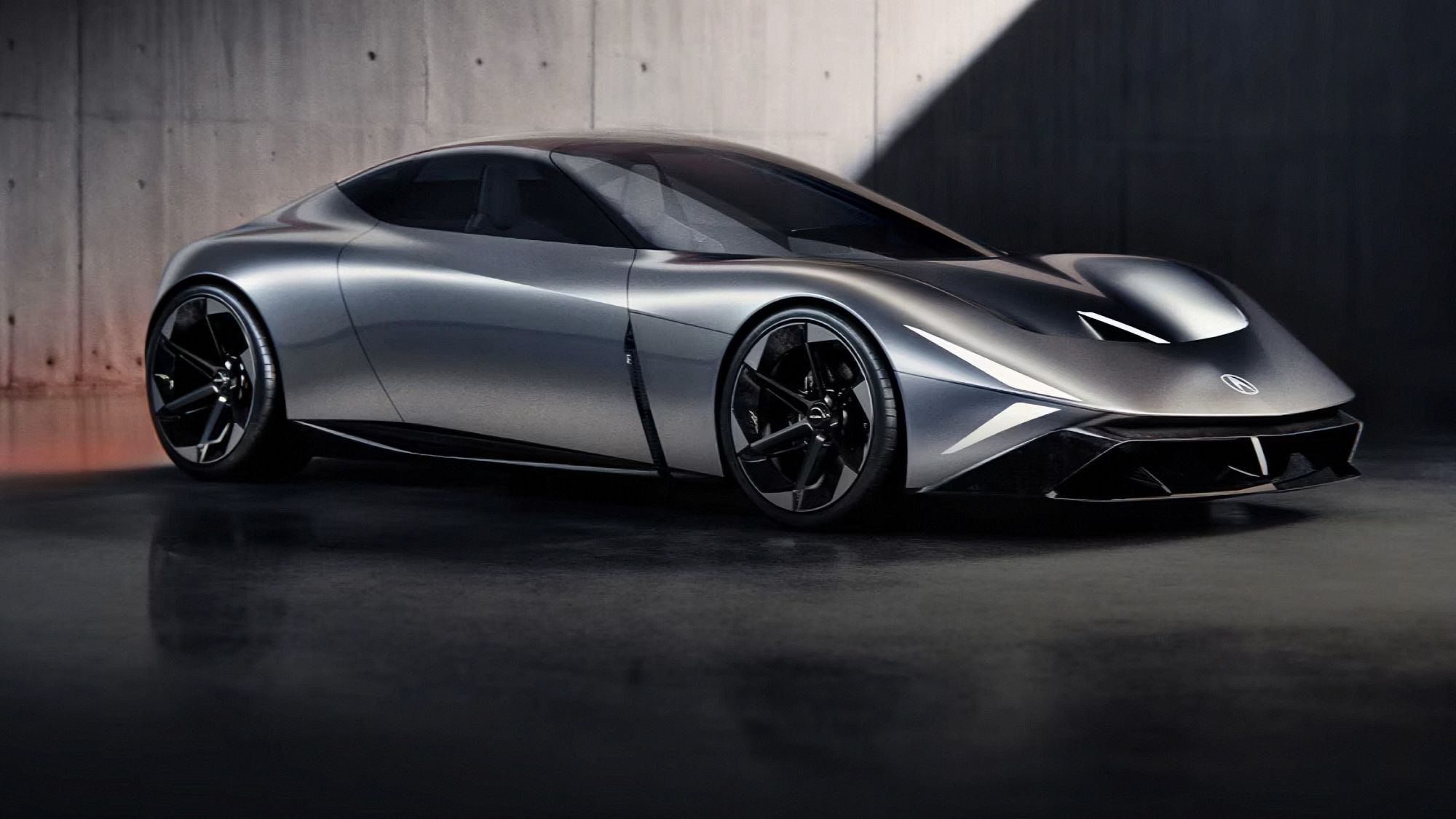
Like the prototype, the production model is a two-seat, mid-engine, rear-wheel-drive supercar that the company compares to the 2004 Porsche Carrera GT, the 2025 Gordon Murray Automotive T50, and the 1990 Sauber C9. The production version has a planned weight of under 2000 lb (907 kg) and measures just 4335 mm (170 in) long, 2050 mm (80 in) wide, and 1120 mm (44 in) tall, with a 2712-mm (106.8-in) wheelbase.
The relatively light curb weight is due to the company’s use of an aerospace-grade pre-preg carbon-fiber monocoque, two-sided-construction carbon-fiber body panels, and front and rear subframes made of 15CDV6 low-carbon-alloy-steel tubing. The company gives key aerodynamics stats at 150 mph (241 km/h) of 589 kg (1300 lb) of downforce and 227 kg (500 lb) of drag.
Oilstainlab is taking a unique approach when it comes to HF-11 powertrain options. Customers will be able to choose from a naturally aspirated 4.6-L flat six ICE (internal combustion engine) producing 600 hp (447 kW) and 500 lb·ft (678 N·m), a twin-turbo 5.0-L flat six producing 1200 hp (895 kW), or a fully electric version producing about 850 hp (634 kW). The ICE can spin to 9000 rpm (base) or 12000 rpm (optional), and the 4.6-L can propel the car from 0 to 60 mph (0 to 97 km/h) in 3.2 s.
Thanks to the car’s modular subframe system, owners will be able to swap between the ICE and electric powertrains in their own garage, depending on customer need or mood, according to the company.
Front and rear suspension is by fully adjustable double wishbones with machined lightweight aluminum uprights, inboard pushrods, and custom Ohlins shocks. Wheels are center-lock machined aluminum from a forged block. Standard tires are Michelin Pilot Sport Cup 2 R, 275/35R19 front and 335/30R20 rear, and for the track are Michelin Pilot Sport Legends, 25.5x12R18 front and 28.5×14.5R18 rear.
Access to the interior is by assisted butterfly-style doors. Interior design highlights are a five-gauge digital driver display, high-definition digital rearview mirror, small 330-mm (13.0-in) steering wheel, adjustable pedals, and upholstered carbon-fiber seats. Two race helmets can be stored in the doors.
According to industry reports, Oilstainlab plans to produce 25 of the HF-11, with prices starting at $1.85 million for the ICE version. The fully electric or engine-swappable version of the car will be priced at $2.35 million.
Production of the Oilstainlab HF-11 is scheduled to start in 2027. Earlier this year, the company announced it was expanding operations into Canada for Oilstainlab North, an R&D and manufacturing facility.
Kevin Jost contributed to this article.
-

- Oilstainlab Half-11 Delphi Art Car studio right side from above.
-

- Oilstainlab Half-11 Delphi Art Car far off in studio.
-

- Oilstainlab Half-11 Delphi Art Car studio rear view.
-

- Oilstainlab Half-11 Delphi Art Car studio left side rear.
-

- Oilstainlab Half-11 Delphi Art Car studio right side.
-

- Oilstainlab Half-11 Delphi Art Car studio warm up.
-

- Oilstainlab was founded by twin brothers Nikita and Iliya Bridan.
-

- Oilstainlab in simulated Le Mans 1967 race.
-

- Oilstainlab Half-11 Delphi Art Car studio warm up.
-

- Simulated work on the Oilstainlab Half-11 in Europe.