Alpine‘s A110 Future made its global dynamic public debut today at the Goodwood Festival of Speed in England. BWT Alpine Formula One Team driver Pierre Gasly steered the development mule for the future third-generation A110 up the venue’s famous hill accompanied by Charles Gordon-Lennox, the Duke of Richmond and Founder of the Goodwood Festival of Speed, as the Renault Group‘s sports car and high-performance brand revealed new details of the technology underpinning the EV sports car.
“It was great to be amongst the first to drive the future of Alpine with my run up the Goodwood Hill in the Alpine A110 Future today,” said Gasly. “Alpine continues to show that an electric sports car can be lighter, sharper, and really enjoyable to drive.”
The brand says the third-generation A110 will be the world’s first true EV sportscar, designed to remain true to Alpine’s DNA while outperforming the best of today’s combustion sports cars. Key to this strategy is the new APP (Alpine Performance Platform), which the development mule was built to test, and a modular architecture built to cover a range of body styles and drivetrain configurations with one platform. The aluminum architecture is engineered to provide “the dynamic responsiveness that defines Alpine.”
The A110 Future previews the two-seat production coupé layout, which runs a dual battery pack split front and rear, paired with a dual rear e-powertrain. This front/rear split was engineered to offer an overall height that matches today’s A110, with a low driving position and cabin space to comfortably fit a range of driver and passenger sizes. The current A110 is 1244- to 1252-mm (49.0- to 49.3-in) tall, with a 4181-mm (164.6-in) length, 1798-mm (70.8-in) width excluding mirrors, on a 2420-mm (95.3-in) wheelbase.
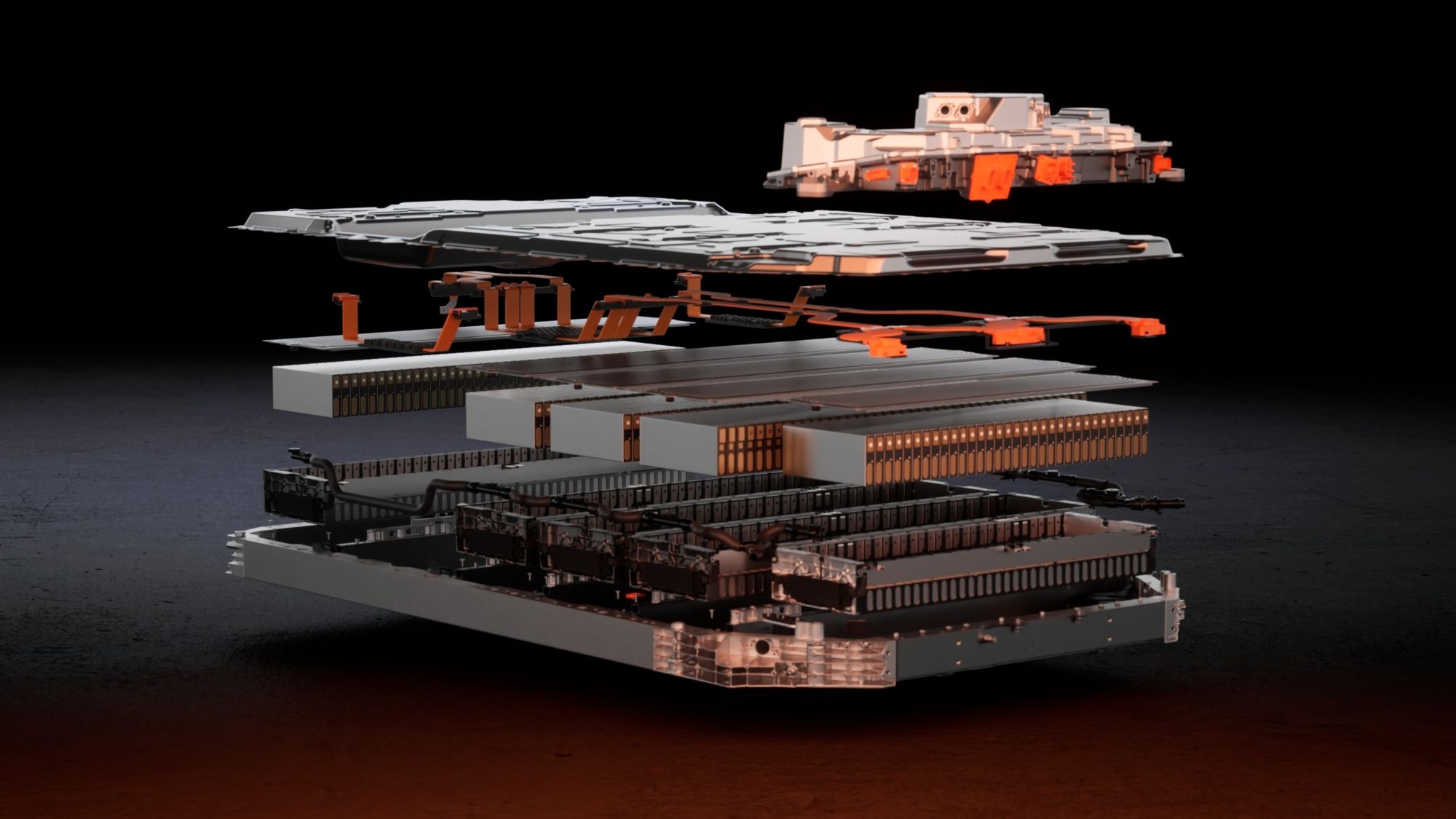
The two battery packs are positioned “to respect the 40% front/60% rear balance of a true sports car,” using 800-V cell-to-pack technology with high energy density cells to reduce weight and charging time. The battery system, which splits its energy 25% front and 75% rear, is built across two floors within a high-pressure die-cast aluminum casing that contributes directly to the car’s structural stiffness. A centralized BMS (battery management system) and aluminum connection harness complete the pack.
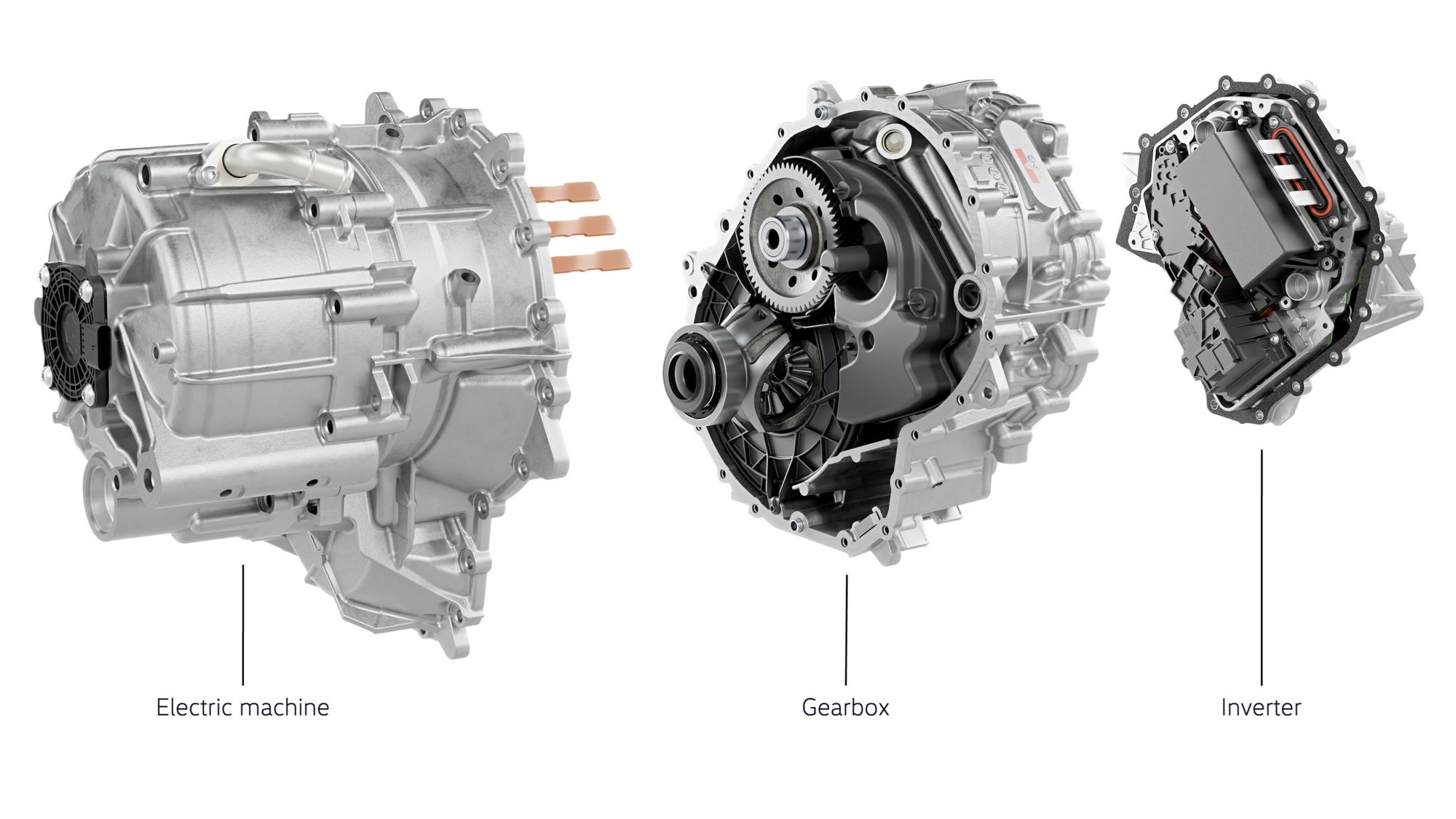
Engineered for agility and intensive use, and built to be compact and light, the car’s e-powertrain incorporates PSM (permanent magnet synchronous) motors spinning up to 21,500 rpm driven by 3-in-1 e-machines with 800-V SiC (silicon carbide) inverters. The result is said to be precise, instant control at each wheel. Tailored for performance, the system uses torque pre-control, with a 400-V boost charging system, and features an e-motor-driven sound.
To make the A110 Future fun to drive on both track and road, the full aluminum suspension set-up gets new integrated braking and steering systems. New Active Torque Vectoring 2.0 and Wheel Slip Torque Control help to reduce understeer during corner entry and mid-corner, managing load transfer and torque under acceleration and lift-off. Both sit within a wider control suite—covering braking, steering, and battery and thermal management—engineered to flex across the platform’s RWD/AWD configurations.
Alpine says that development has been shaped by extensive use of simulation, saving time and cost by reducing reliance on physical prototypes, and helping define specifications for suppliers ahead of physical joint testing. Its DiM250 driver-in-the-loop simulator—built around an A110 cockpit, a 9-m conical screen, and hexapod motion technology reproducing full chassis dynamics—supports chassis tuning, powertrain calibration, and tire and control function development.
Across all projects combined, more than 45,000 km (27,960 mi) has been logged since the start of simulator use.
The A110 Future mule will run every day, from July 9 to 12, at Alpine’s strongest-ever Goodwood Festival of Speed showing, which includes full model range, starring vehicles that have shaped the brand’s history and five-strong BWT Alpine Formula One Team driver lineup. In addition to the mule, Alpine is bringing together current and previous generations of the A110 alongside its current electric line-up including the A390 sport fastback and A290 hot hatch.
For the A390 line, which shares its modular AmpR Medium platform with Renault’s Scénic E-Tech and Mégane E-Tech, the GT version launched in 2025 was joined last month by the highest performance GTS with its increased power, high-performance battery, and comprehensive standard equipment. It combines three electric motors—one at the front and two at the rear, mounted on a purpose-built aluminum subframe—for 470 hp (350 kW), but more importantly, 824 N·m (608 lb·ft).
The GTS is designed to deliver performance “without running out of steam” in the most demanding conditions, such as when climbing mountain passes, thanks to its high-density 89-kW·h battery with performance-oriented chemistry. The car’s AWD system and AATV (Alpine Active Torque Vectoring) have been enhanced to manage the increased output, distributing torque independently to each rear wheel every 20 ms for improved agility, safety, and responsiveness.
The Alpine A290, revealed in June 2024, was named 2025 Car of the Year by the European Car of the Year jury alongside its Renault 5 E-Tech sibling. Developed on Renault Group’s AmpR Small platform, the A290 is an electric Alpine produced in France at the Manufacture de Douai, part of ElectriCity, and its electric motor, available in 180- and 220-bhp (134- and 164-kW) versions, comes from the Cléon site.
To distinguish the A290 from its Renault sibling, its AmpR Small platform base gets a 60 mm (2.4 in) widening of its track to achieve the visual presence desired by the Antony Villain-led Alpine design team. Other design distinctions are a unique lighting signature comprising four headlamps, as on all Alpine models, with X-shaped motifs reminiscent of rally cars.
The car also gets a high-performance e-motor and unique technologies with exclusive suspension, specific brakes, tires, and torque management, and Alpine-engineer tuning. The result is one of the best-performing cars in the segment, with a 0-100 km/h (0-62 mph) time of 6.4 s, up to 220 hp and 300 N·m (221 lb·ft), and a weight of just 1479 kg (3260 lb).
-

- Alpine A110 Future development mule at Goodwood FOS.
-

- Alpine A110 Future development mule front side in studio.
-

- Alpine A110 Future development mule front in studio.
-

- Alpine A110 Future development mule from above.
-

- Alpine A110 Future development mule in studio.
-

- A110 Future’s Alpine Performance Platform with body and driver.
-

- A110 Future’s Alpine Performance Platform.
-

- Pierre-Gasly behind the wheel of the A390 GTS.
-

- Alpine A390 GTS interior.
-

- Alpine A290 GTS.