For its one-day brand experience late last month, Mercedes-AMG reimagined its Affalterbach, Germany, base as “Affasterbach” with famous faces from the sports, fashion, music, and culture worlds for the debut of the Concept AMG GT XX. The “technology program” offered a look into a four-door series-production sports car coming from the brand with technical innovations earmarked for use in production models based on the high-performance AMG Electric Architecture (AMG.EA).
“The best minds in our global R&D network have contributed their extensive expertise, from Mercedes‑Benz in Sindelfingen and Untertürkheim, to Mercedes‑AMG in Affalterbach and YASA in the UK, to our Formula One drivetrain experts at Mercedes‑AMG High Performance Powertrains in Brixworth,” said Markus Schäfer, Member of the Board of Management of Mercedes-Benz Group AG, Chief Technology Officer, Development & Procurement.
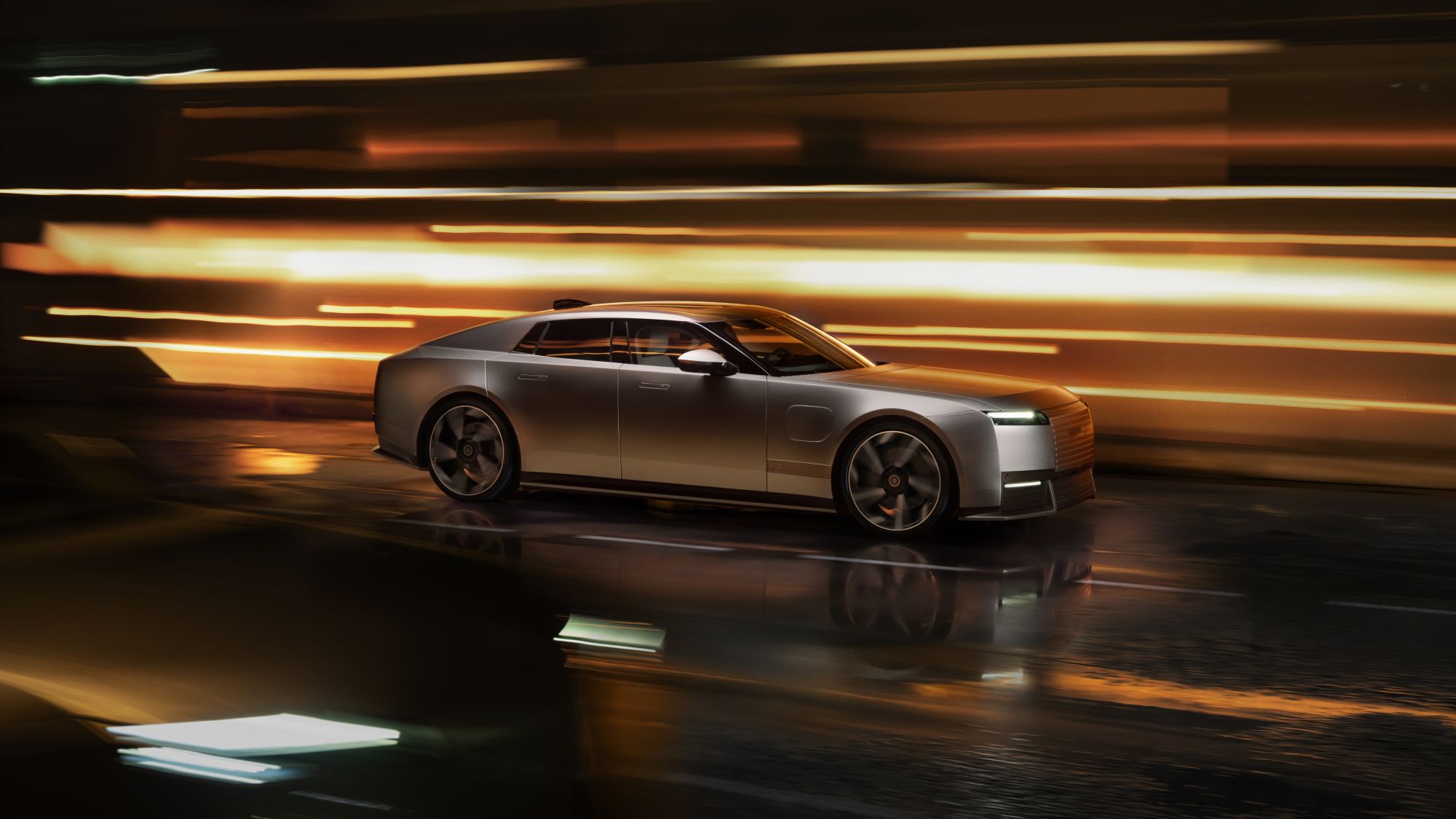
The concept, which measures 204.9 in (5204 mm) long, 76.6 or 83.9 in (1845 or 2131 mm) wide without or with mirrors, and 51.9 in (1318 mm) tall, represents the design vision for future AMGs, according to Gorden Wagener, Chief Design Officer of Mercedes-Benz Group AG.
“Icons like the 300 SL and the legendary Silver Arrows are the emotional heart of our brand, as are the GT and AMG ONE,” he said. “Crafting these masterpieces is about creating something extraordinary, from the C111 to the Vision One‑Eleven and into the future of production. The brand-new Concept AMG GT XX embodies the hot part of our design philosophy of sensual purity.”
The concept car is based on the new AMG.EA architecture, consisting of aluminum, steel, and fiber composite materials for AMG-hallmark rigidity with low weight.
“First-class” aerodynamics
For the Concept AMG GT XX, designers and engineers focused on a wind-cheating shape and details because, at 186 mph (300 km/h), about 83% of the drive energy is required to overcome drag, showing how important efficient aerodynamics are in the high-performance segment, according to Mercedes. The concept shows what is technically possible with a sporty flat shape and wide, high-performance tires. Its aerodynamic shaping and refinements resulted in a drag coefficient of just 0.198 and, combined with a low 2.24-m² (24.1-ft²) frontal area, contribute to high-speed performance as well as longer range at high speeds.
Design highlights include a low-slung front end, fenders that flare organically to frame the front wheels. The long, low greenhouse with double-bubble roof and three windows on each side rests on the muscular rear shoulders.
The AMG-specific illuminated ten-vertical-strut front grille has a more oval and concave form, Mercedes star integrated into the middle, and rectangular auxiliary headlights recessed into its outer edges. The vertically arranged main headlights feature stacked low and high beams.
The concept vehicle’s AMG GT series’ Airpanel active air control system was further developed for the best compromise between cooling and aerodynamic drag. The system manages airflow in multiple stages according to cooling requirements, operating louvers hidden behind the air intake in the front bumper. The louvers are normally closed, reducing drag and directing air towards the underbody; when cooling demand increases, they open in multiple stages, allowing cooling air to flow to the heat exchangers as needed. The motorsport-inspired two-part air outlets in the hood optimize the cooling air path through the front horizontal cooling modules.
The front splitter extends far around the front with an integrated air curtain function reaching up the front wheel arches. A passive cooling plate in the front underbody uses the airflow beneath the car for cooling.
Along the side are exterior mirrors elevated on the front doors in “sports car fashion,” with aerodynamics aided by flat door handles and wheel coverings and sill cladding with aerodynamic contours that extend into the rear wheel arches. The body rests visually on a floor structure that extends from the front splitter along the sill blades to the rear diffuser.
From above, the greenhouse tapers rearward, emphasizing the wide shoulders. Designed to ensure rear stability at high speeds, the wide diffuser in exposed carbon sweeps deeply down on either side, and its form is reminiscent of the AMG ONE.
The rear design has a sharply angled aerodynamic edge and an active airbrake. The six circular deep red taillights and centrally positioned MBUX Fluid Light Panel are framed by a recess with conical sidewalls to create a sense of depth.
Special underbody contouring ensures aerodynamic balance, meaning optimum downforce paired with maximum efficiency. It generates the Venturi effect, which reduces lift at the rear without notably impacting the drag figure. This facilitates a lower rear and lessens the need for a pronounced rear spoiler.
A “special highlight” is the 21-in five-spoke forged aluminum active aero wheel that optimizes brake cooling, aerodynamic efficiency, and range with five movable elements.
Integrated in the hub of each wheel is an easy-to-install/remove actuator that moves the aero blades. Each autonomous actuator uses the spinning wheel to produce its own electrical energy via a mini-generator. Paired with an integrated high-performance battery, the system can generate and store enough energy for up to 200 blade movements to ensure optimal brake cooling at all times.
The actuator uses Bluetooth to communicate wirelessly with a vehicle control unit that monitors, among other things, the need for increased brake cooling. When it sends a signal to the actuators, they deploy and actively open the blades and outer wheel cover. Supported by radial louvers on the inner side of the aero blades, cooling air is pumped through the wheel to the brake and back out again.
Increasing the airflow in this way achieves significantly more efficient brake cooling while the active removal of air from the wheel arch, which interacts aerodynamically with the underbody, also has a positive influence on the vehicle’s aerodynamic downforce.
Exterior tech innovations
With the Concept AMG GT XX, Mercedes-AMG pioneered other sports car exterior innovations like luminescent paint, speakers integrated into the headlights, and a special rear light panel.
The concept has luminescent paint segments on the lower vehicle body that allow special effects clearly noticeable in the dark. However, the paintwork is not only for visual effects at night. During charging, it serves as a means of communication and visually enhances the experience, with segments indicating the charge level.
Company R&D experts use electroluminescence technology in special coatings—built up in several electrically conductive and insulating layers—that emit light in response to an alternating current. Mercedes successfully evaluated the paint on a GT3 race car at the 24-h Nürburgring race. On the concept, the longitudinal cladding is highlighted in color with luminescent segments referencing the AMG logo.
In another innovation combining light and sound, the first application of exterior speakers for emitting driving sounds for pedestrians integrated into the headlights, the housings acting as speaker enclosures. The integration saves space, reduces weight, and enables new sound variants.
In the rear of the concept between the taillights is the MBUX Fluid Light Panel that enables communication with the outside world in real time as text or animation via more than 700 programmable RGB LEDs. It can show a variety of content, such as a digital AMG logo or the current charging process.
Three axial-flux motors
The Concept AMG GT XX delivers its power through an all-wheel-drive powertrain featuring three axial-flux electric motors and a high-performance battery developed by the brand. It can reach speeds of more than 223 mph (359 km/h) thanks to a peak output of over 1000 kW.
The three motors allow variable torque distribution to the front and rear wheels for a balance of traction, driving safety, and efficiency. The transition between rear-wheel and all-wheel drive occurs continuously based on control algorithms.
“The heart of an AMG was always the motor, and that will remain so with our in-house electric architecture,” said Michael Schiebe, CEO of Mercedes-AMG GmbH and Head of Business Units Mercedes-Benz G-Class and Mercedes-Maybach. “With our high-tech axial flux motor, we’re delivering a revolutionary new drive that is unparalleled in terms of power density, weight, and packaging. This pairs with a new performance battery developed from scratch that enables previously unimagined level of performance and endurance.”
The axial-flux motor’s technological underpinnings were originally developed by British electric motor specialist and Mercedes-Benz AG subsidiary YASA. For its application in the concept and then series production, the tech was taken to a new performance level by Mercedes-AMG experts who developed the operating strategy software that enables high output from a compact package. It will enter series production at Mercedes-AMG in 2026.
In combination with the new high-performance battery, the motors attain a new level in performance, particularly in terms of continuous output, allowing the concept to be pushed to its limits repeatedly. The battery remains in an optimal temperature range even during intense driving, benefiting vehicle performance and extreme fast charging.
Compared with conventional radial-flux types, axial-flux motors are significantly one-third the size, two-thirds lighter, and with triple the power density. The compact motor’s design offers more flexibility when it comes to drivetrain packaging.
In an axial-flux motor, the electromagnetic flux runs parallel to the motor’s axis of rotation rather than perpendicular as in a conventional electric motor. The stator is positioned between two rotors, the layout enabling optimum power transmission to the rotors through the electric field generated by the stator. In the concept vehicle, each of the two motors at the rear are around 3.1 in (79 mm) wide.
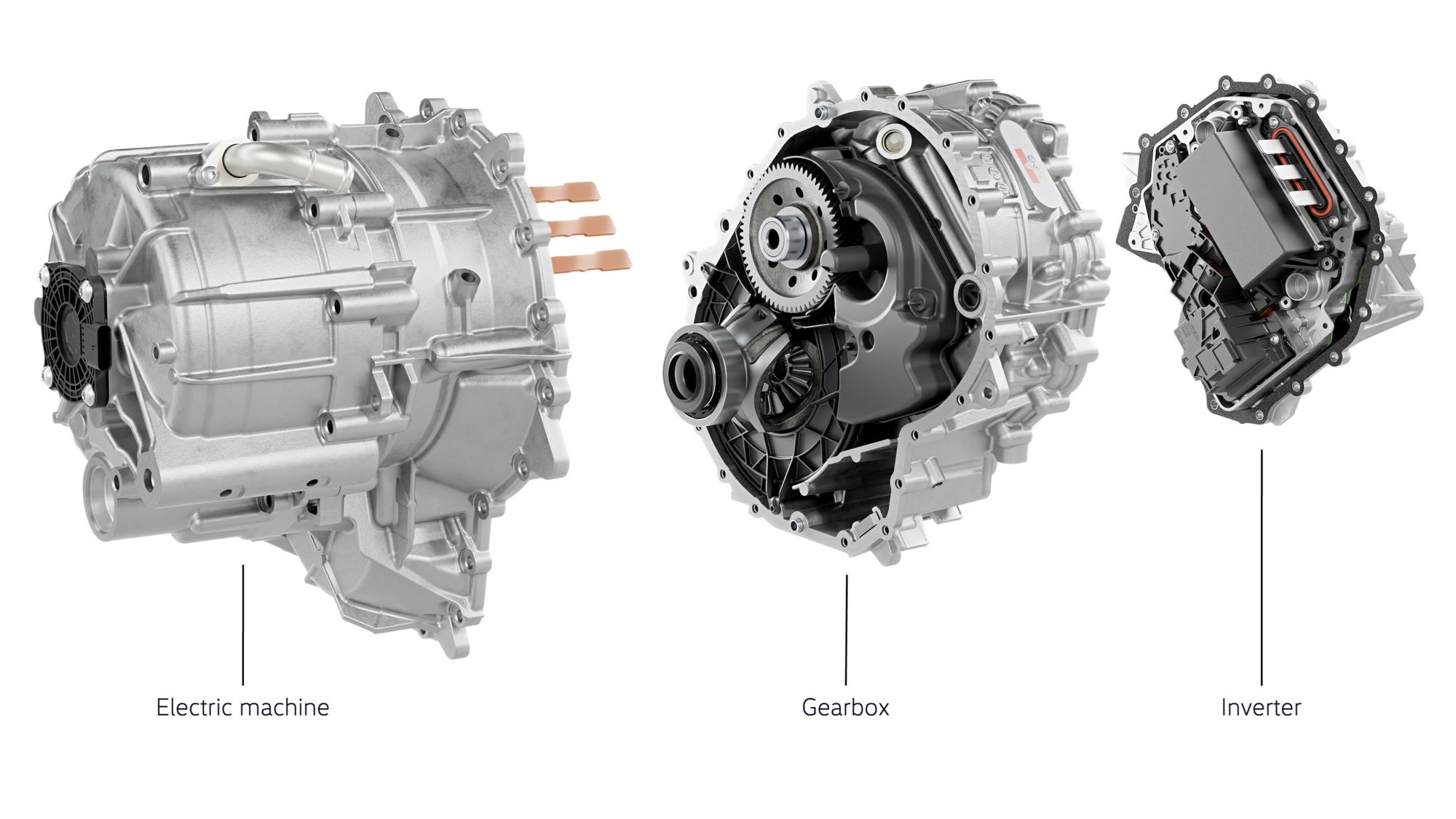
In the concept, the three motors are packaged into front and rear HP.EDUs (high-performance electric drive units). The rear has two axial flux motors, each equipped with a compact planetary gearset and one inverter in a single casing.
The motors and transmissions are oil-cooled. To save space, the control unit with hydraulic pumps and suction filters is integrated into the HP.EDU.
The two inverters, one per motor, are water-cooled. Their silicon carbide material offers multiple benefits for demanding applications requiring high voltages, high current, high temperatures, and high heat conductivity.
The front HP.EDU functions as a booster motor or provides traction when required at the front wheels. A disconnect unit decouples it during steady driving, low load, and coasting, reducing drag losses and increasing efficiency.
The axial flux motors are produced at the Marienfelde plant near Berlin. Production involves about 100 processes, of which roughly 65 are new for Mercedes‑Benz and 35 are world firsts. These include laser technology combined with innovative joining processes and artificial intelligence. These new production processes, developed largely in-house, led to more than 30 patent applications.
In-house electric battery
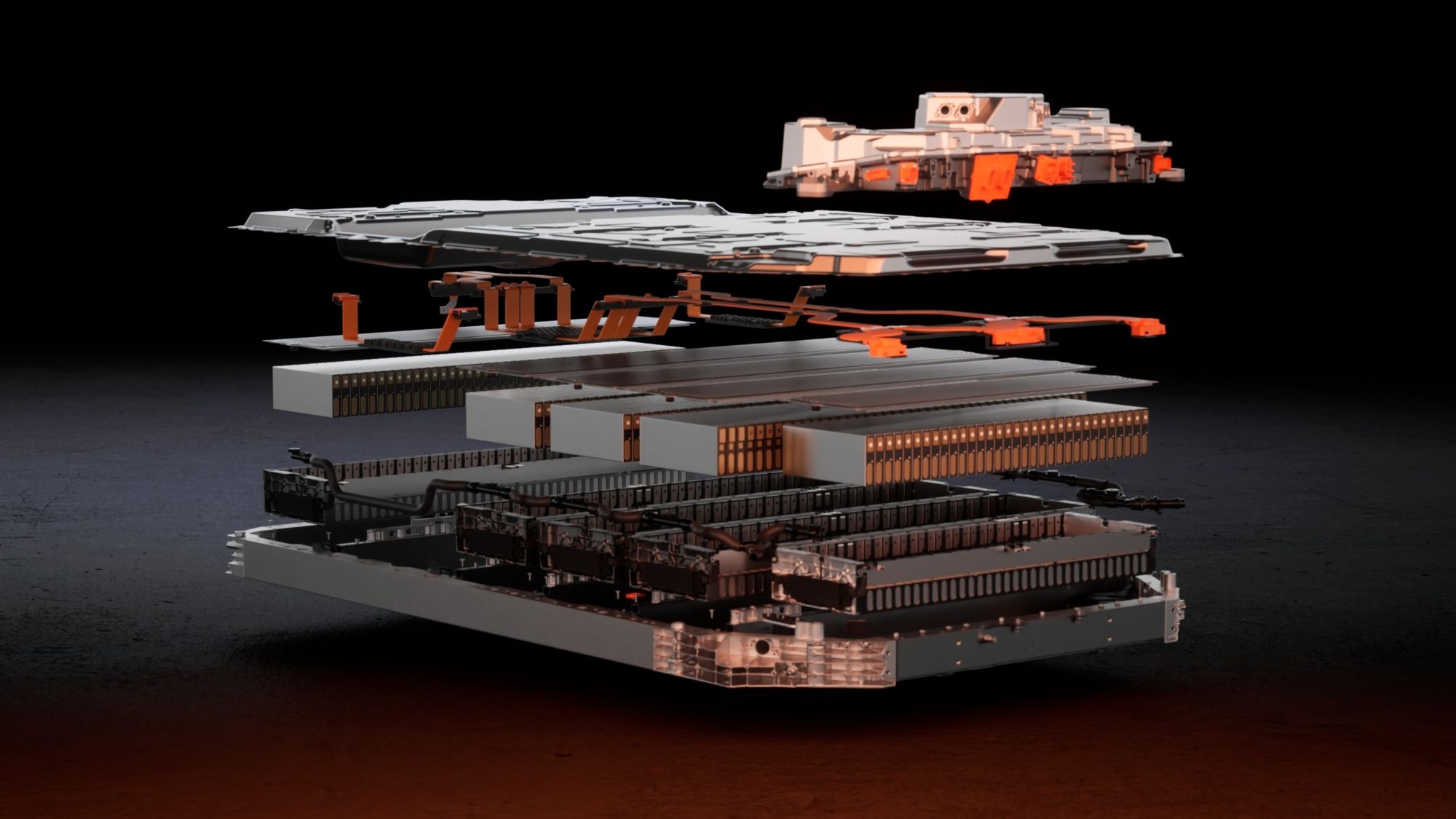
The concept’s high-voltage HP.EB (high-performance electric battery) is a completely new development benefiting from experience from the AMG ONE and Formula One, as well as the knowledge of engineers from Mercedes-AMG in Affalterbach and Mercedes-AMG HPP (High Performance Powertrains) at Brixworth in the UK.
It is centrally integrated into the electric skateboard platform structure. Its protective housing—which encases the cell modules, all switch components, and the in-house-developed BMS (battery management system)—is part of the vehicle structure and integrated into the crash concept. Defined lateral load paths, combined with high torsional rigidity and low weight, are said to provide a high level of crash safety.
The HP.EB delivers a high power output with “exceptional repeatability” paired with rapid energy absorption and high power density thanks to new battery cell developments, direct cooling of the cells, and high voltage.
The battery uses cylindrical cells that are tall and slim, the format delivering many cell-cooling benefits. The narrow diameter means the distance from the cell core to the casing is small, enabling the rapid dissipation of heat generated under load and ensuring each cell is kept more easily within its optimum temperature window.
The laser-welded aluminum cell housing is lighter than the steel housings typically used and has considerably better electrical and heat conductivity, offering benefits in the targeted thermal control of the cells, with faster cooling or heating on demand. A full-tab configuration means the entire surface of the cell tail is electrically and thermally connected to the pole, enabling a significant reduction in the cell’s internal resistance, facilitating high charging and discharging power, and functioning reliably under demanding load conditions.
The cell developed specifically for the concept car is based on NCMA (nickel cobalt manganese aluminum) cathode chemistry with a silicon-content anode. This offers a unique combination of high energy density of 300 Wh/kg or 740 Wh/L on the cell level, powerful charging performance, and a long lifespan.
More than 3000 cells are packaged into laser-welded plastic modules with direct cell cooling channels for optimum heat dissipation. A high-tech coolant, based on an electrically non-conductive oil, flows around each cell to maintain the optimum temperature.
The lithium-ion battery pack operates at more than 800 V. The benefits of the high voltage are lower weight due to the lighter cables, higher continuous power output, shorter battery charging times, and lower losses via the charging cable.
The charging performance is said to set new benchmarks due to direct cooling paired with optimized cell and power line thermal management. The concept vehicle achieves an average charging power of more than 850 kW at 1000 A over a wide range of the charging curve. It can charge by WLTP measures to about 400 km (249 mi) of range in around 5 min.
To help achieve this performance, Mercedes‑Benz worked with Alpitronic, which has developed the first prototype charging station able to transmit such a high current via a standard CCS cable. For future production models, the OEM states that it will expand its charging network with next-generation stations, enabling its customers to benefit from extremely fast charging times.
To read more about the Mercedes-AMG concept’s cockpit, check out our article on the driver-focused tech and innovative Modern Meadow bio-based leather and silk alternative materials.
-

- Mercedes-AMG Concept AMG GT XX side.
-

- Mercedes-AMG Concept AMG GT XX front.
-

- Mercedes-AMG Concept AMG GT XX rear.
-

- Mercedes-AMG Concept AMG GT XX wheel cover deployed.
-

- Mercedes-AMG Concept AMG GT XX, from Affalterbach to “Affasterbach.”
-

- Mercedes-AMG Concept AMG GT XX headlight-speaker integration.
-

- Mercedes-AMG Concept AMG GT XX MBUX Fluid Light paint.
-

- Mercedes-AMG Concept AMG GT XX MBUX FLuid Light Panel.
-

- Mercedes-AMG Concept AMG GT XX powertrain and suspension.
-

- Mercedes-AMG Concept AMG GT XX rear electric drive unit.