In its Automotive Semiconductor Trends 2026 report released last month, Yole Group forecast a $160 billion automotive semiconductor market by 2031, with a 31% CAGR (compound annual growth rate) between 2025 and 2031. That growth for that new silicon will be increasingly driven by the number of chips per car rather than higher-value content and rebuilding the car’s E/E (electrical/electronic) architecture.
Memory will become the fastest-growing device category through 2031, driven by higher DRAM (dynamic random-access memory) and NAND (not-and) content in ADAS (advanced driver assistance system), cockpit intelligence, and centralized compute architectures. Memory inflation does not stop the ADAS and cockpit trend, but it changes the rollout path—from “standardization for all” toward premium-first deployment, paid activation, and tighter hardware/content segmentation.
The “power & analog” category will remain one of the largest growth engines by device type and contributes the largest increase in semiconductor unit shipments, driven by electrification, power conversion, battery management, and distributed analog/power content.
Logic will become increasingly value-driven, supported by higher-performance processors, MCUs (microcontroller units), and compute SoCs (systems on chips) for ADAS, cockpit, and centralized vehicle architectures.
By domain, ADAS and safety will become the largest revenue pool by 2031, as regulation, higher sensor content, and growing compute and memory requirements accelerate semiconductor adoption.
Semiconductor content will remain structurally higher in electrified vehicles, with that for BEVs (battery electric vehicles) reaching $2047 per vehicle in 2031—almost two times that of ICE (internal combustion engine) vehicles. China and Europe remain the highest-content regions due to faster electrification, ADAS, and cockpit feature penetration.
Cross-domain zonal controllers dismantle decades of complexity
Yole Group has now expanded on its analysis of the auto semiconductor shift with a new Automotive E/E Architectures 2026 report. Among the key takeaways, company analysts say the market for E/E architecture semiconductors will expand to $36 billion by 2031. Domain and zonal architecture segments are expected to reach roughly 74% of global semiconductor production by 2031, a jump of about 70 percentage points since 2021.
For the overall ecosystem, OEMs are gaining direct control, and China’s companies are rising fast, with memory now the primary constraint. Ethernet will become the backbone, CANs (controller area networks) will evolve, FlexRay and MOST (media oriented systems transport) communication will be retired, SerDes (serializer/deserializer) will replace LVDS (low-voltage differential signaling) communication, and the 12- to 48-V shift will arrive with zonal architectures and e-fuses.
The analysis zooms in on the transition from over 100 scattered control units to a handful of domain, zonal, and central computers; the rise of the SDV (software-defined vehicle); and the specific processors, network chips, and power devices powering this evolution.
The network of controllers, processors, communication chips, and power devices that make up a car’s E/E architecture is undergoing its biggest change in decades. For years, the wiring harness was one of the heaviest and most expensive subsystems on board, as carmakers stacked function-specific ECUs (electronic control units) until a single vehicle could carry over 100 units and kilometers of cable.
That model is being dismantled. Driven by the SDV, the rise of ADAS and AI, and the pressure to cut cost and weight, carmakers are consolidating scattered ECUs into a few high-performance domain, central, and zonal controllers.
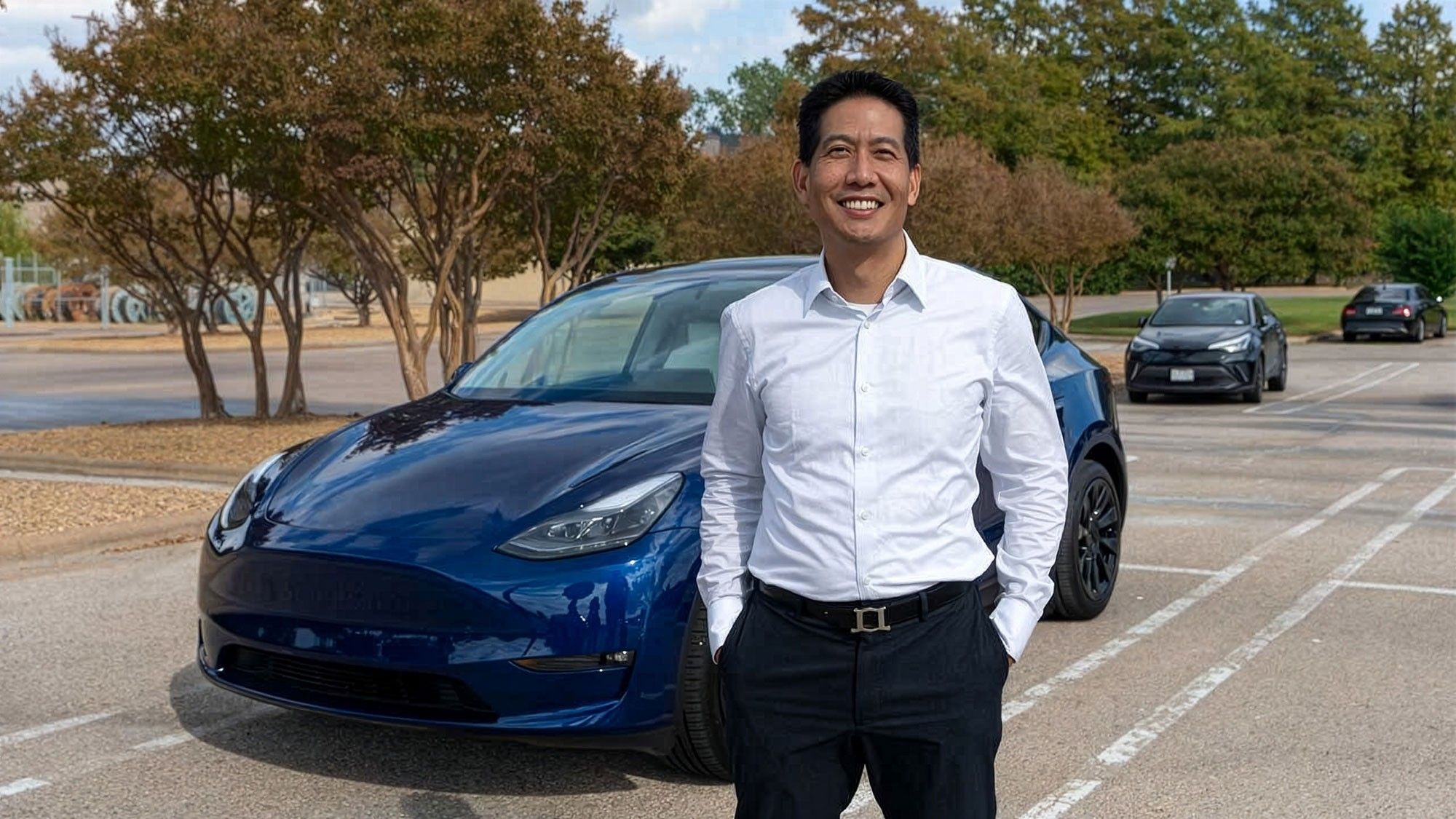
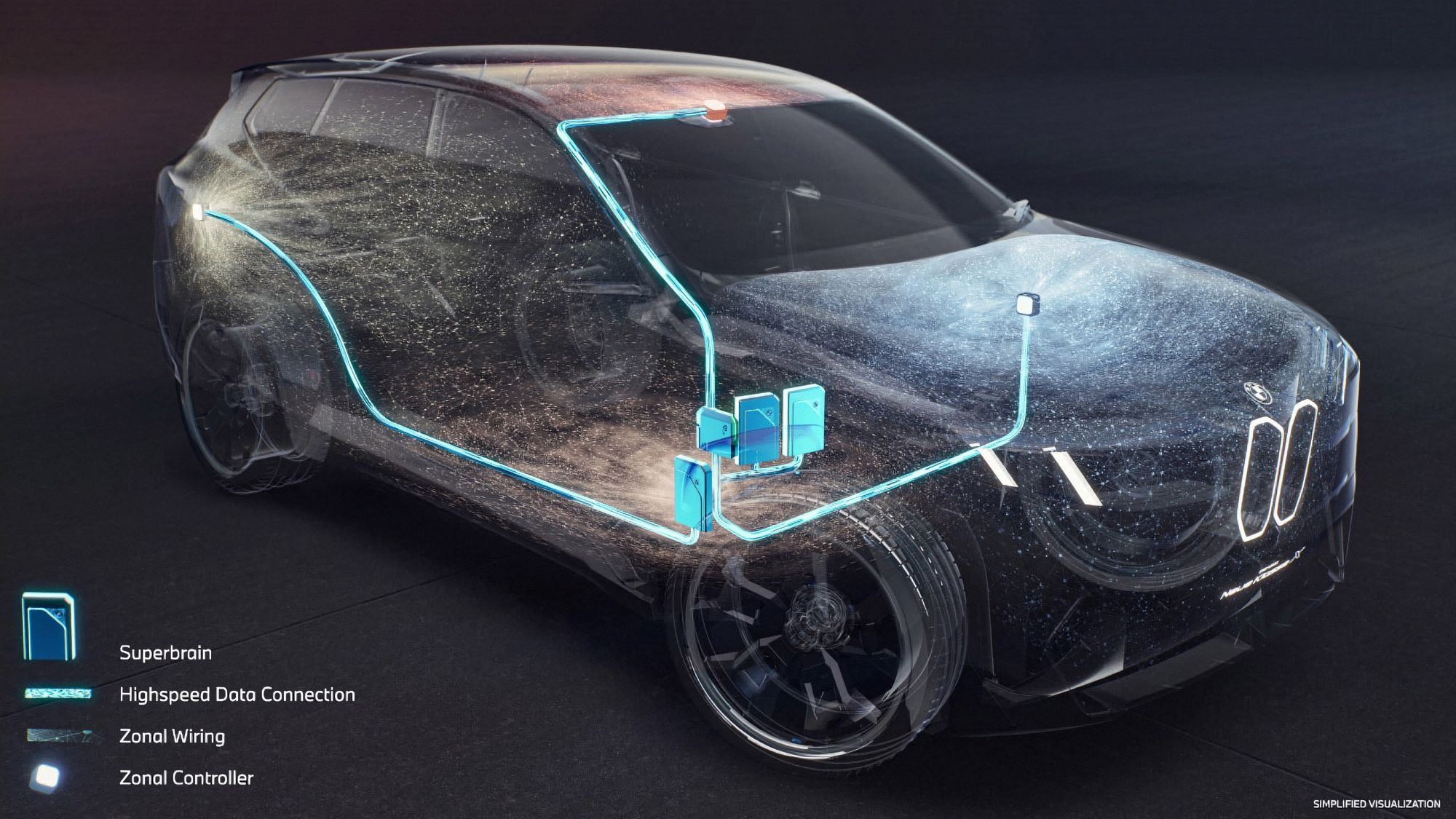
The benefits are already measurable, as demonstrated by OEM leaders. Tesla cut the wiring for its second major model, the Model 3, to half that of that in its pioneering Model S; Rivian reduced the ECU count from 17 to 7 in its latest R1; and BMW, with its Neue Klasse, saved around 600 m (1970 ft) of cable while replacing up to 150 fuses with smart e-fuses.
The E/E architectures report quantifies who wins, when, and by how much, mapping the transformation end-to-end, from architectural strategy down to the individual chip.
This E/EA transition is creating new demand across the automotive semiconductor stack, said Pierrick Boulay, Principal Analyst for Automotive Semiconductors at Yole Group. Among the highlights, he cited advanced processors for central AI-based computation ($5.6 billion to $15.3 billion, 16% CAGR), high-performance MCUs for domain and zonal controllers (6.6% CAGR), in-vehicle network ICs as CAN/LIN give way to CAN FD and Ethernet (doubling from $3.9 billion to $8.1 billion), and a nearly new category of PMICs (power management integrated circuits) for 48-V power networks (173% CAGR).
Uneven regional development
Focusing on light vehicles with forecasts spanning 2021-2031, Yole Group’s report tracks the architectural shift from distributed to domain, zonal, and central designs, including one-box, one-board, and one-chip integration. It shows how the pace of change diverges sharply by region. Chinese OEMs are set to reach 56% zonal production by 2031, compared with just 18% outside China.
“In the long-term trend of centralized E/E architectures, we are in the phase of upgrading backbone networks from domain-based to cross-domain zonal architectures plus a central computer for ADAS, infotainment, and vehicle control,” said Yu Yang, Principal Lead Analyst for Automotive & Robotics at Yole Group. “Many new technologies are on the horizon, creating new opportunities for semiconductor devices: e-fuses, 48-V powernet, optical communication, etc.”
The report also maps the semiconductor landscape enabling this transition, including automotive processors and the RISC-V ecosystem, microcontrollers, network chips, and power management ICs. It also examines how OEMs and Tier 1s are sourcing silicon, weighing the make, buy, or partner decision that keeps full in-house design within reach of only high-volume players like Tesla and a handful of Chinese OEMs.
For more information from Yole Group analysts, check out their Automotive White Paper: Drive the future and Automotive White Paper – Shifting gears: Semiconductors at the heart of automotive’s next chapter (Vol.2).
-

- Rivian’s 2nd-gen R1 has 7 ECUs in its zonal electrical architecture.
-

- Yole’s 2025-2031 E/E architecture semiconductor market by device type.
-

- Tesla cut the wiring for the Model 3 to half that of the Model S.
-

- BMW’s Neue Klasse saves around 600 m of cable while replacing up to 150 fuses with smart e-fuses.