Helm.ai, a leading AI (artificial intelligence) software provider for high-end ADAS, autonomous driving, and robotics, today announced what it says is a breakthrough in AI-generated synthetic data with the launch of GenSim-3 and VidGen-3. The foundation models are the first to achieve native Full HD (1920 x 1080) resolution across a full 6-camera, 360-degree surround view suite, according to the company. By rendering a massive 12-MP (megapixel) fully synchronized synthetic canvas per timestep, it delivers five times higher pixel density than current state-of-the-art benchmarks for generative world models.
While other generative world models rely on the massive computational scaling of thousands of GPUs to generate sub-HD video, Helm.ai achieved the full HD resolution milestone using a highly optimized cluster of just a few hundred advanced GPUs. By bypassing the heavy compute requirements typical of pure end-to-end scaling, the company’s proprietary generative architecture not only offers automakers a high-fidelity synthetic data pipeline with a significantly more efficient GPU footprint but also ultimately enables the compression of highly capable autonomous driving software onto low-cost, mass-market vehicle compute chips.
“We are moving the industry from standard ‘AI video’ to authentic, hardware-accurate sensor emulation,” said Vladislav Voroninski, CEO and Founder of Helm.ai. “By leading with a full HD (2 MP) standard and a 12-megapixel total aggregate capability per timestep, we have solved the resolution bottleneck that has historically limited the utility of generative AI in safety-critical systems. By optimizing our compute architecture, we are giving our partners a high-performance platform to validate their autonomous stacks using synthetic data that perfectly matches the fidelity of their actual production sensors.”
As the autonomous vehicle industry encounters the “data wall,” the point where the cost and time required for real-world edge-case collection stall development, Helm.ai’s new models provide a production-ready alternative. Standard generative world models typically operate at sub-HD or VGA-level resolutions, or about 0.4 MP per camera. The company’s native full HD output matches the hardware specifications of modern production cameras, effectively bridging the “sim-to-real” gap for Level 2 and Level 4 autonomy.
The key breakthrough is the fidelity of the multi-camera generative simulation. By producing full HD video, the company’s solution provides five times the visual information of traditional generative datasets.
This density is said to be a fundamental prerequisite for modern autonomous development because today’s production vehicles use high-resolution sensors, and the simulated training data must natively match the resolution of that hardware to be effective. Attempting to train a full HD perception stack on sub-HD synthetic data creates a critical domain gap. Generating natively at 2 MP per camera ensures that autonomous neural networks are trained on the exact pixel density they will process on the road, dramatically accelerating safe deployment.
To accommodate diverse sensor and training requirements, the architecture is highly configurable. Engineering teams can optimize for dynamic, high-speed validation with three-camera setups at 30 fps (frames per second) or maximize spatial context with a full six-camera, 12-MP surround view at 5 fps.
Unlike CGI-based video generators, Helm.ai’s models function as hardware-accurate virtual sensors by replicating physical constraints. This includes the deliberate, high-fidelity reproduction of actual hardware sensor anomalies, such as native sensor banding, optical lens flares, and dynamic exposure blinding. By providing perception stacks with these mathematically authentic hardware inputs, the company says it enables more robust training that mirrors real-world sensor behavior.
The platform provides automakers with a pipeline for both data augmentation and creation.
The GenSim-3 for high-fidelity scene transfer enables development teams to re-stylize real-world video synchronously across six-camera, 360-degree surround view setups. The model alters parameters such as weather, illumination, and object appearance at full HD resolution. The latest model also introduces improvements in environmental texture, surface reflectivity, and light behavior on complex materials.
The VidGen-3 for fully synthetic generation creates highly realistic driving sequences completely synthetically. By simulating complex environments, human-like agent behaviors, and traffic logic from scratch, it bridges geographic and environmental data gaps at scale.
-

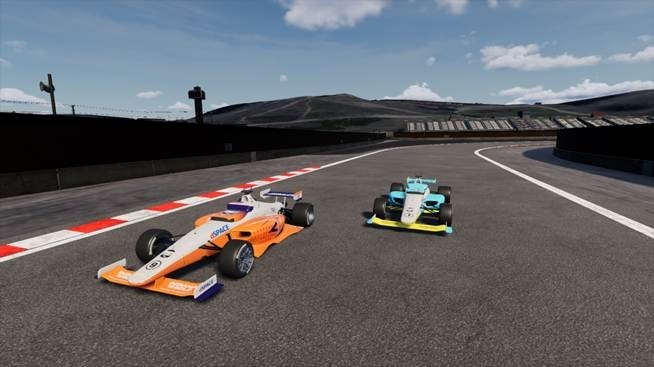
- AI-generated synthetic data with Helm.ai’s new foundation models.
-

- AI-generated synthetic data with Helm.ai’s new foundation models.