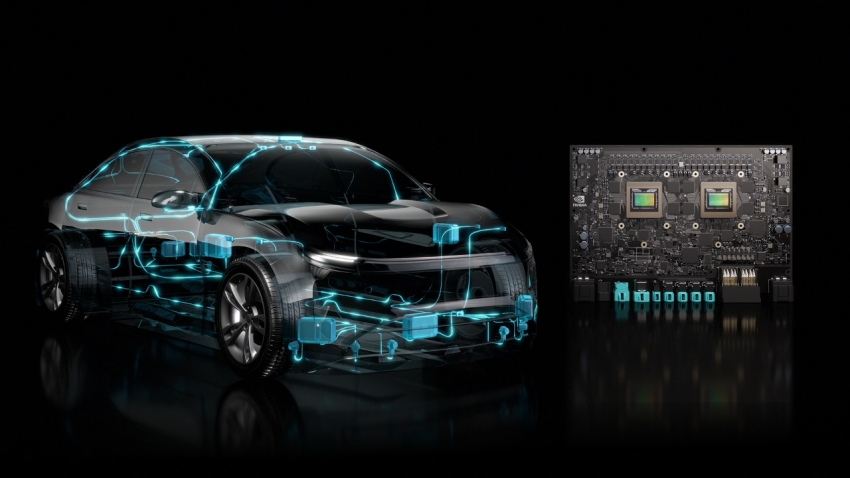
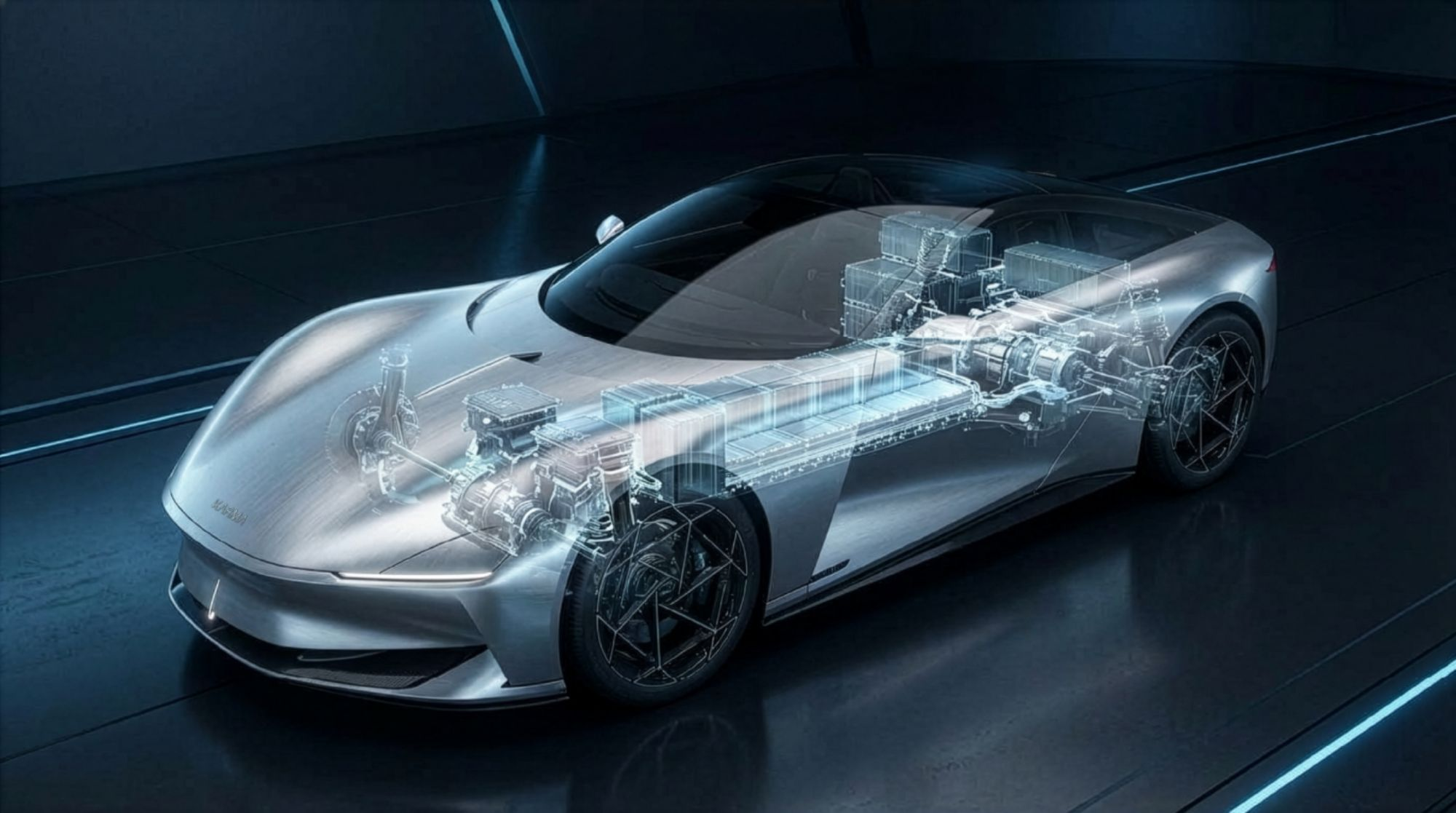
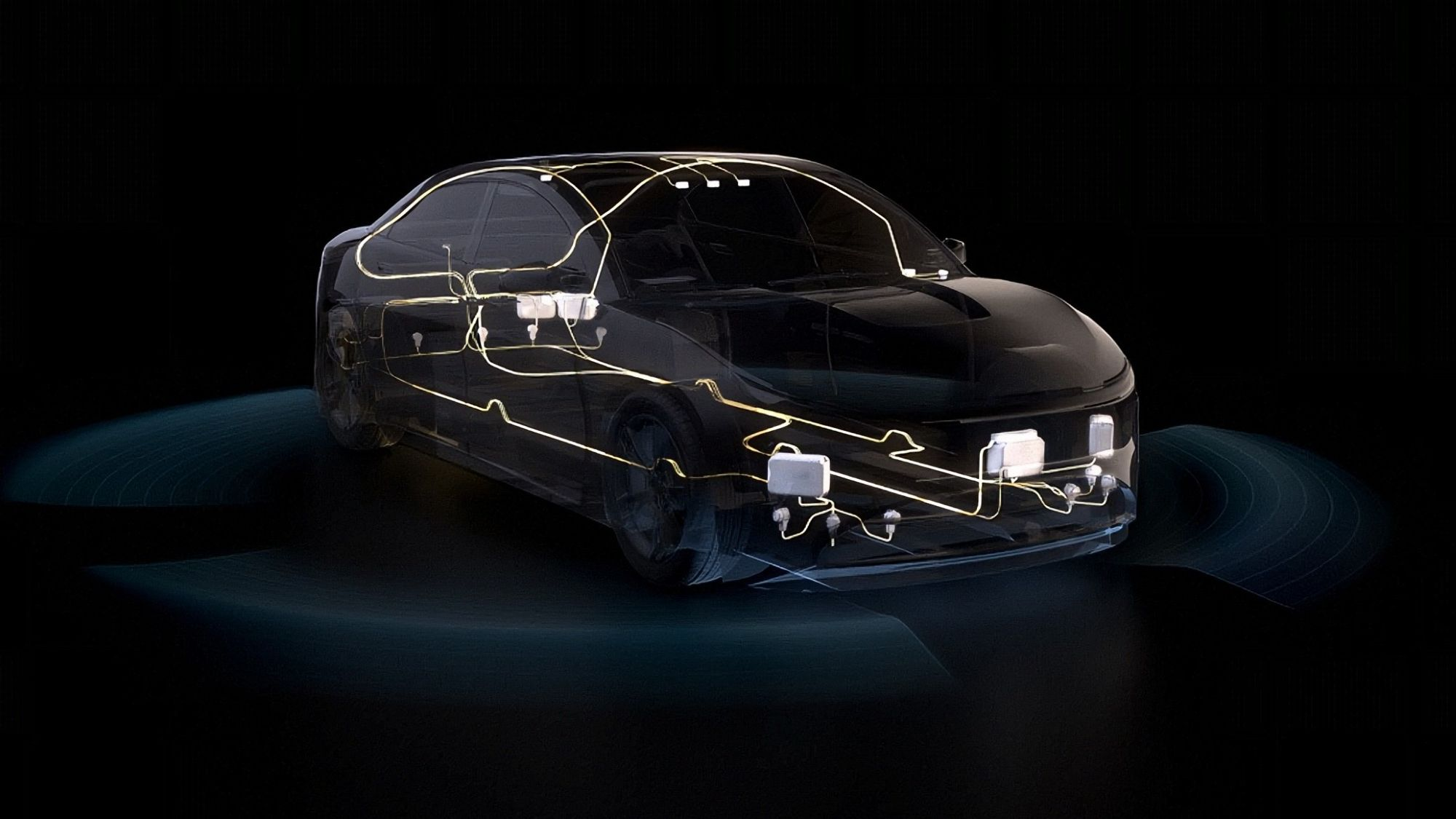
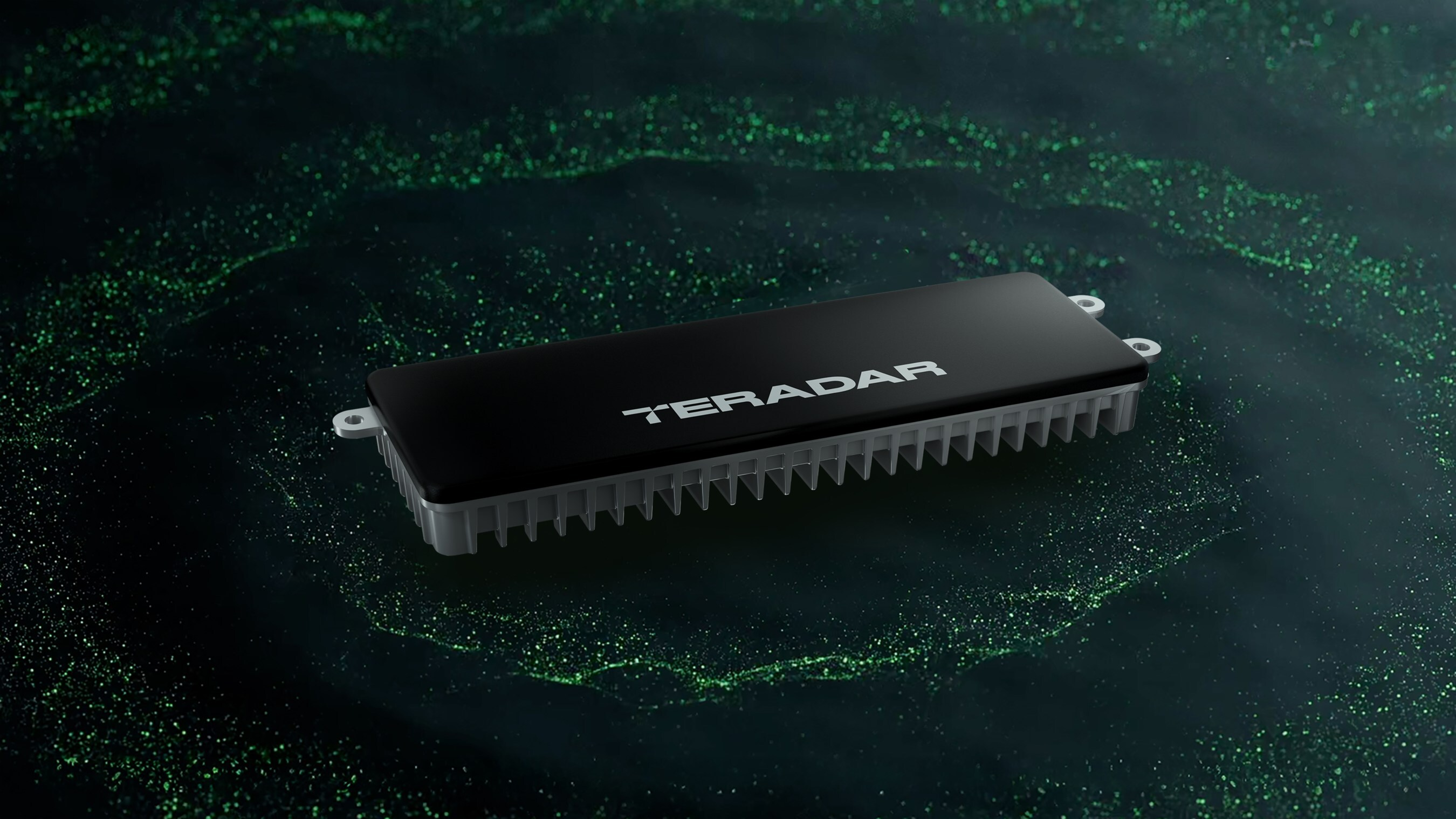
On the heels of Boston-based Teradar‘s out-of-stealth debut in November (see Futurride’s coverage here), it showed its flagship Summit sensor for the first time at CES 2026. The pioneer in terahertz (THz) vision technology says that its first product represents a breakthrough in sensing technology. It is the industry’s first long-range, high-resolution sensor designed for high performance in any type of weather, filling a critical gap left by legacy radar and lidar sensors.
“As extreme weather makes low-visibility crashes more common and more deadly, the need for reliable all-condition automotive vision has never been more urgent,” said Matt Carey, CEO and Co-Founder of Teradar. “By delivering visibility through fog, rain, snow, and sun glare, Teradar’s terahertz sensors could help prevent up to roughly 150,000 road deaths every year worldwide. We’re opening a sensing domain that simply hasn’t existed in automotive before, giving vehicles the ability to see in conditions where today’s systems break down.”
Teradar claims its unique ability to deliver reliable, high-quality data has attracted Tier 1 and automotive OEMs around the world that will manufacture and integrate its highly customizable chip design to achieve enhanced ADAS and higher-level autonomy in new vehicles. The company is currently in eight development partnerships across the U.S. and Germany and will begin bidding on high-volume production programs in 2026, targeting the start of production in 2028.
Terahertz waves, which lie between radar and lidar on the electromagnetic spectrum, have held great promise for sensing applications due to the unique characteristics of the wavelength, which allow both high-resolution and all-weather penetration, according to the company. Previously constrained by available technologies, the new category of sensing is now viable following its breakthrough in THz chip design.
A new class of sensor
We caught up with Teradar’s Carey and VP of Marketing Jason Wallace just before they showed their B-sample sensor at CES to OEM customers, Tier 1 suppliers, and partners in a private suite at the Fontainebleau Las Vegas hotel next to the show’s main Las Vegas Convention Center venue.
“Our goal, and the reason why we’re here as a company, is we’re building a new class of sensor at the last part of the electromagnetic spectrum where no one has ever been able to build a sensor before,” Carey told Futurride.
“I started the company when a really good friend of mine passed away from a car accident,” said Carey. “The road was foggy. It was early morning. The sun was rising. It was highway driving, and there was an object in the center of the highway that he hit.”
At the time back in 2014, Carey was going to go work for an autonomous car company. One of the engineers who interviewed him said there was no sensor at the time that would have saved his friend. He decided to pursue his mission to develop a better sensor.
His company’s technology is aimed at overcoming the limitations of the radar and lidar sensor incumbents. Company leaders chose a wavelength between radar and lidar to meet OEM demands for resolution. To satisfy automakers’ demands, typically in the 0.05-0.1 degree resolution range, they chose the terahertz frequency.
“The advantage is that we can give the robustness of radar, but with all the advantages that we really enjoy with a lidar,” he said.
He elaborated that radar resolution isn’t very good, and it’s limited by physics—the Rayleigh criterion that is tied to wavelength. Lidar is expensive, it’s got rotating parts that are very difficult to make last 20 years, and it struggles with fog and rain. And cameras don’t do well in bad weather, dynamic range at night, and with depth perception.
“We pair really well with a camera, and, with that, we can essentially enable SAE Level 3 for the OEMs,” he said. “The camera’s blind spots are our strengths, and vice versa. One limitation of our sensor is that we won’t read signs. I can’t tell you what the speed limit is of a particular sign, but what I can tell you is where a soccer ball is, with the exact velocity of it in the pouring rain, 200 m out with a kid chasing after it. A camera can’t do that, and it can be at night. We’re completely weather agnostic.”
The jury is still out on the competition with radar and lidar.
“If you talk to some OEMs, we’re replacing the radar,” elaborated Carey. For other OEMs, “we’re replacing the lidar. And other OEMs are like: ‘Hey, we recognize you’re a super set of both. Once you gain our trust, we would have you replace both of those.’”
For some of the company’s SAE Level 4 and 5 customers, execs want an additional sensor: “NHTSA will probably require a third orthogonal sensor to have that full safety piece,” said Carey.
Teradar will be bidding on its first vehicle programs in Q1 and Q2, said Carey.
“We have some significant traction with OEMs,” he elaborated. “We have five OEM partners. These are partners that are either in paid development programs or full track testing time.”
Detailing the tech
The Summit sensor uses a solid-state digital-phased-array architecture for 4D measurement of range, azimuth, elevation, and relative velocity. The tech features SAE Level 2 through 5 “AV compatibility,” with day, night, fog, rain, snow, sleet, and dust weather performance. In addition to a 3D + Doppler point cloud, key specs are a range of more than 300 m (984 ft) and 0.13-degree native resolution. The latter compares favorably to a “really big radar’s” 1.5 degrees.
“It’s a factor of between 10 and 20,” said Carey, comparing his tech’s improvement in resolution. “It’s a really big radar that gets you 1.5 degrees. If you do the same as the [industry benchmark Continental] 540, you’re looking at 2.2 degrees or so.”
Carey said that OEMs don’t want to cover the entire front of the car with 77-GHz radar to get just 1.5-degree resolution. Up the frequency band is lidar, with “phenomenal” resolution, but the downside is with photonics that you’re trying to manage.”
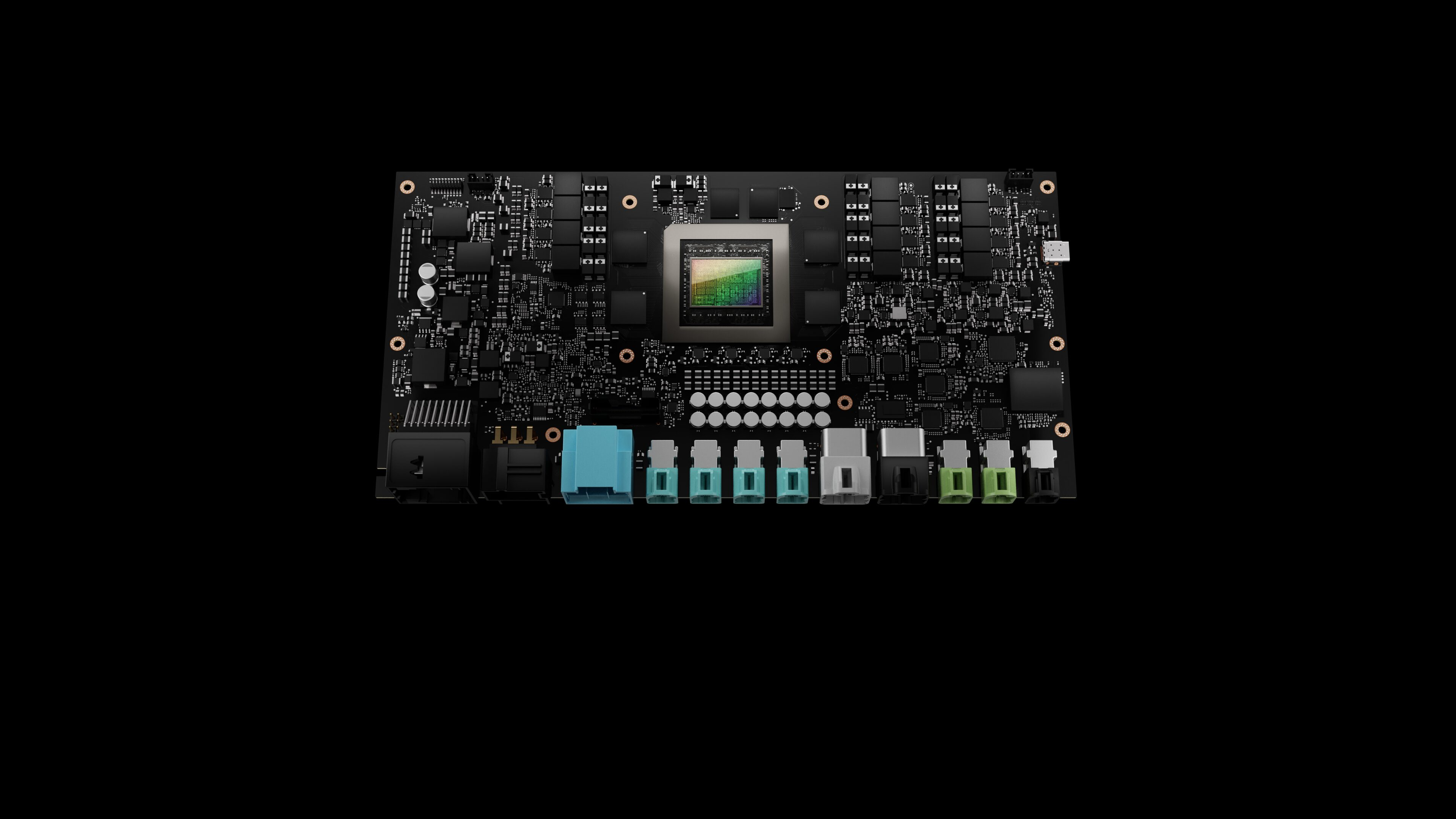
The company provides lidar resolution in a scalable package via small transmitters and receivers. Its Modular Terahertz Engine (MTE) is an all-solid-state sensor platform built on proprietary transmit (TX), receive (RX), and core processing chips, which are said to deliver crystal-clear vision, detect small objects at great distances, and maintain uncompromised reliability in any environment—day or night, and in rain, fog, and snow.
“We can stack any number of transmitters and receivers,” he said. “If an OEM wants more, we’ll give them more. We just stack more chips without changing the chip topology at all.”
Another “beautiful thing” about the terahertz tech is that it can avoid the major design-bump objections vehicle designers have with lidar.
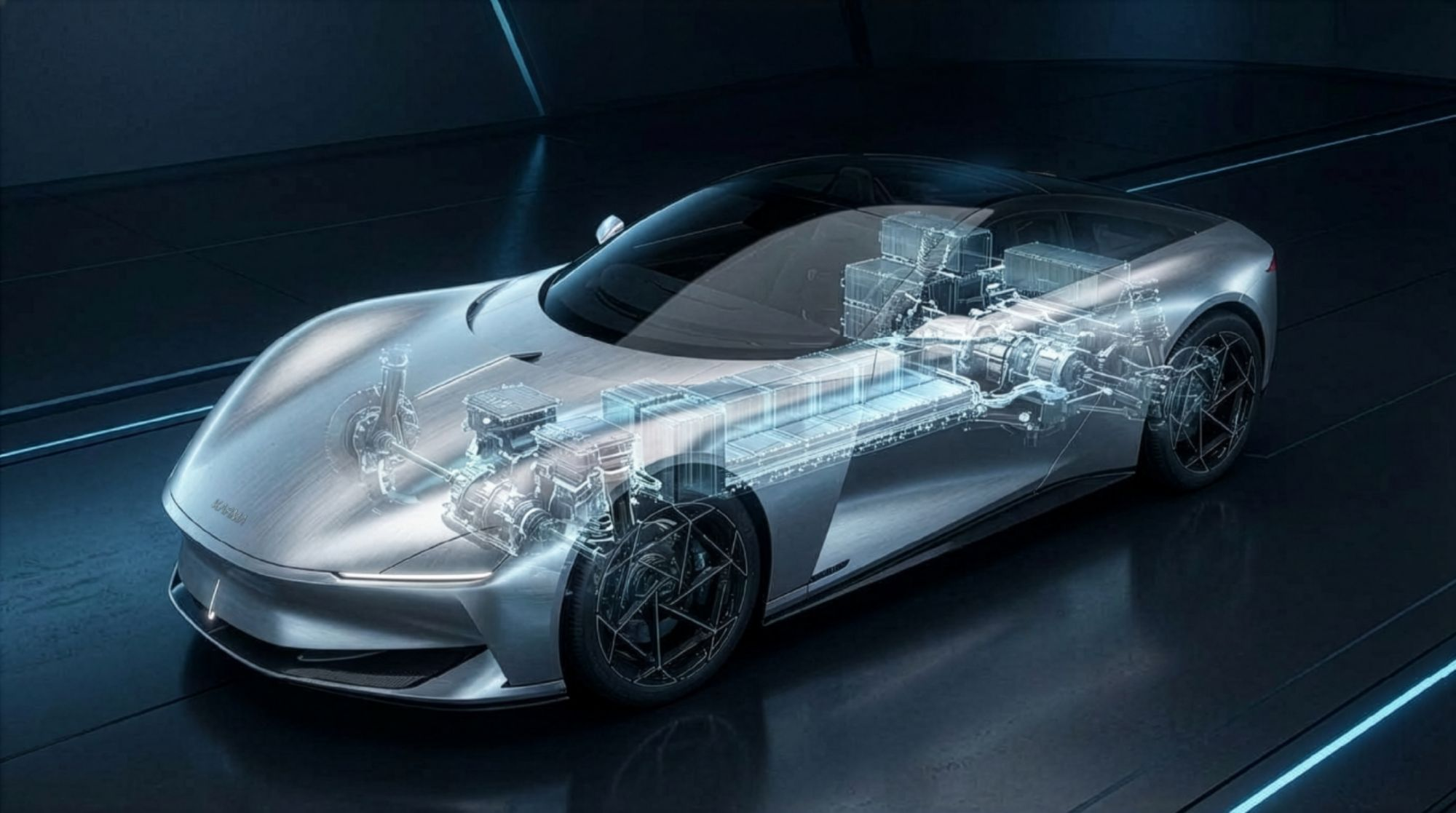
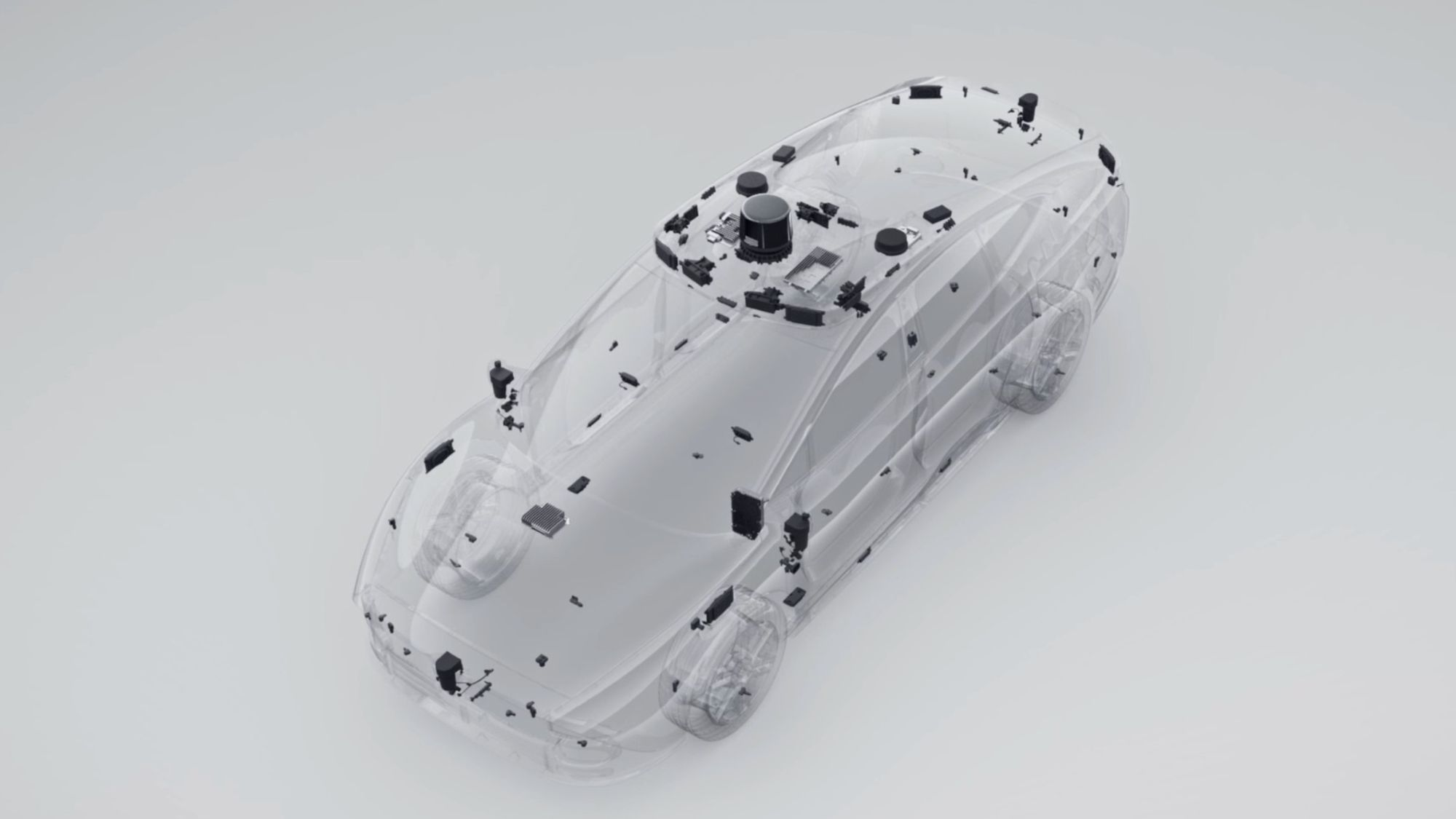
“From our standpoint, you can mount us just as a radar would behind that front grill or behind the bumper, whatever you want to do,” he explained.
The development journey to low power consumption and cost
This year was the third consecutive year that the company had a presence in Las Vegas during CES.
“The first time we just showed that terahertz was possible,” said Carey. “It only went 10 m. The big box consumed 500 W, so we could heat the room. The second one was our A sample. That’s where we showed real targets out in the real world, but with a limitation of 180 m. The feedback we got from [OEMs] is that the range has to be 300 m or better, so the B sample that we’re showing off at CES goes out to 340 m.
However, development continues.
“We’ve solved all the fundamental R&D and all the hard engineering problems,” said Carey. “The next step for us is, we’re finishing up our system-on-chip, and that allows us to get to the final power and size requirements. That comes out later in 2026.”
One of the benefits of further SOC development is a reduction in power consumption, which “matters an immense amount,” said Cary. “It’s always a dance with the OEM to say, ‘Where do you want the power to land relative to the performance?’”
Carey said some radar and lidar sensors consume over 30 W.
“It really limits what vehicles you can be on,” he said. “Our first sensor will probably be about 25 W, and then ultimately we’ll get it down to well below 20 W, especially for less-capable versions.”
Those less-capable versions will help in democratizing the technology. The concept piggy-backs off an original edict to keep the product simple, with no moving parts, and a focus on low cost. Not surprising, considering that one of the running jokes in the company is that Carey still drives a 2018 Ford Focus.
Teradar’s first sensor is the high-performance Summit for high-end vehicles, “but we are designing this sensor to be on every vehicle, including my Ford Focus,” concluded Carey. “While we’re not disclosing the exact pricing, we are targeting having versions available for every vehicle. We have a very good idea of what those price points have to be; so forget lidar, think radar and lower.”
-

- Teradar’s Summit is the “world’s first” terahertz vision sensor.
-

- Teradar CEO Matt Carey.
-

- Teradar terahertz vision sensor testing.
-

- Inside the Teradar sensor.