At CES 2026 in January, will.i.am, the entrepreneur, technologist, futurist, and musical artist behind The Black Eyed Peas, unveiled Trinity, his partner venture with Nvidia, and its vehicle and next‑generation micromobility platform powered by Nvidia DGX Spark technology. The all‑electric, self‑balancing, single‑passenger, three‑wheeler is designed to show what happens when an AI agent “becomes the organizing brain for life on the move.”
“Trinity represents the future of micromobility, where humans, vehicles, and AI agents work together seamlessly,” said will.i.am, also known as William Adams, at CES. “With Nvidia DGX Spark as its AI brain, Trinity delivers conversational, goal-tracking workflows that transform how people interact with mobility in connected cities. It’s brains on wheels, designed from the agent up.”
Fresh off the unveiling at CES, will.i.am showcased the vehicle at GTC, Nvidia’s main AI-focused event, which took place earlier this month in San Jose, CA. At the show, Futurride caught up with him to discuss the deeper vision behind his collaboration with Nvidia, explore how GPU-powered agentic AI can transform mobility, and hear how his project connects manufacturing, robotics education, and inner-city workforce development, where he grew up in Los Angeles.
The Grammy‑winning artist and entrepreneur has been dedicated to using creativity and innovation to uplift communities. An early investor in Tesla and co‑founder of Beats, he has a long track record of backing and building breakthrough technology platforms. He is an investor in leading AI companies, including OpenAI, Anthropic, Eleven Labs, Stability Ai, UDIO, Hugging Face, Inflection, Runway, and Loveable, and “champions responsible, accessible AI.”
Will.i.am said he “loves taking moon shots. So, I started the [Trinity] company, created the vehicle, bootstrapped it, funded it, and put the team together over the past three years to materialize the Trinity. We wanted to build the vehicle from the agent up. The concept is to have a GPU at the core, build the vehicle from the agent up, [and be] fully electric.”
Will.i.am’s industry experience informs Trinity
Will.i.am’s previous collaborations with industry helped form his strategic approach with Trinity.
In 2011, he worked at Intel in its Futures Department.
“That got me to be ambitious, audacious, and put my imagination to work,” he said. “That led me to take my earnings from Beats to create solutions in the form of products.”
Being an ambassador at Intel led to envisioning software systems that could eventually be deployed in cars. A partnership with Mercedes-Benz resulted in the launch of MBUX Sound Drive, which turns driving behavior into music, and RAiDiO, which offers hyper-personalized conversational AI news stations, via will.i.am’s AI-focused, Los Angeles-based FYI.AI company.
While working with the automaker, he decided “to make a car from scratch” that did not compete with Mercedes or other OEMs.
“Let’s make a vehicle that most car companies don’t focus on—like a superfast, sports micromobility vehicle that performs like a motorcycle, but with the safety of a car,” he said.
To that formula, he added a powerful GPU and air conditioning, advanced chassis tech, and airbags.
“That vehicle doesn’t exist in [Mercedes’] fleet and American fleets,” he said. “I need to do that. That’s safe because there’s no redundancy. I don’t have to worry about the competition.”
The cost for such an undertaking was the next hurdle.
“I was super naïve,” he admitted, but he combined that with being “ambitious, audacious, competitive, and critical,” he said, doing some self-reflection on the many qualities needed in his new endeavor.
“Being naive gives you fearlessness,” so he pulled the trigger. “Let’s do it, and I’ll fund it, put the team together. Let’s materialize it to get the attention from Nvidia, to be like, ‘Hey, I got a use case for the DGX Spark that I don’t think people are thinking about.’”
DGX offers the powerful compute needed for the experience that he wanted.
“I want to research,” he said. “I want to drive for an hour and just have a conversation like I’m talking to a colleague on a phone call, but I’m talking to my agent, and everything is local.”
The vehicle only goes to the cloud for research, but it’s doing all its inferences and compute on the edge.
“That insight that I saw three years ago is what got us here,” he said. “So, thank God I was audacious, ambitious, competitive, and a little bit naive.”
Composing a vehicle
According to will.i.am, in some ways composing a car is not unlike composing music. He related this to some of the Black Eyed Peas’ massive hits like “Where Is the Love?,” “Boom Boom Pow,” and “My Humps.”
The similarities involve “putting together different disciplines to work together on solving a problem,” he said. “What problem does ‘My Humps’ solve? It’s joy, it’s escape, it’s fun to listen to, it’s not so serious. If you want something serious, listen to ‘Where is the Love?’ There’s a full ass orchestra in that song, and the lyrics make you ponder the fabrics of society.”
It took a smaller team to execute ‘My Humps,’ a larger team to execute ‘Where is the Love?’
“That type of team assembly is similar to the team assembly to make a Trinity,” he said. “It’s joy, like My Humps, when you’re in the infotainment.”
Creating the more complex Trinity is like “Where is the Love?”
“It’s sophistication, as far as the complexities from different disciplines coming together, from the electrical engineering, from the software engineering, from the mechanical engineering, the control systems and balancing, the battery and power ratio on as you propel, as you take off, and it steers, and counterbalances,” he elaborated. “That takes an insane amount of team assembly to work.”
He’s especially proud of the Trinity’s design, which he said, “looks like it came from a sci-fi film,” with a little bit of Tron (the movie), and a little bit of freaking Blade Runner movie vibes, with a mix of stealth fighter and K.I.T.T. from “Knight Rider” thrown in.
The car isn’t just about leisure. Will.i.am is also targeting delivery service applications like those from Amazon, UPS, and FedEx—and the gig economy.
“You see a lot of folks with small packages in [larger] four-seaters,” he explained. “You see a lot of folks delivering to and from orders on motorcycles and bikes, putting themselves in harm’s way.”
He says that delivery workers are protected when it’s raining and snowing, and the Trinity has air conditioning, heat, airbags, and a roll cage.
Another target audience is law enforcement “because motorcycles are not safe for CHP (California Highway Patrol) and “they’re not patrolling when it’s snowing.”
Focused on agentic AI with Nvidia
The Trinity is targeted as a high‑design, urban‑first vehicle, with an initial limited-edition production run planned at 500 units and first deliveries scheduled for August 2027. The driver‑centric vehicle is not a robotaxi or self‑driving pod. A human always drives, and the AI thinks, tracks, and orchestrates.
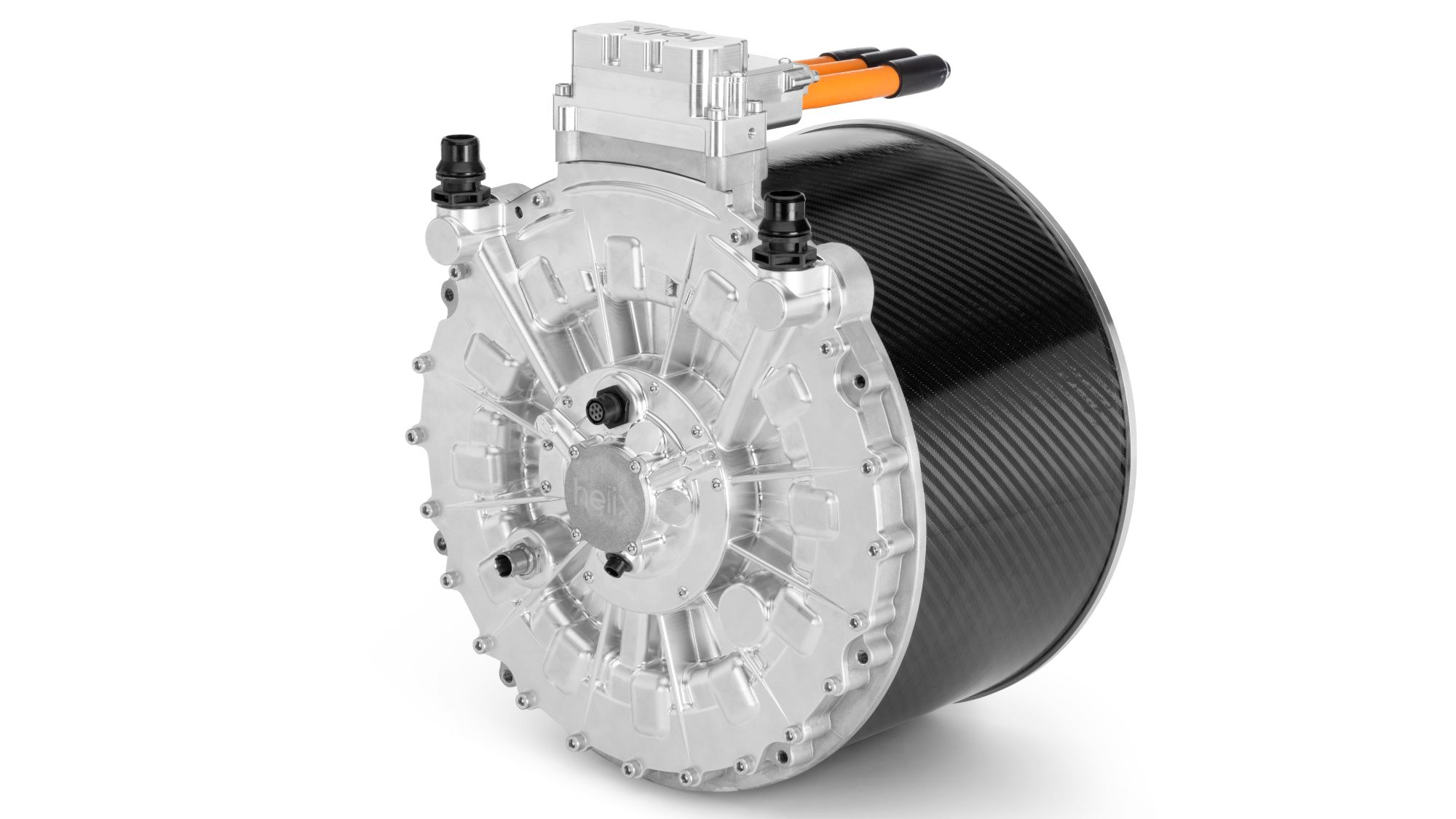
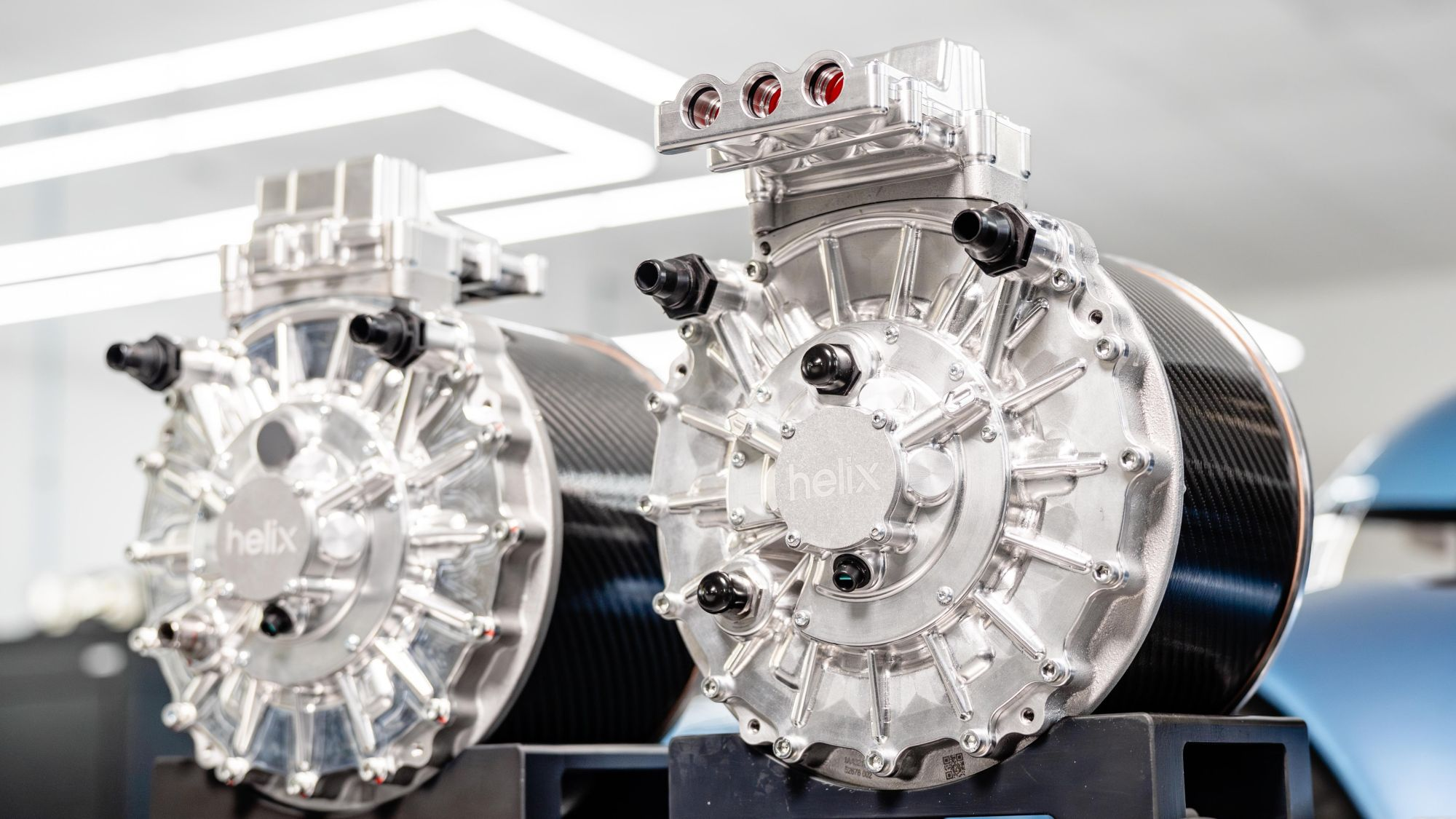
Each of the two rear-mounted YASA motors produces up to 400 hp (298 kW) for a total of 800 hp (596 kW) to propel the 2000-lb (907-kg) vehicle. Performance claims are impressive, with a 0-60 mph (0-97 km/h) in 1.8 s and a top speed of 124 mph (200 km/h). Range is about 176 mi (283 km), with a full battery charge taking about 1.1 h.
The experience is dominated by agentic AI, with agentic vision giving the Trinity self‑awareness and allowing it to interpret and reason about the world it sees. The agentic OS allows apps to talk to apps—for instance, email with maps—simultaneously. MBUX Sound Drive and FYI RAiDiO come along for the AI‑tuned audio experience.
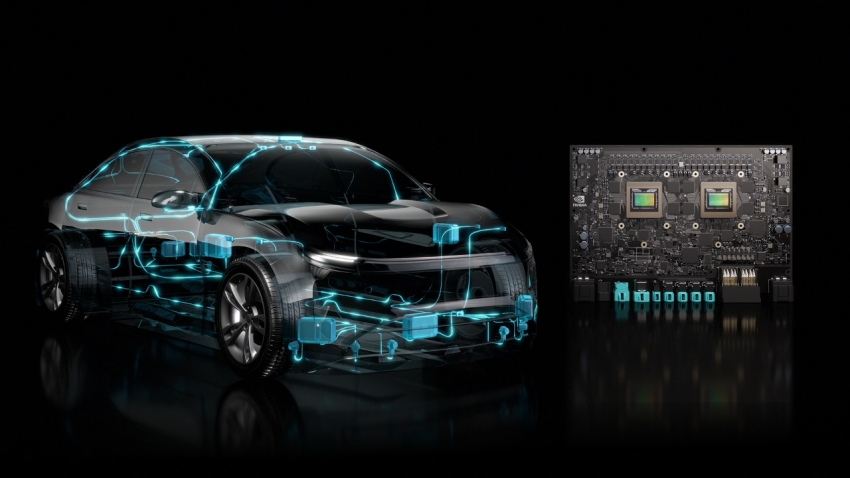
Instead of focusing on self‑driving autonomy, Trinity is built around an Agentic Operator leveraging Nvidia DGX Spark as the “brains” for AI inference of the real-time VLM (vision language model) workloads, which sends environmental awareness information to the RAiDiO infotainment system to turn traditional radio into conversational audio experiences.
“Artists have always pushed technology until it becomes a new instrument,” said Richard Kerris, Nvidia VP/GM of Media, during CES. “With agentic AI running on Nvidia DGX Spark, Trinity turns that instrument into something you can take with you—an intelligent collaborator that helps you capture ideas, shape experiences, and realize a vision in ways that simply weren’t possible before.”
The Agentic Operator harnesses MCP (Model Context Protocol) protocols and n8n automations, handles multitasking and goal‑tracking, and runs conversational workflows that span in‑cabin and in‑the‑world actions. From the driver’s perspective, the agent feels like a “workflow wizard riding shotgun”—managing calendars, errands, communications, and cloud services through natural conversation while the human stays focused on driving.
“It’s brains on wheels, built from the agent up,” said will.i.am.
Built with DEKA and West Coast Customs
In development for three years, Trinity has been helped by some key collaborators.
DEKA Research & Development Corp. provides the self‑balancing technology and robotics expertise for bike‑like agility with car‑like stability. Ryan Friedlinghaus and West Coast Customs bring the design language and build execution. The trio combines frontier engineering, custom‑car craft, and AI‑first thinking into one micromobility platform.
“Teaming up with will.i.am on Trinity is a mission that the DEKA team is deeply committed to, and we’re proud to be part of the development team behind an entirely new category of personal transportation,” said Dean Kamen, Founder of DEKA Research & Development. “DEKA’s top engineers rose to the challenge, adapting the architecture and controls approach underlying our original design for the Segway to deliver the next-generation micromobility vehicle.
Being a long-time client and friend, when will.i.am approached West Coast Customs about the Trinity project three years ago, Friedlinghaus said he knew that this build would truly break ground within both the technology and automotive sectors.
“His projects always require our master craftsman to push their skills beyond convention to create something that is truly one-of-one,” said Friedlinghaus. “We are so honored will.i.am allowed us to be a part of another of one of his masterpieces—turning his creative vision for a futuristic single-passenger vehicle into reality.”
Giving back to the inner city
Trinity is a project grounded in what will.i.am calls “American dynamism” with a vision to deeply involve the community.
“Starting that as a case study, you assemble and manufacture the Trinity in the local inner-city, teaching the community robotics and agentic architecture so that the brain and the dataset were configured by the community itself,” he said. “If it’s doing deliveries, the vehicle knows the context and the vibration of the city.”
If the vehicle is used for law enforcement, when an officer who’s not from the community is in it, the vehicle knows the community “because the community built it.”
“At this point in time in society, there is no law enforcement community thing that people can collaborate on,” will.i.am said. “What do we do together to ensure we feel comfortable? In this case, the community feels safe because it has configured the agent’s brain at the local community college.”
The project also addresses the unease the public has with AI and its role in the workforce.
“In the age of agents, what is a community college, when jobs are being stripped away and replaced by agents?” he asked. “In this case, you would have outfitted the community college to be agentic when the Trinity system is implemented as a curriculum to get the community involved in building agents that law enforcement would adopt while they go out and serve and protect the community.”
Will.i.am started and now teaches a course called The Agentic Self with university academic partner ASU (Arizona State University), which “will outfit” the facility that’s manufacturing and assembling the Trinity.
The plan is to build Trinity vehicles in the Boyle Heights part of Los Angeles, in a facility that is both a manufacturing plant for an initial, limited 500‑vehicle run and a “university” for autonomy, robotics, and agentic systems—training local residents in advanced manufacturing and agentic workflow engineering.
“What excites me even more is the opportunity to establish an entirely new type of robotics university, one that combines a built-in-the-USA manufacturing facility with a teaching and apprenticeship program,” added Kamen. “This new university can grow a skilled workforce in an underserved community, transforming lives, and uplifting the local economy.”
The will.i.am organization will tap program graduates and the robotics club community as part of the ramp-up effort, leveraging the work that his i.am Angel Foundation does, teaching 15,000+ students STEAM (Science, Technology, Engineering, the Arts and Mathematics) and robotics skills in partnership with LAUSD (Los Angeles Unified Schools) and hundreds of Los Angeles-area robotics clubs organized by FIRST Robotics founded by Kamen.
Will.i.am has spent over a decade investing in robotics, computer science, and STEM education in underserved neighborhoods, with a special focus on East Los Angeles. He has 500 youth robotics teams in partnership with LAUSD.
By having high‑tech production and education in an underrepresented neighborhood, Trinity aims to turn cutting‑edge mobility into a channel for community uplifting, future preparation, and contribution to an awesome tomorrow.
Taking it on the road
The Kickstarter crowdfunding and launch platform community was the first to have a chance at purchasing a Trinity vehicle in January. Backers can participate in a pre-order program that offers priority consideration for a potential future purchase, with pricing currently anticipated to be under $30,000.
“Products that debut on Kickstarter are launching in front of a global audience that values being early—people who take pride in being the first to discover, support and champion what’s next,” said Everette Taylor, CEO of Kickstarter, in January. “We’re honored to see will.i.am recognize the marketing power of Kickstarter and choose our platform as a key part of Trinity’s launch strategy alongside their debut with Nvidia at CES.”
To spread the word to potential customers and investors, after appearances at CES and GTC, the Trinity was shown at MARS, the yearly invite-only conference hosted by Amazon Founder and Executive Chair Jeff Bezos, that brings together innovative minds in machine learning, automation, robotics, and space to share new ideas across these rapidly advancing domains.
Major aims of the road show include completing a funding round that, among other things, would raise capital to build its presence in the LA inner city, as well as inspiring a new “American dynamism,” taking inspiration from what’s happening in Southeast Asia and China, specifically how Shenzhen transformed in the past four years, said will.i.am.
“Our inner cities could transform the way Shenzhen transformed,” he concluded. “That’s what we should be doing.”
-

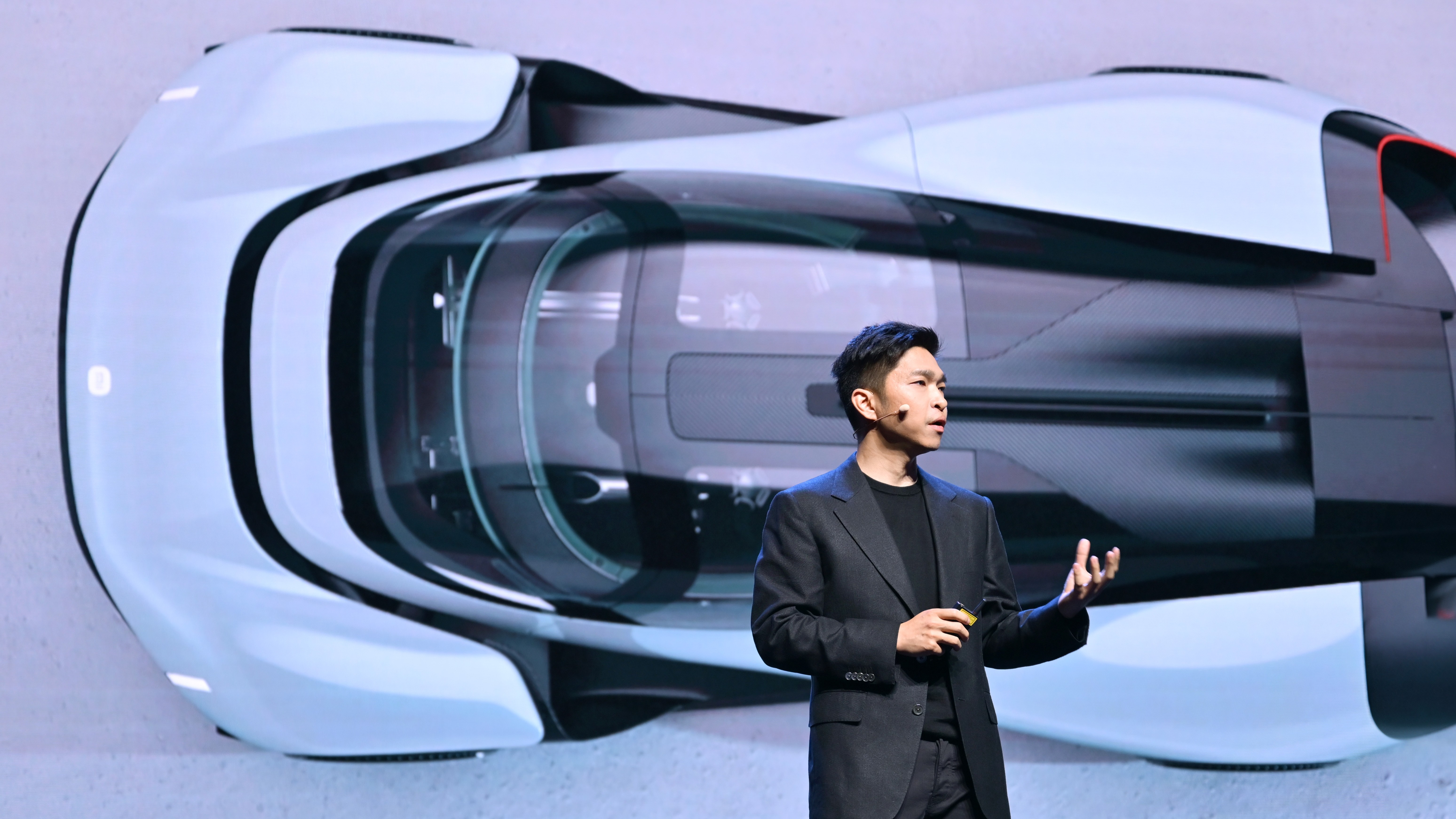
- Will.i.am at CES 2026 holding core GPU and showing the Trinity vehicle.
-

- Trinity head on at CES 2026.
-

- Three Trinities in the simulated city.
-

- The Trinity interior is accessed by a large, rear-hinged door.
-

- The Trinity has two rear drive wheels.
-

- Trinity’s wheels aglow on the street at dusk.
-

- Trinity uses Nvidia’s DGX Spark as the “brains” for AI inference.
-

- A peek at the Trinity interior user interface.
-

- Trinity rear wheel and suspension detail.
-

- The Trinity uses two YASA P400R motors with up to 400 hp each.