Ferrari has unveiled the interior design and announced the name for its new electric sports car. The company says the Luce launch marks the start of a new chapter and philosophy in its history, saying the sports car represents electrification as a means, not an end. Meant to be simple, pure, and evocative, the EV is a symbol of clarity and inspiration, expressing Ferrari’s approach to innovation of “uncompromising vision, transparent design, silent energy that is felt in every fiber, and form shaped by function.”
The launch was hosted in San Francisco by Ferrari and LoveFrom, the “creative collective,” founded by Jony Ive in 2019 with fellow designer Marc Newson, of architects, artists, engineers, filmmakers, graphic designers, industrial designers, interaction designers, motion designers, musicians, sound designers, type designers, and writers. With studios in San Francisco and London, LoveFrom works closely with OpenAI and a small number of selective projects. One of those is its collaboration with Ferrari for five years on the new car’s design.
Ferrari says its decision to conceive the car with LoveFrom is a deliberate expression of its vision for the future in a car that honors its heritage while challenging conventions and reimagining details from materials and ergonomics to the interface and the overall user experience. LoveFrom was charged with defining the project’s design direction from the outset, translating a new, cross-disciplinary design language into an authentic Ferrari experience.
In the development phase, LoveFrom worked with the Ferrari Styling Centre, led by Ferrari Design Director Flavio Manzoni, and supported at the event by Ferrari CEO Benedetto Vigna and Executive Chairman John Elkann, in evolving the concept and ensuring solutions met functional targets, packaging constraints, and homologation requirements for a production sports car.
The major interior components offer a first insight into the design philosophy behind the new EV. The team focused not only on perfecting and refining solutions, but also on not reinventing what already works and creating a new expression of Ferrari for a world where interaction is increasingly meaningful.
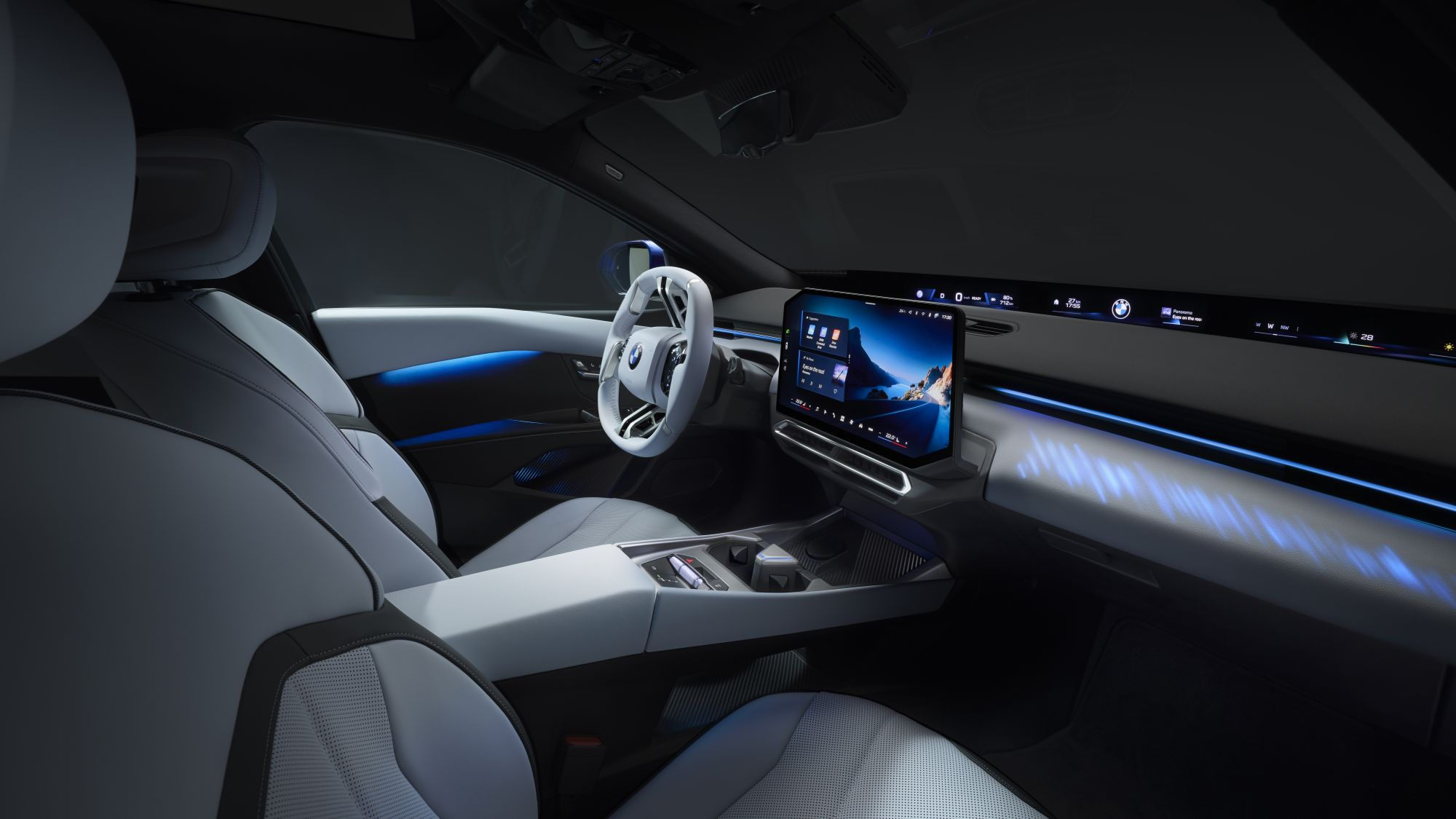
The cabin is conceived as a single, clean volume, with forms simplified and rationalized for driving, creating an environment that feels calm, focused, and spacious. Hardware and software were developed together so the physical architecture and the interface behavior feel harmonious. Essential elements such as the binnacle, control panel, and central console are self-contained and clearly organized around inputs/controls and outputs/displays. The unified aesthetic and functional whole is meant to preserve and intensify the emotional thrill of driving a Ferrari.
Ultimately, the design of the Luce’s interior is meant to be a synthesis of meticulous craftsmanship, respect for tradition, and thoughtful innovation.
Key processes and materials
Sophisticated manufacturing technologies were used to ensure that every material “is presented in its most noble form.” This is meant to give a modern and timeless feel, with materials that are not only luxurious but also authentic and chosen for their durability and integrity.
The designers embraced aluminum for its suitability in precision machining, with engineered components that celebrate the quality and beauty of the material. The 100%-recycled alloy selected is machined from solid billets using advanced three- or five-axis CNC (computer numerical control) machines, then subjected to a state-of-the-art anodization process.
The treatment creates an ultra-thin, hexagonal cell microstructure on the surface, ensuring exceptional resistance, hardness, and a refined micro-texture. The result is a finish with a deep, enduring color that remains vibrant over time.
Another material figuring prominently in the interior is precision-milled Corning Fusion5 glass, which is durable, scratch-resistant, and has high visibility. It is designed to offer superior surface durability as well as better impact and scratch resistance than conventional glass and is used on the control panel, binnacle, and on the central console surface.
Fusion5 is made using a first-of-its-kind manufacturing process unique to automotive interior design. To achieve the level of precision required by Ferrari, lasers were used to make tiny holes in the glass half the width of a human hair to deposit the ink for the graphics with a high level of uniformity.
Human-machine interface
Ferrari says that the Luce human-machine interface design has a strong emphasis on tactility, clarity, and intuitive interaction. The design team prioritized physical controls that invite touch and engagement between occupants and the car.
Defying the convention that electric cars must be dominated by large touchscreens, many of the car’s controls are mechanical and precisely engineered to make interaction simpler and more direct. Inspired by classic sports cars and Formula One racecars, the interface is clearly organized and pared down to essential functions.
Starting the Luce is meant to be memorable, with the Fusion5 glass also featured prominently in the key and “shifter.”
The ritual begins with engaging a Fusion5 glass key that features a specially developed “automotive first” electronic ink display that only uses power during color changes. Inserting the key into its central console dock initiates a choreographed sequence. The key’s color switches from yellow to black as it integrates with the glass surface of the central console, and the control panel and binnacle simultaneously light up, signaling the transition from stillness to motion.
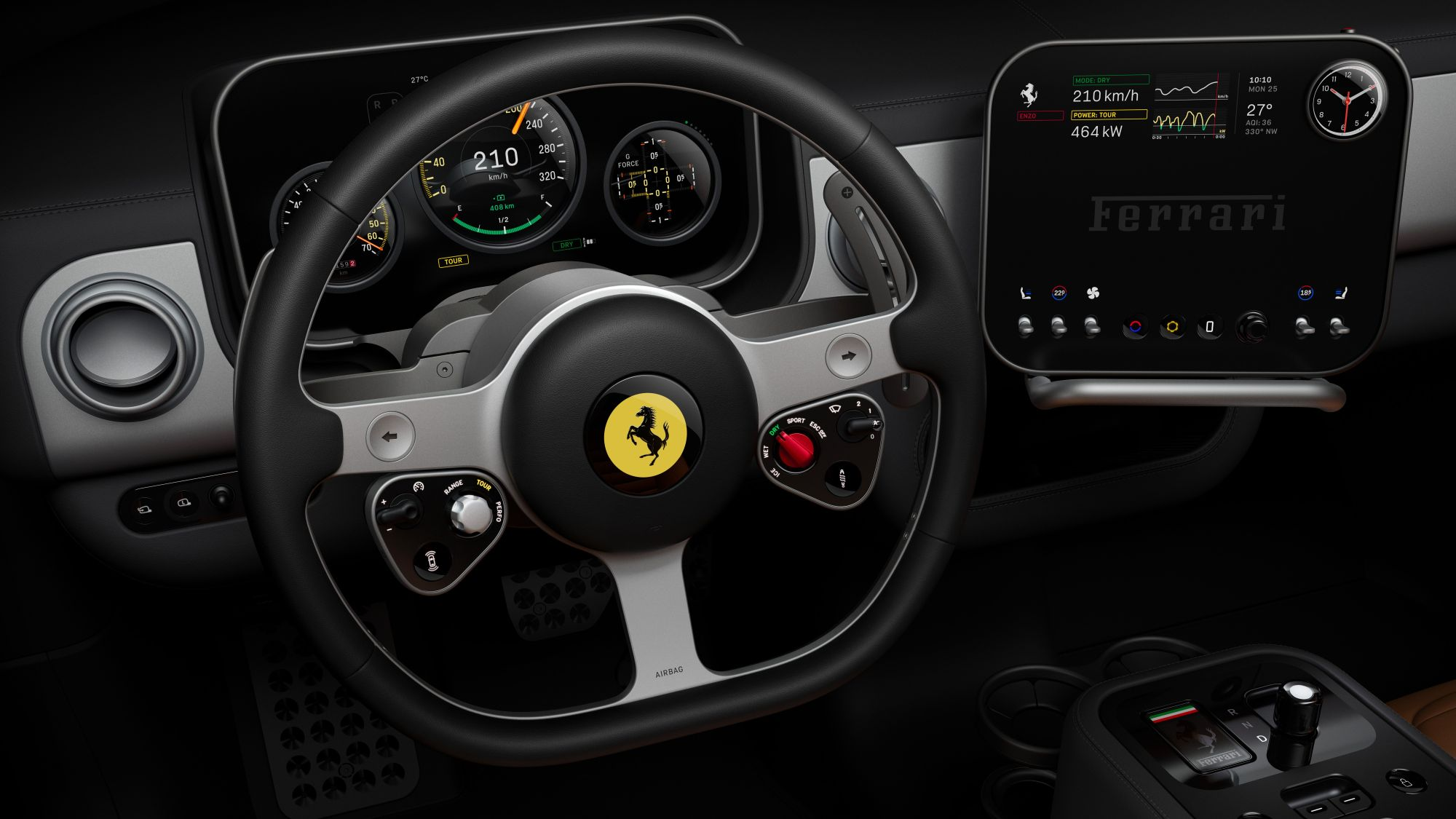
The most prominent HMI element, the steering wheel, pays homage to Ferrari’s heritage while embracing innovation, the design team reinterpreting an iconic 1950s-60s wooden three-spoke Nardi wheel. The new wheel is made with 19 CNC-machined parts and weighs 0.4 kg (0.9 lb) less than a standard Ferrari steering wheel.
The 100% recycled aluminum spokes are intentionally exposed and highlighted to showcase the material’s strength and finish. The alloy was developed specifically for the Luce to ensure mechanical resistance and a surface quality for the anodization process.
Steering-wheel controls are organized into two analog under-spoke control modules for functionality and clarity that echoes the layout from Formula One. The buttons and switches were developed to provide the best combination of mechanical and acoustic feedback based on more than 20 evaluation tests with Ferrari test drivers.
Three main displays
On the display front, the design team spent significant time considering the organization of inputs (controls) and outputs (displays), with the aim of making the user experience intuitive and easy to navigate. The three main displays are the driver’s binnacle, front central control panel, and rear control panel. A new custom typeface gives the interface and identity a coherent “typographic voice” informed by historic Ferrari type and Italian engineering lettering.
The driver binnacle (with instrument cluster) moves with the steering wheel, optimizing the driver’s view of the instrumentation and supporting driver performance. It merges digital and analog elements in a self-contained unit, moving in sync with the wheel’s rake and reach. It features two overlapping OLED displays with crisp graphics, vibrant colors, and leading contrast.
Designers collaborated with Samsung Display’s engineers to create an ultra-light/thin OLED panel. In a “world first,” three large cutouts strategically reveal the information generated by a second display behind the top panel—giving visual depth. Each opening is protected by a clear glass lens, further enhancing the sense of three-dimensionality, and is surrounded by anodized aluminum rings echoing the binnacle’s structural frame style.
The front, central control panel is mounted on a ball-and-socket joint, allowing it to be oriented for either the driver or passenger—a feature meant to enhance and share the Ferrari experience. Attention to ergonomic details, including a palm rest for operating the panel, improves the experience by allowing users to interact with controls without looking, demonstrating the team’s commitment to solving problems in ways that feel simple and natural.
The central display’s multigraph is said to honor Ferrari tradition and redefine the onboard experience, blending watchmaking artistry and technology. The “masterpiece of micro-engineering” features three independent motors that move three anodized aluminum hands independently over a minimalist dial protected by Corning Fusion5 glass. An advanced electronic control system gives the multigraph four modes—clock, chronograph, compass, and launch control—with animated transitions reminiscent of fine chronographs.
The instrument cluster controls are inspired by both historic automotive cues and the “purposeful” graphics of aviation. Its displays are designed to resemble analog gauges, delivering a sense of familiarity and tactile engagement, yet are fully digital beneath their surfaces.
The binnacle’s graphics are inspired by the clarity and elegance of classic instrument dials, particularly from Veglia and Jaeger of the 1950s and 60s. Drawing on decades of experience in horological design, the team sought to achieve a watch-like clarity, creating a modern, clean layout that highlights the legibility of the dials.
This approach is rooted in the concept of reducing driver cognitive load. The designers aimed to make the car’s controls and displays equally intuitive through the simplicity of analog watch dials, for which time can be read at a glance. The graphics are purposefully minimal and clear, allowing drivers to glean essential information quickly and effortlessly while keeping their attention on the road.
The third and final phase of the Luce’s launch, including the exterior reveal, will be hosted in Italy in May 2026.
-

- Ferrari Luce driver view.
-

- Ferrari Luce seat and other interior components at LoveFrom event.
-

- From L to R – Benedetto Vigna, John Elkann, Flavio Manzoni, Jony Ive, and Marc Newson.
-

- Ferrari Luce console with key and shifter.
-

- Ferrari Luce steering assembly at LoveFrom event.
-

- Ferrari Luce binnacle.
-

- Ferrari Luce central control panel.
-

- Ferrari Luce clock closeup.
-

- Ferrari Luce toggle switches.
-

- Ferrari Luce overhead console.