At GTC earlier this month, Nvidia announced its NemoClaw reference stack for the OpenClaw agent platform, which lets users install its Nemotron models and the newly announced OpenShell runtime in a single command. The company’s new stack is engineered to add privacy and security controls to make self-evolving, autonomous AI agents, or “claws,” more trustworthy, scalable, and accessible.
“OpenClaw opened the next frontier of AI to everyone and became the fastest-growing open-source project in history,” said Jensen Huang, Founder and CEO of Nvidia, at GTC. “Mac and Windows are the operating systems for the personal computer. OpenClaw is the operating system for personal AI. This is the moment the industry has been waiting for—the beginning of a new renaissance in software.”
Peter Steinberger is the developer and creator of OpenClaw, the viral open-source, local-first AI agent designed to act as a personal assistant, managing tasks like email and calendars. In February, he joined OpenAI to work on the next generation of personal agents, with OpenClaw transitioning into a supported foundation project.
“OpenClaw brings people closer to AI and helps create a world where everyone has their own agents,” said Steinberger, creator of OpenClaw, and Founder of Amantus Machina. “With Nvidia and the broader ecosystem, we’re building the claws and guardrails that let anyone create powerful, secure AI assistants.”
NemoClaw uses any coding agent and Nvidia’s Agent Toolkit software to optimize OpenClaw in a single command. It installs OpenShell to provide open models and an isolated sandbox, or environment for safely running applications, that adds data privacy and security to autonomous agents. It provides the missing infrastructure layer beneath claws to give them the access they need to be productive, while enforcing policy-based security, network, and privacy guardrails.
With open agents, NemoClaw can tap open models, including Nvidia’s Nemotron, running locally on the user’s dedicated system. Using a privacy router, agents can use frontier models running in the cloud. The combination of local and cloud models provides a foundation for agents to develop and learn new skills to complete tasks according to defined privacy and security guardrails.
Always-on agents need dedicated computing to build software and tools as well as complete tasks. NemoClaw for OpenClaw can run on any dedicated platform—including Nvidia-equipped GeForce RTX PCs and laptops, RTX PRO-powered workstations, and DGX Station and DGX Spark AI supercomputers—to provide local computing for autonomous agents to run around the clock.
The operating system of agentic computers
Huang devoted a full 20 min to OpenClaw in his keynote and reiterated some key points in a later GTC Q&A with the media, emphasizing its significance.
“OpenClaw is the most popular open-source project in the history of humanity, and it did so in just a few weeks,” he said. “It exceeded what Linux did in 30 years. It’s that important.”
As Huang describes it, it is an agentic system that can access tools, file systems, LLMs (large language models), and it is able to do scheduling, decompose a problem step-by-step, and can call upon other sub-agents. A user can talk to it in any modality, and it understands and can send messages, texts, and emails.
“OpenClaw has open sourced, essentially, the operating system of agentic computers,” he said. “It is no different than how Windows made it possible for us to create personal computers. Now, OpenClaw has made it possible for us to create personal agents.”
The implication is incredible, believes Huang.
“Every company in the world today needs to have an OpenClaw strategy,” he said.
Making OpenClaw enterprise-ready
Huang said that every SaaS (software as a service) company will need to become an agentic-as-a-service company.
“OpenClaw gave the industry exactly what it needed at exactly the time,” he said.
He likened it to beginnings of Linux, the mobile cloud’s Kubernetes, and the Internet’s HTTP/HTML, making it possible for the entire industry to grab onto an open-source stack and “go do something with it.”
However, he says there’s just one catch. Agentic systems in a corporate network can have access to sensitive information (on employees, supply chains, and finances), execute code, and communicate externally.
“Obviously, this can’t possibly be allowed,” said Huang.
So, Nvidia experts worked with Steinberger and the world’s top security and computing experts to make OpenClaw enterprise-secure and enterprise-private capable.
The company’s NemoClaw reference stack integrates agentic AI toolkits and OpenShell to make OpenClaw enterprise-ready. With the reference stack, developers can download it and connect to SaaS company policy engines, which “are super important and valuable.”
NemoClaw is able to execute that policy engine, it has a network guardrail, it has a privacy router, and, as a result, we could protect and keep the claws from executing inside a company and do it safely.
Open models and Nemotron coalition
Huang says that Nvidia’s open-model initiative across language, vision, biology, physics, and autonomous systems will enable AI builds for specialized domains and their “custom claws” or models. The company has built and released six families of open frontier models, as well as the training data, recipes, and frameworks to help developers customize and adopt.
At the core are Nemotron reasoning models for language, visual understanding, RAG (retrieval augmented generation), safety, and speech. Cosmos frontier models enable physical AI world generation and understanding. Other frontier models are Alpamayo for thinking and reasoning autonomous vehicle AI; GROOT for general-purpose robots; BioNeMo for biology, chemistry, and molecular design; and Earth-2 for weather and climate forecasting rooted in AI physics.
In support of the first, Huang announced at GTC the Nemotron Coalition, which takes advantage of the billions of dollars the company has invested in AI infrastructure. He announced the initial batch of enterprise and software company partners to integrate the NemoClaw reference design, agentic AI toolkit, and open models.
“This is a renaissance of enterprise IT, from what would be a $2 trillion industry, this is going to become a multi-trillion dollar industry offering not only tools for people to use but also agents in very special domains,” he said.
Implications for automotive
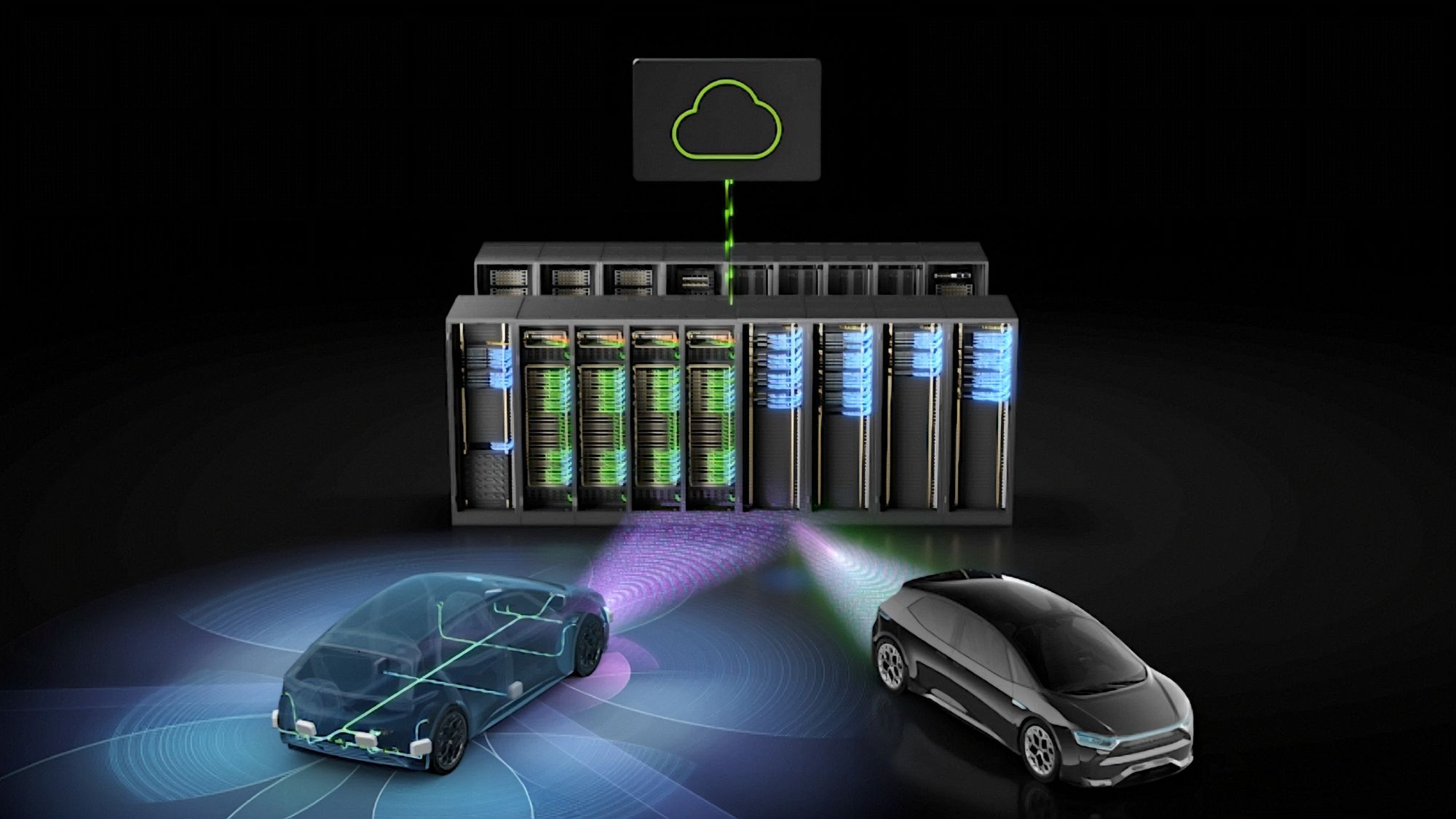
For the automotive industry, there are many use cases for OpenClaw and the NemoClaw reference stack, according to Ali Kani, Vice President and General Manager of Automotive at Nvidia, who spoke exclusively to Futurride at GTC.
He gave a few examples.
It will impact how software is built in the cloud, with engineers rethinking how they use it in the development loop.
“OpenClaw is going to revolutionize how we can do that because we could literally just say: ‘Hey, grab this data, annotate it, and find me clips of uncontrolled intersections, because it connects all these services that we have,” he explained.
It has implications for the massive data lake and its use in development, he said. OpenClaw has the potential to significantly accelerate developer flow.
“That’s very foundationally valuable for us, and we’re constantly doing that,” he said. “The most important part of building AV is how fast your developer flow is. It’s not [for just] the software in the car, it’s the way that you learn from data in the car, retrain a model, like process the data, train a model on it, test it.”
OpenClaw’s use will also impact the experience inside the car. For driver assistance and higher-level autonomy, it could provide a better human-machine interface through voice.
“You can say, ‘Hey, why are you slowing down right now? Why don’t you go a little bit faster? Can you take me to my favorite coffee spot?’”
The answers and dialog will be more conversational and informative during the self-driving experience, he concluded.
The future token budget
More broadly, Huang said OpenClaw will help drive every software company to be agentic token manufacturers. They’ll be token users for their engineers, and they’ll be token manufacturers for their customers.
How many tokens that come along with a job is becoming one of the primary recruiting tools in Silicon Valley, said Huang. “The reason for that is clear, because every engineer that has access to tokens will be more productive.
“I could totally imagine in the future every single engineer in our company will need an annual token budget,” he concluded. “They’re going to make a few hundred thousand dollars a year of their base pay. I’m going to give them probably half of that on top of it as tokens so that they could be amplified 10x.”
-

- Jensen Huang, Nvidia’s Founder and CEO, says that OpenClaw is the operating system for personal AI.
-

- Nvidia CEO Jensen Huang says that, with launch of OpenClaw, an inference inflection has arrived.
-

- Huang explains agents and OpenClaw at Nvidia GTC.
-

- Nvidia’s OpenShell provides tools for controlling autonomous agents in a trusted infrastructure policy layer, adding security in the environment.
-

- Huang announced the enterprice-ready Nvidia NemoClaw Reference for OpenClaw.
-

- Huang says that Nvidia is world’s largest contributor to open-source AI.