At CES 2026, Caterpillar Inc. unveiled a set of AI-powered and autonomous innovations that it says mark a major step forward for heavy industry, transforming machines into intelligent, connected systems that help customers build and power the world’s critical infrastructure. With $30 billion invested in research and development over the past 20 years, it announced plans to increase investment in digital and technology by 2.5 times through 2030 to help solve its customers’ toughest challenges.
Company CEO Joe Creed took the CES stage with Chief Digital Officer Ogi Redzic and Chief Technology Officer Jaime Mineart for a future-facing keynote to showcase how AI, autonomy, and edge computing are converging to create the next generation of heavy equipment.
A demonstration of how the company is advancing Industrial AI was its introduction of the Cat AI Assistant. The solution unifies Caterpillar’s diverse portfolio of digital applications and high-quality data into a simple, conversational experience.
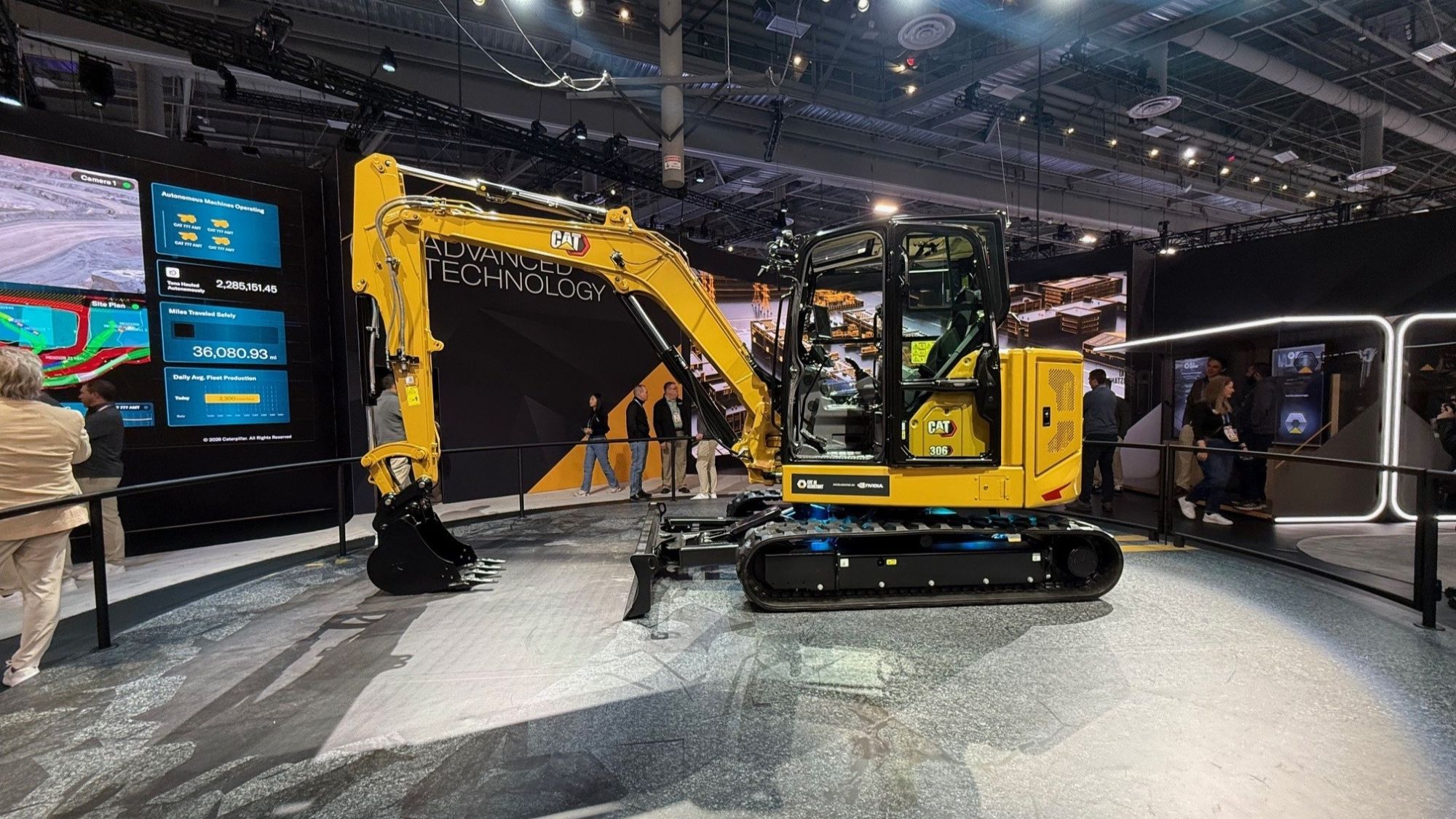
The Cat AI Assistant provides customers with reliable, context-rich information to make daily work easier. The goal is to help customers stay one step ahead from the office to the jobsite—and soon in the cab of the machine. CES attendees could see how the Cat AI Assistant can interface with a mini excavator in the company’s booth.
While technology is transforming operations, Creed reaffirmed the company’s commitment to the “most important part of the invisible layer of the tech stack—people.”
To ensure employees and customers are equipped to use advanced technologies as new roles emerge, Caterpillar is pledging $25 million over five years to launch a global innovation prize. The initiative will identify, test, and scale solutions that help workers with the skills needed to thrive in an increasingly digital and autonomous environment.
Powered by Nvidia AI
Also at the show, Caterpillar announced an expanded collaboration with Nvidia aimed at accelerating an AI-enabled future, including onboard AI features, AI agents for its products and industries, and safer, leaner, and more resilient production systems.
“As AI moves beyond data to reshape the physical world, it is unlocking new opportunities for innovation—from job sites and factory floors to offices,” said Creed. “Caterpillar is committed to solving our customers’ toughest challenges by leading with advanced technology in our machines and every aspect of business. Our collaboration with Nvidia is accelerating that progress like never before.”
The collaboration leverages Nvidia AI infrastructure and Caterpillar’s century of building and maintaining the physical world to set a new standard for industrial innovation.
“Nvidia and Caterpillar are partnering across the full spectrum—from autonomous construction fleets to the AI data centers powering the next industrial revolution,” added Jensen Huang, Founder and CEO of Nvidia.
Caterpillar is using Nvidia‘s Jetson Thor platform to enable real-time AI inference on Cat construction, mining, and power equipment, laying the foundation for next-generation autonomy and intelligent in-cab experiences.
The company’s fleets powered by AI, machine learning, computer vision, and edge computing will process sensor data in real time and serve as a digital nervous system for customers’ jobsites. Construction and mining machines equipped with AI-driven recommendations will better enable the navigation of complex, variable jobsite conditions. An intelligent operator assistant will provide customers with personalized insights to help them with real-time coaching, productivity tips, and safety alerts for operators.
Caterpillar says its AI Assistant is built using Nvidia’s Riva open speech models to deliver leading accuracy and lifelike voices, answer questions, and provide personalized recommendations on equipment, parts, and maintenance. In cab, it will use voice activation to enable settings, guide troubleshooting, and connect users to the right resources across Caterpillar apps and websites. It uses Caterpillar’s data stored on the Helios unified data platform, so customers get reliable, context-rich information to make work easier.
To transform manufacturing and create safer, leaner, more resilient production systems, Caterpillar is using the Nvidia AI Factory. Caterpillar’s manufacturing digital data platform takes advantage of the accelerated AI infrastructure and Nvidia AI libraries to automate and accelerate important manufacturing processes, including forecasting and scheduling.
Caterpillar is building digital twins of its factories on Nvidia Omniverse libraries and OpenUSD so its teams can design, simulate, and optimize layouts and production processes before building in the real world.
Making construction more autonomous
In its CES booth, Caterpillar highlighted how decades of leadership in autonomous mining equipment and support from AI will revolutionize the construction industry.
Caterpillar has been at the forefront of automation for more than 30 years. The company’s entry into autonomy began in the 1980s with a Carnegie Mellon University partnership that developed software, GPS, and perception systems that led to its first autonomous truck tests.
In the 1990s, Caterpillar teams advanced their capabilities in sensing, positioning, and control. By the mid-2000s, the company conducted real-world testing under extreme conditions to be one of the first companies to deliver SAE Level 4 autonomy.
Caterpillar’s autonomous mining fleet is now one of the largest and most proven in the world, having safely moved over 11 billion t (12.1 billion ton) of material and traveled more than 380 million km (236 million mi).
After deploying autonomous machines in some of the world’s most demanding mining environments, Caterpillar is expanding that expertise to construction sites.
“By embedding autonomy into construction workflows, we’re reshaping the industry to achieve safer jobsites, better jobs, and easy precision that redefines productivity for the modern jobsite,” said Mineart.
Caterpillar previewed five autonomous machine categories designed to operate safely and reliably in complex construction environments.
The company showed excavators that can be used for autonomous trenching, loading, and grading. Its material handling and truck loaders use real-time data processing to improve autonomous navigation. Haul trucks can better carry and distribute more materials like rock, soil, and minerals. Its autonomous dozers feature more precise grading and earthmoving to optimize efficiency. Finally, its compactors use automated surface preparation to ensure more consistent quality and safety for construction.
Caterpillar’s autonomous solutions are built on a foundation of AI, machine learning, computer vision, and edge computing. Lidar, radar, GPS, and high-resolution cameras provide a 360-degree, constantly updated digital view of the jobsite, enabling precise and reliable autonomous operations—even in complex and chaotic environments.
To better connect fleets and enable coordinated, intelligent operations across the jobsite, the equipment is backed by Caterpillar’s VisionLink and MineStar site optimization systems.
“Together with our customers, we’re transforming the industries we serve—one jobsite, one breakthrough, one bold idea at a time,” concluded Mineart.
The company’s autonomy journey into construction will continue and be spotlighted again in March at the CONEXPO-CON/AGG trade show, which is held every three years and is back in Las Vegas.
-

- Caterpillar 306 with AI Assistant powered by Nvidia AI.
-

- Caterpillar CEO Joe Creed delivers CES 2026 keynote.
-

- Caterpillar autonomous construction equipment preview.
-

- Caterpillar construction truck autonomy in action.
-

- Caterpillar autonomous excavator in action.
-

- Caterpillar autonomous bulldozer.
-

- Caterpillar autonomous soil compactor.
-

- Cat AI Assistant use on site.